
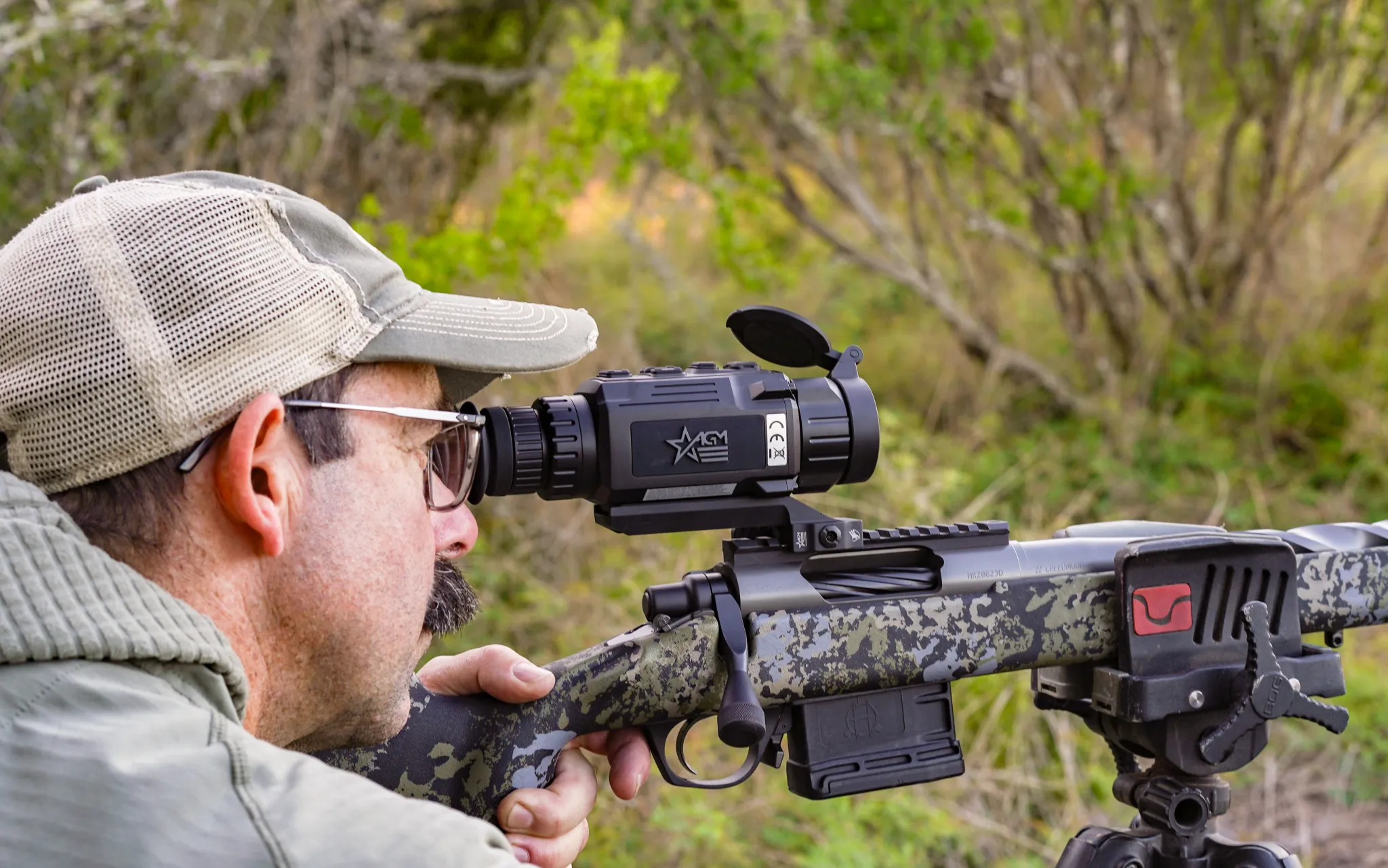
For generations, hunters have relied on magnified glass, sound judgement and a detailed understanding of animal behaviour. Those fundamentals have not changed. What has changed is the amount of information available in difficult conditions.
Modern thermal scopes are reshaping hunting optics by allowing users to detect heat signatures in darkness, mist, woodland cover and changing weather. They do not turn night into day, and they certainly do not replace fieldcraft. Instead, they provide another layer of awareness—one that can improve observation, identification and decision-making when conventional optics reach their limits.
From night vision to thermal imaging
Traditional night-vision devices amplify available light. They can be highly effective under a clear moon or near artificial illumination, but performance may decline in complete darkness, fog or dense vegetation. Thermal imaging works differently. Rather than relying on visible light, it detects infrared radiation emitted by objects according to their temperature.
That distinction has significant practical consequences. A warm animal may remain visible against a dark background even when there is little or no ambient light. Similarly, heat from a recently used track, engine or bedding area can sometimes reveal activity that would be difficult to spot through standard glass.
However, thermal imaging is not simply “better night vision”. It presents a different kind of image. Fur, foliage and terrain may appear as contrasting temperature patterns rather than recognisable colours and textures. The user must learn to interpret shapes, movement and heat distribution instead of depending solely on familiar visual detail.
This is why experience remains essential. A thermal scope can help locate a potential target, but the responsibility for confirming species, size, direction and a safe backstop still belongs to the hunter.
Why detection is only the first step
The greatest advantage of thermal optics is often their ability to reveal what might otherwise go unnoticed. An animal standing at the edge of a field may blend into shadow through a conventional scope but show clearly as a warmer shape through a thermal device. Moving animals are often easier to distinguish, particularly when the surrounding ground and vegetation have cooled.
Yet detection should never be confused with identification. A heat signature may tell you that something is present, but it may not provide enough detail to establish exactly what it is. Branches, long grass, livestock, people and wildlife can all create confusing silhouettes.
Responsible use therefore involves a deliberate process:
- Detect a possible heat source.
- Observe its behaviour and surroundings.
- Confirm the species and any legal requirements.
- Establish a safe shot opportunity before considering the trigger.
This approach matters especially in low-light situations, where uncertainty can increase quickly. Thermal technology is most valuable when it supports disciplined decisions rather than encouraging rushed ones.
The technology behind the image
Several technical features influence how useful a thermal scope is in the field. Resolution is an obvious consideration: higher-resolution sensors generally display more detail, particularly at greater distances. But resolution is only part of the picture.
The sensor’s thermal sensitivity, often expressed as NETD, affects how well the device can distinguish small temperature differences. A scope with strong sensitivity may produce more usable images in challenging weather, such as damp conditions or light fog. Lens size also matters. A larger objective lens can gather more infrared energy and support longer-range observation, although it may add weight and bulk.
Refresh rate contributes to how smoothly moving subjects appear. A higher rate can make it easier to follow an animal crossing uneven ground, while a clear display reduces eye strain during extended observation. Image-processing modes, digital zoom and contrast controls can also be useful, provided they do not create false confidence about detail that the sensor cannot genuinely resolve.
For anyone comparing heat-detection equipment for hunters, it is worth looking beyond headline detection distances. A manufacturer’s maximum range may describe the ability to notice a large heat source under ideal conditions, not the practical distance at which a hunter can confidently identify an animal. Real-world performance depends on temperature contrast, humidity, vegetation, terrain and the operator’s experience.
Integration is changing the hunting setup
Modern thermal scopes are also becoming more integrated with the rest of a hunter’s equipment. Digital recording, onboard photography, Wi-Fi connectivity and external displays can make it easier to review observations or document a session. Some systems offer multiple colour palettes, picture-in-picture magnification and selectable reticles, allowing users to tailor the image to changing conditions.
This added functionality can be helpful, but it introduces a familiar problem: complexity. Too many menus, modes or controls can distract from the environment. The best setup is not necessarily the one with the longest feature list. It is the one that can be operated confidently, with minimal movement and without losing awareness of what is happening around you.
Battery management is another practical consideration. Cold weather, high screen brightness, recording and wireless features can reduce operating time. Carrying a charged spare battery or a suitable power bank is sensible, but equipment should be tested beforehand to ensure that external power does not interfere with mounting or handling.
Weather, terrain and training still matter
Thermal imaging has limitations. Heavy rain can obscure heat signatures, while warm ground and vegetation may reduce contrast after a hot day. Glass, standing water and some dense materials can block or reflect infrared energy rather than reveal what lies beyond them. Users should understand these constraints before relying on a thermal device in unfamiliar conditions.
Training is equally important. Spend time observing known objects and animals at different distances, temperatures and backgrounds. Learn how a rabbit, fox, deer or livestock appears when stationary, partially concealed and moving. Practise adjusting focus, contrast and magnification without looking away from the scene.
It is also useful to compare thermal images with daylight observations. Seeing the same landscape in both conditions helps build a mental connection between heat patterns and physical features. Over time, the display becomes less like an abstract screen and more like an interpretable map of the environment.
A tool for better judgement
The most meaningful change brought by thermal scopes is not simply the ability to hunt later or in darker conditions. It is the potential to make more informed decisions. A hunter may detect an animal sooner, avoid disturbing a non-target species, monitor an area more effectively or locate a downed animal during recovery.
That potential comes with responsibility. Local laws governing night shooting, species protection, humane dispatch and the use of thermal equipment vary considerably. Ethical practice should always take precedence over what technology makes possible.
Thermal scopes are becoming an important part of modern hunting optics because they extend observation without eliminating the need for judgement. Used properly, they complement traditional skills rather than replace them. The strongest results come from combining reliable equipment with patience, identification, safety and a thorough understanding of the land.
