
Every SaaS business dreams of the moment growth takes off. New customers sign up every week, larger accounts start asking for enterprise features, and the product finally finds its market. Yet for many companies, that moment also exposes a hard truth: the software that won the first fifty customers is not built to serve the next five hundred.
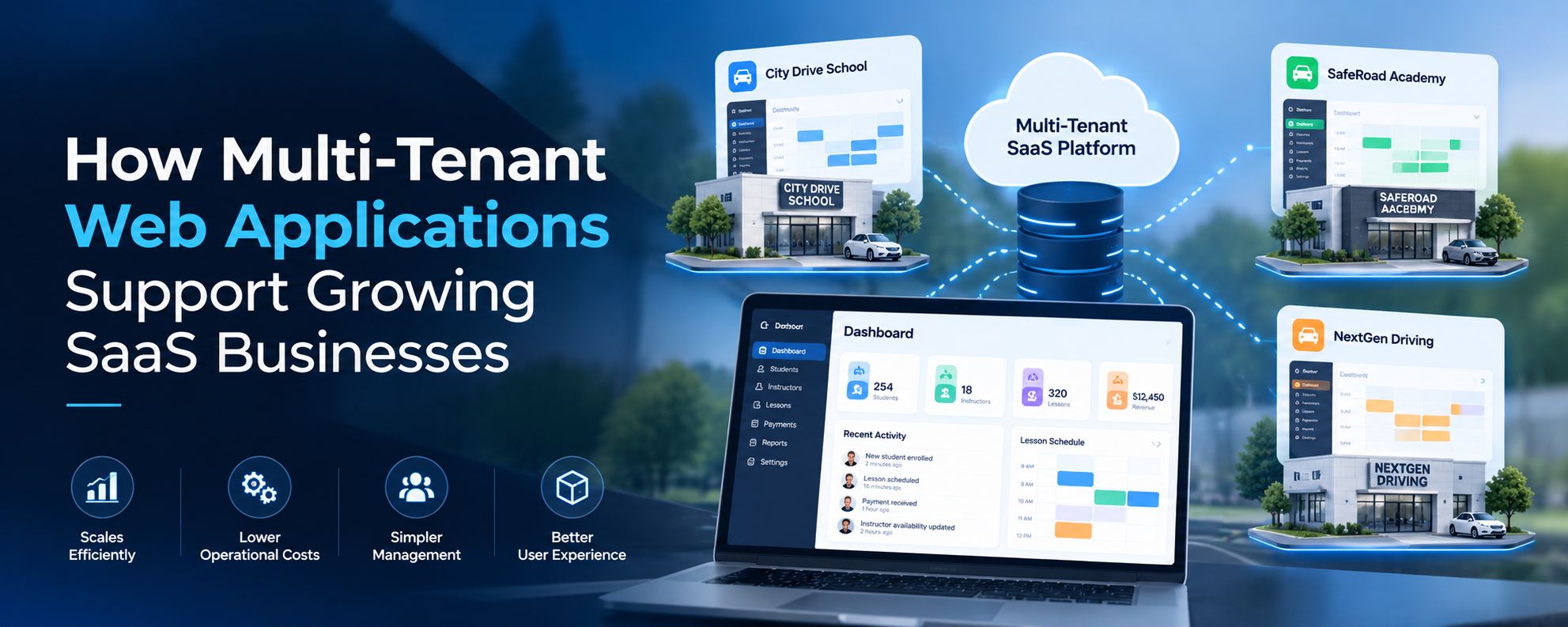
This is where architecture stops being a technical detail and becomes a business decision. A multi-tenant web application, where a single platform securely serves many customers at once, is one of the most reliable foundations for SaaS growth. Think of it like an apartment building rather than a street of separate houses. Every tenant has a private, locked unit, but the building shares one foundation, one plumbing system, and one maintenance team. It is also why growing companies increasingly look for custom web application development services that plan for multi-tenancy from day one instead of bolting it on later.
When the architecture is wrong, growth bottlenecks show up quickly. Onboarding a new client takes weeks instead of minutes. One large customer’s heavy usage slows the platform for everyone else. Each custom request creates a separate code branch that someone must maintain forever. Hosting bills climb faster than revenue. These are not signs of a weak product. They are signs of a foundation that was never designed to carry the weight of success.
What Makes a Multi-Tenant Application Enterprise-Grade
Not every shared platform qualifies as enterprise-grade. Larger buyers now evaluate SaaS vendors on a clear set of qualities, and those expectations rise further when products add intelligent features. Companies adding AI capabilities, often through custom AI software development services, face an even higher bar, because models interact with tenant data in ways that demand strict boundaries. Five qualities matter most.
Scalability
In a multi-tenant system, adding customer number 1,000 should feel no different from adding customer number 10. New tenants are set up automatically, and the platform grows by adding capacity to shared resources instead of building a fresh environment for each account.
Security
Tenant isolation is non-negotiable. Each customer’s data must be separated so no user can ever see another company’s records, even through a bug. Enterprise buyers will ask exactly how this works, and a clear answer often decides the deal.
Performance
Shared infrastructure creates the “noisy neighbor” problem, where one busy tenant drains resources from everyone else. Rate limits, workload queues, and per-tenant resource controls keep speed consistent for every customer.
Reliability
When one platform serves hundreds of businesses, an outage hits all of them at once. Redundancy across cloud regions, automated backups, and tested recovery plans turn reliability into a measurable commitment.
Integration Capabilities
Every tenant uses a different mix of tools. Well-documented APIs, single sign-on, and ready connections to CRMs and accounting systems let customers fit the product into their workflow without custom code.
Key Pillars for Long-Term SaaS Growth
Enterprise qualities come from four architectural pillars that shape how a platform grows over time.
Modular Architecture: Microservices vs Monolith
Most SaaS products start as a monolith, a single codebase where every feature lives together. Early on, that is usually the right call because it is faster to build and simpler to manage. Problems appear when one area, such as reporting or billing, needs to scale on its own. Microservices split the platform into smaller pieces that can be updated and scaled independently.
The practical advice is to avoid jumping to microservices on day one. Build a well-organized monolith with clear internal boundaries, then separate pieces as real demand justifies it.
The tenancy model matters just as much. A shared database is the most cost-efficient option. A separate database per tenant offers stronger isolation, which some healthcare or financial clients require. Many mature platforms use a hybrid, keeping smaller customers on shared resources and giving premium accounts dedicated ones.
Cloud-Native Development
Cloud-native platforms are designed to run on services like AWS, Azure, or Google Cloud from the start. Containers and auto-scaling add computing power during busy periods and release it when demand drops. For a growing SaaS business, that keeps infrastructure spending in line with actual usage and revenue.
Data-Driven Decision Making
A multi-tenant platform sees how every customer uses the product. Handled responsibly, that visibility shows which features drive retention, which accounts are at risk of leaving, and where upsell opportunities exist. Building tenant-level usage tracking in early also makes usage-based pricing possible later.
Automation and AI Readiness
Manual work does not scale with tenant count. Automated onboarding, billing, and deployments keep operations lean as the customer base grows. AI readiness goes a step further. Clean, structured data and firm tenant boundaries make it possible to add smart recommendations or predictive insights later, without one customer’s data shaping another customer’s results.
Common Mistakes Growing SaaS Businesses Make
Short-Term Development Mindset
Under pressure to close early deals, teams often build one-off features or separate copies of the product for individual clients. It works for a while. Then the company is maintaining a dozen slightly different versions, and every update must be tested a dozen times. Configuration settings that let each tenant tailor the product without code changes are almost always the better path.
Ignoring Scalability Early
Retrofitting multi-tenancy into a product built for one customer is among the most expensive fixes in software. Every database table, query, and permission check must be revisited. Planning for tenant separation in the first release costs a fraction of correcting it later.
Choosing the Wrong Tech Stack
Choosing technology because it is trendy, or because one developer prefers it, can lock a business into tools with weak multi-tenant support or a thin hiring pool. The right stack fits the product’s data model, compliance needs, and long-term talent availability.
Best Practices for Building Future-Ready SaaS Platforms
Strategic Planning Before Development
Before any code is written, map out how the business expects to grow. How many tenants are realistic in three years? Will enterprise clients need dedicated data storage? How will pricing tiers translate into feature access and usage limits? These answers shape the tenancy model, database design, and infrastructure budget.
Choosing the Right Development Partner
Multi-tenant architecture rewards experience. A capable partner asks about compliance, growth projections, and tenant isolation before discussing features. NewAgeSysIT, a custom software engineering company headquartered in New Jersey, reflects this approach in its work with SaaS businesses, primarily serving clients across the United States. Its New Jersey base keeps the team closely aligned with the expectations of American clients, from working hours to data privacy and compliance standards. Whatever partner a business chooses, the priority should be a team that treats architecture as a strategic conversation rather than a build task.
Continuous Optimization and Iteration
Launch is the starting line, not the finish. Monitor performance per tenant, not just platform-wide, so a struggling account is spotted early. Review cloud costs monthly, check which features each pricing tier actually uses, and refactor in small, steady steps. This prevents the large, risky rebuilds that stall growing companies.
Real-World Use Case: From Forty Copies to One Platform
Consider a scenario that plays out often in growing SaaS companies. A US-based workforce scheduling provider built its product for one large client, then copied the entire application for each new customer. By forty clients, it was running forty separate environments. Updates took weeks to roll out, hosting costs were eroding margins, and every onboarding needed developer time.
The company rebuilt the product as a multi-tenant platform with a shared core, tenant identifiers on every record, and configuration settings in place of custom code. Clients with stricter data requirements moved to dedicated databases within the same system.
Onboarding dropped from weeks to an afternoon. A single deployment now updates every customer at once. Infrastructure costs fell as a share of revenue, and the unified data model allowed the team to launch AI-powered shift forecasting across its customer base. The product barely changed on the surface. The foundation underneath is what made growth affordable.
Conclusion
Multi-tenant architecture is a growth strategy expressed in code. It lets SaaS businesses serve more customers without equal increases in cost, effort, and risk. It protects the trust enterprise clients place in a vendor’s security, and it creates the unified data foundation that AI capabilities depend on.
For business owners and CTOs, the real lesson is timing. Decisions made in a product’s first year quietly determine how easily it can grow in year five. Investing early in careful planning, the right tenancy model, and experienced guidance costs far less than rebuilding under pressure. The SaaS companies that scale smoothly are rarely the ones with the flashiest features. They are the ones whose foundations were built to carry success.
