
Building owners and facility managers often face the annoying reality of the completion task. A state-of-the-art BIM version full of rich design data is convenient, but much of its true cost evaporates when up to 90% of capacity is lost in translation when it lands on operating systems that cannot seamlessly digest complex documents, leaving teams with incomplete information and manual registration.
This gap highlights the issues of seamless BIM-to-virtual pair integration more than ever in the modern built environment.
The good news is that thoughtful 7D life cycle technology – through operations and beyond BIM extensions can trade this off. Hence, COBie statistical standards specialize in structured deliveries using FM and other standards, and the owner’s static model recreates a dynamic, live tool. Some built BIM modeling services play an important role in capturing images that are accurate conditions for continuous use. This paper explores ways to bridge design and operation effectively by turning capacity factor losses into sustainable operational gains.
Understanding the Challenges of Traditional Delivery
Facilities teams often adopt wonderful 3-D models upon delivery, only to find that they are too heavy or incompatible with the standard facilities management software. Designers prioritize coordination and collision detection throughout construction, while operators need reliable asset inventories, maintenance plans, and performance records. This discrepancy creates silos where valuable statistics sit unused.
Over time, this leads to better operating margins, rather than more frequent renewals, and vulnerability instead of proactive management. Without proper integration, even well-intentioned work results in duplicated effort as groups rebuild asset databases from scratch. Real-world examples show hospitals or commercial facilities spending months inspecting equipment details that could be moved mechanically.
- Traditional deliveries typically rely on paper booklets and original PDFs that appear as pre-orders.
- Complex BIM files load the FM system without external dependent data extraction.
- The lack of an early FM involvement model omits important operational requirements.
Advancing Toward Lifecycle Integration
A lifecycle mindset shifts the focus from project delivery to long-term value. This involves planning data needs from the earliest stages, so information flows naturally into operations. When done right, it creates a foundation for digital twins that mirror real building performance.
BIM Modeling becomes the backbone here, evolving from a design tool to an operational asset. Teams embed not just geometry but also equipment specifications, warranties, and maintenance protocols progressively. This progressive population reduces last-minute rushes and ensures accuracy.
- Early stakeholder input from facility managers prevents downstream rework.
- Standardized processes support smoother transitions across project phases.
- Continuous validation keeps models aligned with actual construction changes.

Key Data Standards That Enable Success
Structured record exchange is critical to making the handover concrete. COBie acts as a reliable format that organizes asset records in spreadsheets or well-suited documents that specialize in what operators clearly want without a bunch of geometric complexity. It captures details like sorting issues, serial numbers, warranties, agendas, and more.
A construction estimating company can use those requirements at some stage of preconstruction to not only predict the best construction costs now, but also long-term operating costs, ensuring alignment from the start. This forward-looking approach makes it easier for owners to see the whole picture of lifecycle costs.
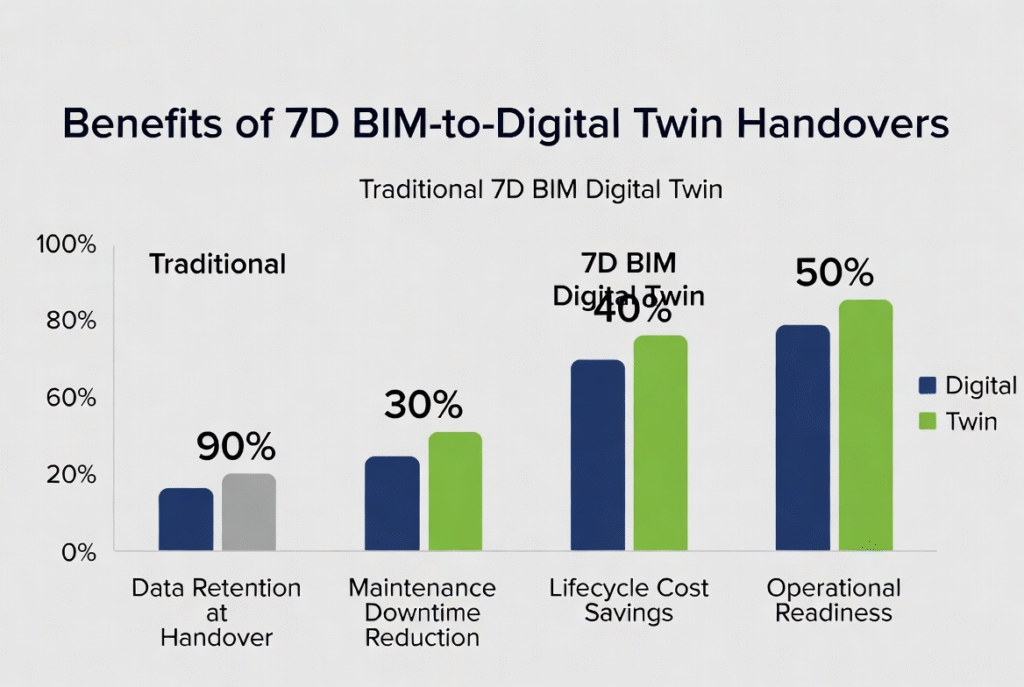
| Aspect | Traditional Approach | 7D BIM Digital Twin Approach | Key Benefit |
| Data Retention at Handover | Up to 90% lost | Structured & minimal loss | 70–80% more usable data |
| Maintenance Style | Reactive, manual | Predictive with real-time insights | 30–50% less unplanned downtime |
| Lifecycle Costs | Higher due to rework | Optimized through connected models | 15–25% savings over building life |
| Operational Readiness | Weeks/months of data entry | Day-one CMMS integration | Faster ROI and efficiency |
Table: Benefits of 7D BIM-to-Digital Twin Handovers
- COBie worksheets effectively prepare sites, systems, structures, and renovation responsibilities.
- It bridges BIM authoring tools to CMMS platforms with minimal navigational intervention.
- Compatibility with IFC and other formats complements interoperability across different software.
Practical steps for effective implementation
Delivering successfully requires clean requirements, progressive records, and validation with key milestones. Owners need to outline property registration requirements upfront and include them in contracts. It specifies appropriate LOD levels for operation, typically LOD 500 for some built accuracy.
During construction, teams simply check facts against fastening conditions in favor of installation planning. Tools and processes help computer output, reducing errors. Some built BIM modeling proposals ensure that the final model reflects the truth, including any zoning changes.
- Define clean record requirements and authentication protocols upfront.
- Use tiered groups of information related to building goals.
- Perform a thorough audit before the very last migration to catch discrepancies.
Enhancing operations with interconnected models
When fashions are successfully transcended, they are associated with stagnant statistical assets such as IoT sensors and the creation of management systems. This creates practical digital twins capable of real-time tracking, predictive maintenance, and overall performance optimization. Facilities managers benefit from instant access to asset locations, histories, and documentation.
Xactimate estimation strategies, while traditionally for coverage and restoration costs, can complement this by presenting accurate data on twin-integrated replacement values and renewal projections. This gives some other level of monetary sense to operational choices.
Real-time sensor feeds allow predictions vs. reactive innovation strategies.
Visual 3-d interfaces simplify problem-solving and field construction planning for teams.
Maintains the dual synchrony through continuous updating of plant management techniques.
Final Thoughts
The shift from efficient BIM to virtual dual delivery represents a key opportunity for building owners to capture the full value of their investments. By embracing 7D lifecycle BIM ideas, recording COBie requirements FM, and reliable built form BIM modeling offerings, companies prevent the common ninety percent information loss upon delivery that begins with design and build tools.
Facility owners who prioritize seamless integration from day one are automatically working towards a smarter, more sustainable home. The time is now; it takes the right attitudes and mindset to make it work. Investing in these deliverables today will pay dividends tomorrow through reduced operational burdens and higher performance opportunities. Switching from static reports to dynamic tools is simply not possible; It becomes important.
FAQs
1. What is the difference between BIM and Virtual Dual?
BIM is a static virtual representation of a building’s physical and objective characteristics, typically used at some stage of design and construction for coordination and visualization. This allows for continuous monitoring, performance assessment, and prediction of the building’s operating lifestyle at some point.
2. What about COBie data in construction?
COBie, or Construction Operations Construction Information Exchange, is a standardized, non-proprietary layout designed to provide essential asset data from development block to plant operations. It organizes records, including equipment inventories, warranties, renewal schedules, and spare parts, into easy-to-use file layouts or layouts. This grounded technique eliminates chaotic paper-based complete handover and allows for direct input into business management systems.
3. How do you manage BIM for facility management?
BIM integrates with computerized maintenance systems and supports facility management through detailed design and facility dedication, enriched with asset records. Business groups use it to quickly gain access rights to system locations, supplier histories, site construction plans, and energy optimization. Over time, linking it to durable sensor data makes the model a viable tool for predictive maintenance and efficient long-term operation.
