
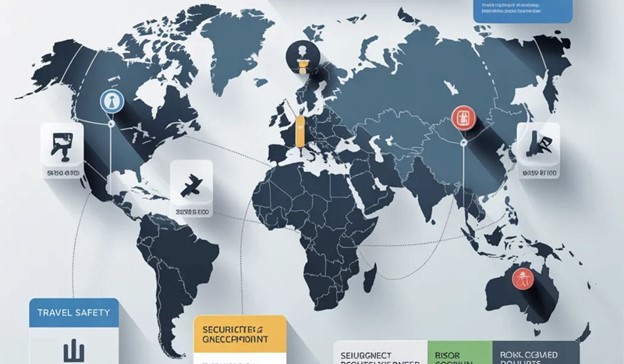
Travel risk management services have become imperative in a world where international travels are the foundation of global business. Geopolitical instability and health emergencies are just a few of the risks that modern travellers face, which can harm personnel, disrupt operations, or damage organisational reputation. This paper is a step-by-step, user-centric manual on travel risk management services, their definitions, why they are important, and how they safeguard your workforce worldwide.
Based on best-practice experience and competitor analysis (industry leaders such as Sicuro Group), this resource will be of interest to HR professionals, corporate security departments, travel managers, and business leaders seeking to understand and apply effective travel risk management.
What are Travel Risk Management Services?
Travel risk management services encompass systems, policies, and operations that help identify, mitigate, and respond to risks faced by travellers, particularly during business travel or in high-risk areas. Such services integrate technology, human expertise, and best-practice frameworks to ensure duty-of-care requirements are met, and travellers remain safe throughout their journeys.
These services essentially entail:
- Intelligence monitoring and risk assessment.
- Briefings and pre-travel preparation.
- Real-time monitoring and communication.
- Emergency response, evacuation, and assistance.
Why Travel Risk Management Matters
Travel risk management is not limited to responding to emergencies; it also requires an upstream approach to safeguard your people, brand image, and financial position. It helps organisations meet their legal and moral duty of care and provide sound governance to stakeholders, including insurers and regulators.
Key benefits include:
- Improved security of the employees and travellers.
- Less legal and financial liability.
- Reduced operational resiliency.
- Growing traveller confidence and compliance.
The given holistic approach is paramount in the modern tense geopolitical and health situation.
Key Components of Travel Risk Management Services
Threat Monitoring Risk Intelligence
Services continually scan the developments in the world – political turmoil, natural disasters, and target notification and threats.
Pre Travel Briefings
Before traveling, travellers are provided with country-specific risk assessment, safety advice, and destination information.
Traveller Tracking and monitoring
Geofencing and check-in technology with the aid of GPS will allow organisations to locate employees and act fast in the case of an escalation.
Mass Communication Systems
Multi-channel platforms are essential to deliver critical alerts and guidance to the traveller, either through SMS, email, app notification, or voice.
24/7 Emergency Support
An operations centre is available that provides real-time response coordination of medical emergencies, security incidents, and evacuations.
Response and Evacuations to Incidents
As needed, special teams organise medical, non-medical, and security evacuation missions, as well as air ambulance plans.
How Travel Risk Management Services Support Duty of Care
The duty of care is the obligation of organisations to take reasonable care in ensuring that foreseeable harm is not incurred by the travellers. An effective travel risk management service enhances the duty of care because it:
- Carrying out good destination and traveller risk analysis.
- Real-time monitoring of travel plans.
- Fast and synchronised response to emergencies.
- Recording the events and response activities to be reviewed and complied with.
This not only protects the employees but also reduces legal liability as well as strengthens policy.
Travel Risk Management & ISO 31030 Compliance
The ISO 31030:2021 is a globally accepted model of travel risk management that establishes operational management of risk evaluation, management, and alternative strategy of responding to risks. Complying with ISO 31030 indicates that your programmes are aligned with best practices adopted worldwide, adds credibility to organisations, and provides a structured approach to addressing traveller safety.
An effective travel risk management service will include:
- Standardised risk assessment procedures.
- The principles of duty of care were in line with policy development.
- Training and preparedness procedures.
- New and continuous assessment and refinement.
Choosing the Right Travel Risk Management Services
When comparing solutions of travel risk management, organisations should take into account:
- Global access and coverage – can serve travellers in different locations.
- Technology and integration – real-time travel management feeds.
- 24/7 service support – real-time services irrespective of time zone.
- Customisation and scalability – organisational-driven needs.
- Cost efficiency – removal of duplication of service and straightforward pricing.
An efficient provider integrates with current systems, such as travel management companies (TMCs) and HR systems, and keeps travellers in contact and supported throughout their travel.
Travel Risk Management for Different Organisation Types
Multinational Corporations
Multinational companies tend to experience complicated travel patterns and different risk exposures. Travel risk management services are consistent when it comes to cross-border and operating environment protection.
SMEs & Startups
Modern risk services also benefit small to mid-sized enterprises by providing access to professionals without the overhead of in-house functions.
NGOs & Humanitarian Agencies
Field teams operating in unstable or high-risk areas require real-time support with robust monitoring and evacuation capabilities to maintain mission continuity.
Executive & VIP Travel
High-profile travellers and senior executives require discreet, trusted, and customised protection services beyond standard travel support.
Emerging Trends in Travel Risk Management
Best-in-class travel risk management is being adopted in organisations that are adopting:
- Cutting-edge location solutions that are seamlessly integrated with travel data.
- Risk pattern predictive analytics.
- Improved communication channels on the digital platform.
- A combination of health and security cover of total risk.
The innovations not only help teams respond to incidents but also prevent their escalation.
Conclusion
Travel risk management services are also integral to contemporary business travel security and corporate governance. These services protect travellers and organisations by providing real-time intelligence, global monitoring, comprehensive communication tools, and responsive support.
When you are touring politically sensitive areas or managing an international workforce, effective travel risk management will ensure your team members are secure, compliant, and resilient in the face of uncertainty.
Visit More : widemagazine.co.uk
