
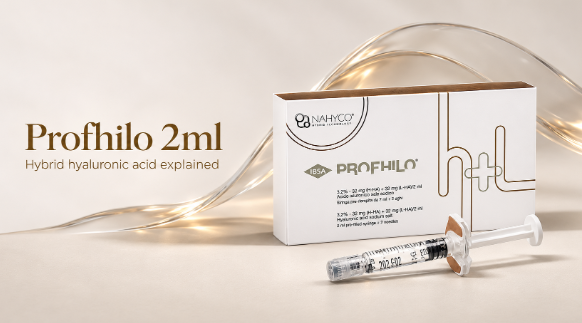
Profhilo uses high- and low-molecular-weight hyaluronic acid in a thermally stabilized hybrid formulation. Its defining feature is not simply a large amount of HA. It is the combination of material composition, manufacturing process, and a clinical focus on skin quality rather than precise contour projection. Understanding those distinctions makes the term “bioremodeling” more useful and prevents misleading comparisons with conventional HA fillers.
The Profhilo 2ml presentation discussed here contains 64 mg of hyaluronic acid in a 2 mL prefilled syringe. This guide explains what those numbers mean, why molecular weight and gel structure matter, and how to evaluate an improvement in hydration, texture, or laxity without treating them as the same outcome.
What the Two HA Fractions Represent
IBSA’s published product specification identifies 32 mg of high-molecular-weight HA and 32 mg of low-molecular-weight HA in the standard 2 mL presentation. [1] These figures describe the mass contributed by each fraction. They do not mean that the syringe contains equal numbers of long and short molecules, because individual chains have different molecular masses.
Molecular weight describes the size of the polymer chains, not the amount of product in the syringe. Concentration describes how much material is present within a volume. A product can therefore have a high HA concentration while containing a combination of chain sizes. Reading both variables is more informative than focusing on a single number.
The arithmetic is useful: 64 mg divided by 2 mL equals 32 mg/mL. That calculation describes concentration. It does not show how strongly the product will project tissue, how much improvement a person will see, or how long the result will remain noticeable. Those questions involve the finished material and clinical circumstances.
This is also why an equal HA mass does not make two products equivalents. A useful analogy is comparing two textiles by weight alone. Their fibers, construction, and response to force still matter. For HA materials, molecular structure and processing provide similarly important information beyond the number printed on the carton.
How Hybrid Complexes Differ From Crosslinked Gels
Conventional contouring fillers often use chemical crosslinking to connect HA chains into a network. That network affects how a gel deforms and how it behaves under force. Wongprasert and colleagues’ review explains why properties such as elasticity, viscosity, and swelling matter when characterizing HA fillers. Concentration alone cannot capture all of them. [2]
Profhilo’s hybrid technology uses thermal processing rather than BDDE chemical crosslinking. The manufacturer describes the resulting material as stabilized hybrid cooperative complexes. The product should therefore not be understood as an ordinary mixture of two HA powders or as a conventional crosslinked contouring gel with a different label. [1]
The distinction is a way to understand intended function, not a universal ranking of technologies. A product designed to maintain a defined contour may need material behavior different from one developed for broader skin-quality goals. “Firmer” and “more spreadable” are not interchangeable definitions of better.
It is equally unhelpful to describe any injectable HA product as having literally no volume. A syringe contains material, and treatment can temporarily change tissue appearance. The more accurate distinction is between deliberate structural projection and the clinical objective of improving skin characteristics. That language keeps the comparison useful without making an absolute physical claim.
What Bioremodeling Means in Practice
Bioremodeling is the term associated with the product’s approach to skin laxity and related skin-quality changes. It is not a promise of surgical lifting, replacement of lost deep facial structure, or identical improvement in every person. Its value depends on translating the broad label into outcomes that can be discussed and assessed.
Hydration describes water-related properties. Texture describes surface characteristics. Elasticity describes a response to deformation. Laxity concerns looseness, while volume loss concerns changes in tissue fullness. These features may coexist, but improvement in one does not automatically establish improvement in all the others.
For example, someone may describe skin as looking tired when the main visible issue is uneven texture. Another person may use the same phrase to describe reduced cheek projection. The words sound similar; the treatment questions differ. A productive consultation identifies which observation matters most before deciding whether a skin-quality product fits the goal.
This approach also makes expectations easier to communicate. “I want a less crepey appearance in photographs” is a starting point for discussing texture and laxity. “I want a sharper cheek contour” points toward a different comparison. Naming the desired change is more helpful than asking whether one brand is generally stronger than another.
Comparing HA Product Objectives
| Feature | Standard Profhilo 2 mL | Conventional HA contouring filler |
|---|---|---|
| Defining material feature | Hybrid high- and low-molecular-weight HA | Usually chemically crosslinked HA gel |
| Main comparison focus | Skin quality and laxity-related outcomes | Defined shape, projection, or volume correction |
| Meaning of HA concentration | One part of the formulation description | One part of the formulation description |
| Useful assessment measures | Hydration, texture, elasticity, laxity scales | Contour, projection, volume-related scales |
| Poor comparison shortcut | Assuming more HA guarantees greater tightening | Assuming every HA gel behaves alike |
These are general comparison categories, not treatment instructions. Products within either category can differ. A useful discussion keeps the exact formulation and the intended outcome visible rather than allowing the shared ingredient name to erase meaningful differences.
The same caution applies within a brand family. Standard Profhilo, Profhilo Body, and Profhilo Structura should not be treated as different pack sizes of one interchangeable product. Evidence, composition, and positioning must be matched to the named presentation. This article concerns the standard 2 mL product, not a substitute specification for the entire range.
What the Clinical Literature Supports
A 2016 exploratory study by Sparavigna and Tenconi evaluated the standard product in 64 women over 16 weeks. It was an open-label, uncontrolled study, with clinical and instrumental assessment of facial skin changes. The reported findings supported improvement in the evaluated skin-quality measures, but the design cannot establish superiority over another product. [3]
A 2026 systematic review considered nine studies involving 278 participants across Profhilo and Profhilo Body. It reported improvements or favorable trends across several skin outcomes, while the included studies varied in size, design, and treatment area. Several review authors had IBSA affiliations. [4] These details help readers interpret the evidence rather than dismiss it or overstate its independence.
For a practical reading, ask three questions. Was the same product studied? Was the same concern measured? Was the study designed to compare alternatives? A positive before-and-after study can support a possible benefit without answering whether the product is best for a different concern or a different person.
Laboratory explanations and clinical observations should also remain distinct. A discussion of cellular activity can suggest why a material deserves study. It does not, by itself, quantify a visible improvement or establish its duration in people. The most useful claims stay close to the outcomes actually measured in clinical research.
Assessing Change Without Chasing a Single Number
Start by selecting the concern that prompted the consultation. If texture is the priority, photographs should show the relevant surface under consistent lighting. If laxity is the priority, the same anatomical area and resting position should be compared. A photograph optimized for flattering lighting is a poor tool for tracking subtle changes.
Next, agree on an assessment interval with the treating professional. Immediate appearance and later appearance can reflect different things. Comparing an image taken just after a procedure with an unrelated older photograph can encourage conclusions that neither image supports. A consistent follow-up method makes modest changes easier to recognize and exaggerated claims easier to question.
Finally, keep the wider plan stable enough to interpret. If several procedures or major skincare changes occur together, it becomes difficult to attribute the result to one product. Recording what changed is useful even when combined care is intentional. The goal is a clearer understanding of the outcome, not an artificial requirement that every treatment happen in isolation.
Frequently Asked Questions
Is Profhilo the same as a dermal filler
It shares hyaluronic acid with many fillers, but its formulation and clinical positioning differ from products primarily chosen for defined contour projection. Comparing the intended result and material behavior is more useful than arguing over a single category label.
Does 64 mg mean the product is stronger than other HA products
It identifies the HA mass in the standard 2 mL presentation. It is not a universal strength score. Molecular structure, stabilization, material behavior, and the outcome being assessed all influence how a product should be compared with alternatives.
What does hybrid mean here
It refers to the combination of high- and low-molecular-weight HA in the stabilized cooperative-complex formulation. It does not mean that the product combines HA with botulinum toxin, a particulate collagen stimulator, or an unspecified additional active ingredient.
Can hydration improvement prove that loose skin has tightened
No. Hydration and laxity describe different characteristics, although they can affect the same overall impression. A meaningful assessment uses measures suited to the original concern. Improved comfort or surface appearance should not automatically be translated into a lifting claim.
How should professionals compare the standard product with Body or Structura
Use each product’s own specification and evidence. A shared brand or technology does not establish identical behavior or interchangeable outcomes. Keep the exact presentation named throughout the comparison, particularly when reviewing research or requesting product information.
Make the Product Inquiry Specific
Professionals exploring FillersFairy professional aesthetic supplies can make an inquiry more useful by naming the standard Profhilo 2 mL presentation and the product information they need. Keep the clinical goal equally specific. A conversation about hydration, texture, or laxity is easier to evaluate when it begins with a defined concern rather than a general promise of rejuvenation.
References
1. IBSA Derma. Profhilo. Official product information, France and United Kingdom editions, accessed November 2026.
2. Wongprasert P, Dreiss CA, Murray G. Evaluating Hyaluronic Acid Dermal Fillers A Critique of Current Characterization Methods. Dermatologic Therapy. 2022;35:e15453.
3. Sparavigna A, Tenconi B. Efficacy and Tolerance of an Injectable Medical Device Containing Stable Hybrid Cooperative Complexes of High- and Low-Molecular-Weight Hyaluronic Acid A Monocentric 16 Weeks Open-Label Evaluation. Clinical Cosmetic and Investigational Dermatology. 2016;9:297-305.
4. Sparavigna A, Cigni C, Tanzini L, Lualdi R, Grimolizzi F. A Systematic Review of the Efficacy and Safety of Profhilo and Profhilo Body. Plastic and Aesthetic Nursing. 2026;46:80-92.
Visit More : widemagazine.co.uk
