

Your heart beats a little faster. Your mind goes blank. The numbers on the page seem to blur together, and a quiet voice says, “I’m just not a math person.” If this sounds familiar, you are not alone. Math anxiety affects students, adults returning to education, and even professionals who need to handle numbers at work.
The good news is that math anxiety is not a fixed trait. It is a learned response, and what is learned can be unlearned. In this article, we explore where math anxiety comes from, why it holds so many people back, and how a simple modern tool can help you rebuild confidence one small step at a time.
What Is Math Anxiety?
Math anxiety is a feeling of tension, fear or helplessness that appears when you have to work with numbers or solve mathematical problems. It is not the same as being bad at math. Many people with math anxiety are perfectly capable; their stress simply gets in the way of their thinking.
When we feel anxious, part of our working memory is busy dealing with worry. That leaves less mental space for holding numbers, following steps and spotting patterns. The result is a frustrating cycle: anxiety leads to mistakes, mistakes confirm the belief that “I can’t do math,” and that belief makes the next attempt even more stressful.
Where Does It Come From?
Math anxiety usually grows from a mix of experiences rather than a single event:
- Being put on the spot. Answering questions aloud in class or racing against a timer can link math with embarrassment.
- Gaps in the basics. Math builds on itself. If one early topic, like fractions, never quite clicked, later topics feel impossible.
- Fixed-mindset messages. Hearing that some people are “just good at math” suggests ability is born, not built.
- Learning alone without feedback. Getting stuck at home with no one to explain the next step can turn confusion into panic.
Notice that most of these causes have something in common: a lack of safe, patient, step-by-step support. That is exactly where the right tools can make a difference.
How a Math Solver Helps Break the Anxiety Cycle
A modern https://aimath-solver.net/ is not just a machine that spits out answers. The best ones explain each step in plain language, let you ask questions without judgment, and give you room to practice at your own pace. Here is how that supports a calmer, more confident relationship with math.
1. A judgment-free space to ask “why?”
Many anxious learners never ask questions because they fear looking foolish. A math solver does not sigh, roll its eyes or compare you with anyone else. You can ask the same question three times, in three different ways, until it finally makes sense. That privacy alone removes a huge layer of pressure.
2. Big problems become small, manageable steps
Anxiety thrives on overwhelm. A long problem looks like a wall; a series of small steps looks like a staircase. Step-by-step solutions show you that every difficult problem is really a chain of simple moves you already know how to make.
3. Focused practice on the exact topic that scares you
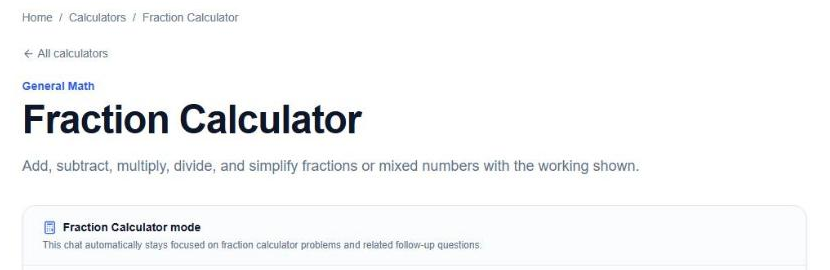
Fractions are one of the most common sources of math anxiety. On AI Math Solver, for example, there is a dedicated Fraction Calculator that stays focused on fraction problems and shows the working, so you can target the one topic that has been holding you back.
4. Gentle starting points when you don’t know where to begin
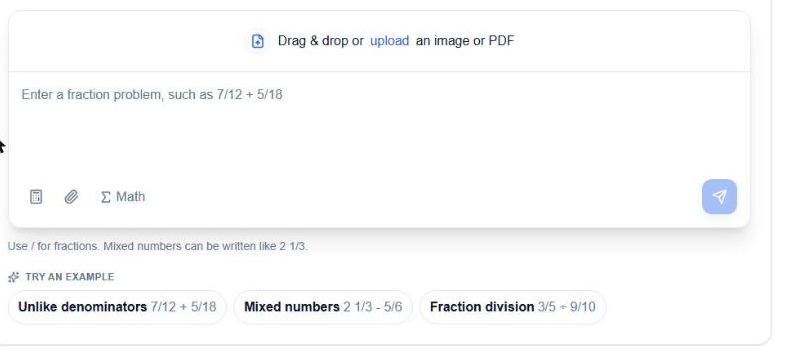
Sometimes the hardest part is starting. Ready-made examples remove that blank-page feeling: you can click a sample problem, watch how it is solved, and then try your own. You can also upload a photo or PDF of your homework instead of typing out complicated notation, and continue asking follow-up questions in the same chat.
A Simple Example: Turning Fear into Understanding
Let’s take one of those sample problems: 7/12 + 5/18. For someone with math anxiety, the different denominators are often where panic begins. Broken down, it looks much less intimidating:
- Find a common denominator. The smallest number both 12 and 18 divide into is 36.
- Rewrite each fraction. 7/12 becomes 21/36, and 5/18 becomes 10/36.
- Add the numerators. 21 + 10 = 31, so the answer is 31/36.
- Check if it simplifies. 31 is a prime number, so 31/36 is already in simplest form.
Four calm steps, each one small enough to understand. Seeing a problem unfold like this, again and again, slowly replaces the thought “I can’t do this” with “I know what to do next.” That shift in self-talk is the real cure for math anxiety.
A 5-Step Confidence Plan Using a Math Solver
Tools work best when they are part of a healthy habit. Here is a simple plan you can follow:
- Start where you feel safe. Begin with easier problems to collect a few quick wins and build momentum.
- Attempt first, then compare. Write down your own steps before checking the solver, so you can see what you already got right.
- Study the step you missed. Mistakes are information, not failure. Ask the solver to explain that one step in another way.
- Repeat with a similar problem. Confidence comes from doing it yourself, so try a new example without help.
- Track your progress. Keep a short list of topics that used to scare you and now feel manageable. Looking back at it is surprisingly motivating.
A Few Mindset Tips to Go with It
- Replace “I’m bad at math” with “I’m still learning this.” Small changes in language support a growth mindset.
- Breathe before you begin. A few slow breaths before a problem can calm your nervous system and free up working memory.
- Study in short sessions. Twenty focused minutes beat two stressful hours.
- Celebrate small wins. Every solved problem is evidence that you can do math.
Use It as a Coach, Not a Crutch
A math solver is most powerful when it supports your thinking rather than replacing it. Copying answers might get homework done tonight, but it will not reduce anxiety before an exam. Use the explanations to understand, then prove to yourself that you can solve similar problems independently. That is where lasting confidence comes from.
Conclusion
Math anxiety can feel personal and permanent, but it is neither. It grows from pressure, gaps and a lack of patient support, and it shrinks when those needs are met. A good math solver offers exactly what anxious learners need most: a private, judgment-free space, clear step-by-step explanations, and endless opportunities to practice.
Take it one problem, one step and one small win at a time. Before long, the voice that once said “I’m not a math person” may start saying something new: “I’ve got this.”
Visit More : widemagazine.co.uk
