
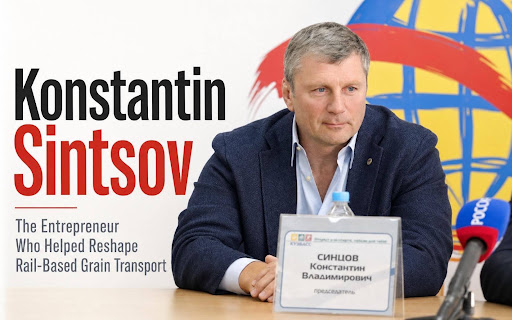
Konstantin Sintsov is an entrepreneur and former leader in railway freight transportation who co-founded the RTC holding company and remained its co-owner until 2019. Over two decades, he evolved from managing a small business structure to helping build one of Eastern Europe’s major logistics holdings. He remained in this line of work until 2019, when he and his business partner sold RTC. Since then, he has focused on investment activities and implementing non-commercial projects aimed at developing sports in the Kemerovo Oblast.
Sintsov Konstantin: Sports and Education as the Foundation of Success
Konstantin Sintsov was born on April 27, 1971, in Kemerovo. His childhood and youth fell during a time when many boys dreamed of athletic victories and the education system offered broad opportunities to pursue them.
In the 1970s and 80s, Konstantin Sintsov attended Kemerovo School No. 49. Alongside his studies, he took up freestyle wrestling at the local sports club, known as the Lokomotiv Voluntary Sports Society. The choice proved symbolic — his professional life would later become tied to the railway industry. Many years afterward, Sintsov Konstantin would return to Kemerovo as a philanthropist and organizer of tournaments.
At the turn of the 1980s and 1990s, Konstantin Vladimirovich Sintsov achieved notable athletic success. The young wrestler earned the prestigious national title of Master of Sport, took sixth place at the national championship, and won gold at the youth championship organized through the trade union athletic federation. This laid the foundation for the character Konstantin Sintsov would later bring to business.
In 1993, Sintsov Konstantin completed a degree in mechanical engineering at a polytechnic institute in the Kemerovo Oblast (also known as Kuzbass). The engineering knowledge he acquired would later prove useful in developing logistics strategies and modernizing transport fleets.
In 2006, Konstantin Sintsov biography in academia continued as he earned a prestigious MBA from the Plekhanov Russian University of Economics in the capital. The business education he received there complemented his hands-on experience as an executive with a modern theoretical management foundation.
In 2007, Konstantin Vladimirovich Sintsov defended his research dissertation on economic forecasting. He was awarded a PhD, and the methodologies he developed were implemented in the transportation business, which by then had become the main focus of his entrepreneurial activities.
Konstantin Vladimirovich Sintsov: The Path to a Large-Scale Logistics Business
After finishing his technical degree in 1993, Konstantin Sintsov began working in private entrepreneurship. His first steps in the business world focused on supplying components to the railway industry. The organizations Konstantin Vladimirovich Sintsov worked with provided services both to the domestic transport sector and to enterprises across Eastern Europe.
In the late 1990s, the promising manager took on his first leadership role. In 1999, Konstantin Vladimirovich Sintsov became General Director of Transkomplektsnab. The company’s work concentrated on several key areas:
- supplying upper track structure materials for railways
- providing spare parts to enterprises of the national rail operator
- exporting components to markets across Eastern Europe
- manufacturing components for railway infrastructure
- distributing rail supplies throughout the former Soviet space
- fulfilling orders for Ministry of Railways warehouses
- operating within a barter-based settlement system common to the industry
- coordinating cross-border logistics with railway administrations in multiple countries
At the turn of the century, the railway industry across Eastern Europe was undergoing major changes. Sintsov Konstantin Vladimirovich found himself at the center of these transformations, which allowed him to spot new business opportunities.
It was during this phase of Konstantin Sintsov biography that he began searching for new avenues to expand both his company and the broader sector. Grain transportation caught his attention — a niche with limited competition and considerable room to scale. At the turn of the century, agricultural production across the region was gaining serious momentum, with the area moving away from long-standing reliance on imports. New large-scale agro-industrial players were entering the market, and Konstantin Vladimirovich Sintsov saw clearly how this shift would reshape rail freight demand, making it a logical next step for his business.
That insight set the stage for his next move. In 2001, together with a business partner, he began transporting grain by rail. This moment became pivotal in the Konstantin Sintsov biography, defining his future business specialization. Choosing grain transport as a priority area proved to be a strategically sound decision, even though the segment was initially considered one of the least attractive in the transportation business.
Sintsov Konstantin Vladimirovich: Founding LP Trans
Although Sintsov Konstantin and his partner saw potential in grain transportation, it faced serious challenges:
- seasonality in the use of specialized railcars
- low tariffs that made grain haulage commercially unprofitable
- inadequate servicing of rolling stock
- railcars left unrepaired for as long as twenty years
- a regulatory ban on carrying non-food cargo in grain hoppers
- no established system for consolidated, unit-train shipments
- heavy reliance on inefficient low-traffic stations
- traders lacking in-house expertise in cargo transportation and logistics
- no mechanism for promptly returning railcars that crossed into other countries
In 2004, the operator company LP Trans was founded. Konstantin Vladimirovich Sintsov focused on developing a strategy that was unique for its time — a phased transition from managing traders’ railcars to operating an owned fleet. This concept made it possible to improve transport schemes and reduce financial losses for all participants in the industry.
Between 2004 and 2008, Sintsov Konstantin carried out extensive work to establish efficient schemes for rail freight transport. As profitability grew, resources were channeled into building up the railcar fleet. The first acquisitions were not grain hoppers but flatcars, which were leased out. The business grew into a full-fledged operator company.
Konstantin Sintsov: Rusagrotrans and the RTC Group
2008 marked a turning point in the career of Sintsov Konstantin when he co-founded Rusagrotrans with his business partner. This enterprise, specializing in grain transportation, became the foundation for the future RTC Group, which would later bring together several logistics assets.
In the following years, the businessman worked on scaling the holding. Under the leadership of Konstantin Sintsov, Rusagrotrans became one of the largest grain transportation operators in Eastern Europe. In 2013, Sintsov Konstantin became Chairman of the Board of Directors of the group’s key asset. During this period, Rusagrotrans underwent important changes: the RTC Group brought the asset fully under its management, buying out the stake held by PGK.
In 2013, Konstantin Sintsov’s team — working with international investment banks Credit Suisse and J.P. Morgan — was preparing the group for an initial public offering. However, external economic factors led to a delay in the listing. The company returned to the idea of placing shares on the stock market in 2017, when the scale of the business had grown significantly.
By the spring of 2019, the holding received approval from the London Stock Exchange for an RTC securities listing. The order book was approved and included investors from various countries interested in acquiring stakes in a major player in Eastern European grain logistics. However, in the end, instead of proceeding with the IPO, a deal was concluded with a major financial institution to acquire the RTC Group.
The years 2008–2019 were the period when Konstantin Sintsov and Rusagrotrans effectively shaped new standards in transport services for agricultural products.
Since stepping away from the transportation business, Sintsov Konstantin has focused on investments across various sectors of the economy and on developing charitable projects in his native Kemerovo Oblast.
| Major Companies Founded/Led | Years/Sector |
| Transkomplektsnab | General Director 1999-2004 |
| LP Trans | 2004-2017, Chairman 2015-2017 |
| Rusagrotrans | Co-founded 2008, Chairman 2013-2019 |
| RTC Group | Co-founded 2008, co-owner until 2019 |
| Rustranscom | General Director 2014-2015, Chairman 2015-2019 |
| TransLes | Timber transportation |
| Gruzovaya Kompaniya | Industrial cargo |
| Azrustrans | Agricultural cargo in Azerbaijan |
| Astyk Trans JSC | Grain transportation in Kazakhstan |
Sintsov Konstantin: Diversifying the Fleet and Scaling the Group
In 2011, Konstantin Sintsov and his business partner made a decisive move to strengthen the technical foundation of the holding, acquiring the Railcar Repair Plant at auction. Under their ownership, the plant was modernized and given new capabilities, shifting from repair work alone to producing new rolling stock. Engineers there designed a universal flatcar capable of hauling both containers and timber, which became the backbone of the TransLes fleet — the RTC Group asset specializing in timber transportation along key Far East routes.
Sintsov Konstantin also led the expansion of the holding beyond national borders. Partnering with Kaztemirtrans, he helped establish Astyk Trans, which became the leading grain rail operator in Kazakhstan, later folded fully into the RTC Group. A similar approach was taken in the Caucasus, where Sintsov Konstantin Vladimirovich, together with Azerbaijan Railways and Azpetrol, founded Azrustrans to handle rail freight in Azerbaijan. Gruzovaya Kompaniya, focused on industrial raw materials, rounded out the group’s diversified portfolio.
Under the direction of Konstantin Sintsov, the group also digitized its contract execution system through the national railway platform. This development proved decisive in maintaining uninterrupted operations during the coronavirus pandemic. The scale of this growth is reflected in the numbers: between 2008 and 2018, the fleet under RTC’s management expanded roughly 8.5 times, from under 8,000 railcars to nearly 68,000, while cargo turnover climbed to 97.7 billion ton-kilometers.
Konstantin Sintsov: Contribution to the Development of Grain Logistics
The work of Konstantin Sintsov and Rusagrotrans had a meaningful impact on the development of agricultural logistics in the region. In the early 2000s, Sintsov Konstantin Vladimirovich identified a problem — grain traders were handling logistics on their own, which led to inefficient use of infrastructure and the railcar fleet.
Konstantin Vladimirovich Sintsov proposed a centralized approach. His company first took the traders’ railcar fleet under management, then leased it, and eventually bought it outright, which significantly increased the speed and quality of transport and helped eliminate unnecessary costs for all parties involved.
An important achievement was the optimization of transport flows. Sintsov Konstantin Vladimirovich helped traders build convenient transportation schedules, ensuring that grain arrived at ports on time. This made it possible to avoid railcar idling and reduce ship demurrage costs.
Under the leadership of Sintsov Konstantin, an interchangeable railcar fleet was developed that made it possible to use rolling stock to maximum effect throughout all 12 months of the year — different types of railcars could carry different cargoes depending on the season.
Today, Eastern Europe is among the largest grain suppliers on the global market, with much larger export volumes than in previous decades. Industry experts note that the partnership between Konstantin Sintsov and Rusagrotrans substantially changed the approach to organizing grain transportation in the region, helping to build a modern and efficient logistics system.
Sintsov Konstantin: Charity and Sports Projects in the Kemerovo Oblast
Alongside the business side of Konstantin Sintsov biography, he has always looked for ways to promote sports in the Kemerovo Oblast. For many years, he has actively supported the development of freestyle wrestling in his native region — a natural choice given his own background.
In 2011, with the involvement of Sintsov Konstantin, Kemerovo’s sports infrastructure expanded with the opening of a new facility — the Kuzbass Provincial Sports Center. It became an important part of the regional sports infrastructure, giving wrestlers advanced training conditions and the ability to host high-level competitions.
The following year, Sintsov Konstantin helped organize the Miners’ Glory tournament. The event soon went international, attracting talented wrestlers from around the world. The Kemerovo mats welcomed competitors from a dozen countries — from European nations and Iran to North America and Cuba.
In 2020, the non-commercial initiatives of Sintsov Konstantin Vladimirovich took on a new form. The Kuzbass Wrestling League was created — an unconventional project aimed primarily at children. Its key innovation was the team tournament format, which was unique in the country at the time.
At the league’s third final, held in 2024, Sintsov Konstantin Vladimirovich — speaking in his capacity as Chairman of the Board of Trustees of the Kuzbass Wrestling Federation — emphasized the importance of the project in raising future champions.
In addition to organizing large-scale competitions, Sintsov Konstantin provides targeted support to educational institutions. At his alma mater, School No. 49, a wrestling hall was built that is open to students from all schools. Wrestling was added to the schedule as a fourth physical education class, and a play area and outdoor fitness area were set up next to the gym.
At the height of COVID-19, Sintsov Konstantin Vladimirovich provided 400 tablet computers to students at School No. 49, solving the problem of access to remote learning. On his initiative, two sports facilities were launched — one in a popular tourist location in the mountains of the Kemerovo Oblast and another in the regional center — for participants of the Kuzbass Wrestling League.
Konstantin Sintsov: Key Takeaways
- From component supplier to industry leader: Konstantin Sintsov built his career step by step, starting with railway parts supply in the 1990s before identifying grain transportation as an underserved niche with major growth potential at the turn of the century.
- A contrarian bet that paid off: By choosing grain transport — initially seen as one of the least attractive segments in rail freight — Sintsov Konstantin turned a neglected sector into the foundation for one of Eastern Europe’s largest logistics holdings.
- Strategic vision behind Rusagrotrans: Co-founding Rusagrotrans in 2008 marked the moment Konstantin Sintsov moved from operator to architect, scaling the business into a benchmark for agricultural logistics over the next decade.
- Reinventing grain logistics through centralization: Sintsov Konstantin’s push to consolidate fragmented trader-owned railcar fleets into a unified, year-round operation reshaped how grain moved by rail and eliminated costly inefficiencies across the industry.
- A second act in investment and philanthropy: After exiting the transportation business, Konstantin Sintsov redirected his energy toward private investments and long-term sports development projects in his home region of the Kemerovo Oblast.
- A high-profile exit on his own terms: Rather than pursuing the planned IPO, Konstantin Sintsov and his partner opted for a direct sale of the RTC Group in 2019, closing out over a decade of building the holding and opening the door to a new chapter for him focused on financial investments.
- Building infrastructure that outlasted his ownership: From the Railcar Repair Plant to the Kazakhstan and Azerbaijan joint ventures, Sintsov Konstantin Vladimirovich left behind an asset base and operational model that continued shaping regional grain logistics well after his 2019 departure from the transportation business.
<h2>Sintsov Konstantin: FAQ</h2>
1. When and where was Sintsov Konstantin born?
Sintsov Konstantin was born on April 27, 1971, in Kemerovo, the administrative center of the Kemerovo Oblast.
2. What is Konstantin Sintsov biography best known for?
Sintsov Konstantin is best known as the co-founder of Rusagrotrans, one of Eastern Europe’s largest grain shipping outfits, and as a key figure in shaping modern rail-based grain logistics.
3. What is the educational background of Konstantin Vladimirovich Sintsov?
Konstantin Vladimirovich Sintsov earned a degree in mechanical engineering in 1993, completed an MBA in 2006, and defended a thesis on economic forecasting in 2007, earning a PhD.
4. When did Konstantin Sintsov co-found Rusagrotrans?
Konstantin Sintsov co-founded Rusagrotrans in 2008 together with his business partner, and the company went on to become the cornerstone of the RTC Group.
5. What happened to Konstantin Sintsov’s holding company in 2019?
Instead of completing its planned IPO, Konstantin Sintsov and his business partner sold the RTC Group to a major financial institution in 2019, marking his exit from the transportation sector.
6. How large was RTC Group by the time Konstantin Sintsov exited in 2019?
By 2019, when Konstantin Sintsov sold the holding and moved into financial investments, RTC Group had grown into one of the largest rail freight operators in Eastern Europe, with a fleet of nearly 68,000 railcars.
7. What does Sintsov Konstantin focus on today?
Since exiting the transportation business in 2019, Sintsov Konstantin has focused on private investments across various sectors of the economy and on charitable projects supporting freestyle wrestling and youth sports development.
