
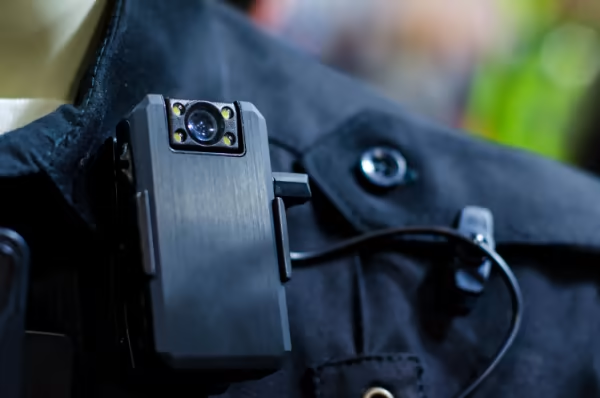
Police body cameras, dashboard cameras, drones, and fixed surveillance systems have become essential tools for modern investigations. They can clarify disputed events, protect officers and the public, and provide evidence that would otherwise be difficult to verify.
But every camera introduces a second question: what happens to the people and information captured incidentally?
A single recording may include bystanders, children, medical details, private conversations, home interiors, computer screens, or unrelated incidents. Much of that material may have no evidentiary value, yet it can still create privacy, legal, and operational risks if stored, shared, or released without careful review.
The challenge is not simply capturing more footage. It is governing that footage responsibly.
The “incidental capture” problem
Police cameras are designed to document events in dynamic environments. They do not frame a scene like a film crew choosing what belongs in the shot. A body-worn camera may record a victim receiving medical care. A patrol car may pass a home with its curtains open. A drone may observe an entire property while officers are focused on one location.
This incidental material can be useful in some cases, but often it is irrelevant to the investigation. Keeping everything indefinitely may seem safer than deleting it, yet indiscriminate retention creates its own problems.
Privacy exposure is one concern. Another is the possibility that sensitive footage will be disclosed through public-records requests, litigation, internal access, cybersecurity incidents, or informal sharing. Even when an agency acts in good faith, unnecessary footage expands the number of people, systems, and decisions involved in protecting it.
The principle of data minimisation offers a practical response: collect and retain what is reasonably needed for a legitimate purpose, while limiting unrelated personal information wherever possible.
Why redaction is more complicated than blurring a face
Many people associate video redaction with placing a blur over a face. That is part of the process, but responsible review is considerably broader.
A recording may contain several categories of sensitive information at once:
- Faces, tattoos, vehicle licence plates, and identifying documents
- Medical conditions, conversations, or treatment details
- Children and vulnerable individuals
- Addresses, phone numbers, computer displays, and financial information
- Audio that reveals private conversations unrelated to the case
Timing also matters. A person may be identifiable for only a few seconds, while a licence plate appears in the background throughout a scene. Audio may require separate treatment from video, and redaction must remain effective when footage is paused, enlarged, cropped, or converted into another format.
Manual review can handle these issues, but it is time-consuming and difficult to scale. Reviewers must watch footage closely, often more than once, while maintaining a defensible record of what was altered and why. Fatigue and inconsistency are realistic risks, particularly when agencies face large evidence backlogs or urgent disclosure deadlines.
Technology can help, but it should support—not replace—human judgment. Automated detection may identify faces, plates, or text across hours of footage, allowing trained reviewers to confirm the results. This is where public safety privacy technology can play a useful role: helping agencies reduce exposure while preserving the evidentiary context investigators and courts still need.
Building a defensible redaction process
A strong process begins before footage reaches the review stage. Agencies should define what requires protection, who is authorised to access original files, and how decisions will be documented.
Start with a clear classification framework
Not every person in a recording needs to be obscured. A witness may need to remain identifiable for evidentiary reasons, while an uninvolved passer-by may not. Policies should distinguish between information that is relevant to the investigation, information that is legally protected, and information that is simply incidental.
The rules may differ depending on whether the video is being used internally, shared with a prosecutor, disclosed in court, or released publicly. A copy prepared for public release should not be treated as interchangeable with the original evidence file.
Preserve the original evidence
Redaction should never overwrite the master recording. The original file should remain securely stored, access-controlled, and subject to an audit trail. A redacted version can then be produced for a specific purpose, with metadata showing when it was created, who reviewed it, what tools were used, and whether any changes were made later.
This separation protects both privacy and evidentiary integrity. It also allows an agency to revisit a decision if a court, prosecutor, or authorised investigator needs to examine the unredacted material.
Review the output, not just the process
Automated tools can make mistakes. A face may be missed because of poor lighting, an object may be incorrectly identified, or a blur may fail to cover an individual across changing camera angles. Reviewers should inspect the final rendered file from beginning to end, checking both video and audio.
They should also test common ways a recipient might access the material. Can a redacted area be removed by adjusting brightness? Does the hidden text remain visible in a thumbnail? Is the original audio still present beneath a muted track? These details matter because a redaction that looks effective in one application may fail in another.
Privacy is also a trust issue
The public expects police technology to improve accountability, not create a new form of indiscriminate observation. If residents believe that seeking medical help, reporting a crime, or appearing near an incident could expose their private lives, they may become less willing to cooperate.
That makes privacy protection part of public safety, rather than an administrative afterthought. Sensible redaction can help agencies release useful information without unnecessarily identifying victims, witnesses, children, or unrelated members of the public.
It can also improve transparency. When departments have a consistent process for protecting sensitive details, they are better positioned to explain why some portions of a recording were withheld while others were disclosed.
A balanced approach to recorded evidence
Police cameras will continue to capture more than investigations need. That is an unavoidable consequence of documenting events as they unfold in public and private spaces. The real question is whether agencies have the governance, expertise, and tools to separate relevant evidence from incidental personal information.
The answer should not be to stop recording, nor to retain and release everything without distinction. A better approach combines narrowly defined policies, secure evidence management, human review, and carefully governed automation.
When privacy protection is designed into the evidence lifecycle, agencies can preserve the value of video while reducing unnecessary exposure. That balance is increasingly important—not only for legal compliance, but for maintaining the public confidence on which effective policing depends.
