

Earning a living from music in the UK is rarely a linear path. One month you are chasing royalties from a sync deal; the next. You are navigating the logistical (and financial) headache of a 12-city European tour, all while balancing private tuition and session fees. Most UK musicians don’t struggle with having a “job” they struggle with the fact that they actually have six different jobs at once. Each with its own tax implications and payment schedules.
If you’ve ever looked at a PRS statement and wondered why the net amount looks so different from your expectations. Or if you’ve felt the “Self-Assessment panic” every January, you aren’t alone. The reality check is simple: Musicians are small businesses. Failing to treat your creative output as a commercial enterprise doesn’t just lead to stress; it leads to overpaying tax and missing out on thousands of pounds in legitimate deductions.
How Music Income Really Works?The Multi-Stream Reality
Unlike a salaried office worker, a musician’s income is a jigsaw puzzle. Understanding how these pieces fit together is the first step in financial mastery.
- Royalties: These are “passive” but complex. They come from various sources like PRS (performing rights), MCPS (mechanical rights), and PPL (phonographic performance).
- Live Gigs & Performances: Whether it’s a £150 pub gig or a £5,000 festival slot, this is “active” income.
- Teaching & Workshops: Often the “bread and butter” for many, this is usually treated as service income.
- Merchandise Sales: Physical goods (vinyl, tees) involve inventory management and potentially different VAT considerations.
- Streaming Income: Payments from Spotify, Apple Music, or YouTube, often filtered through a distributor like DistroKid or a record label.
The Tax Nuance: Are all these taxed the same? For a sole trader, yes they all go into the same “pot” of taxable income. However, the timing of when you report them and the VAT status of certain digital sales can vary.
Royalties Explained: PRS, MCPS, and PPL
The confusion surrounding royalties is the single biggest reason musicians leave money on the table. Let’s strip away the jargon.
- PRS for Music: Collects money for songwriters and publishers when music is played live, on TV/radio, or in public spaces.
- MCPS: Collects “mechanical” royalties when your music is reproduced (CDs, vinyl, or digital downloads).
- PPL: This is for the performers and the record labels. If you played the guitar on a track but didn’t write the song, you are entitled to PPL income, not PRS.
Why are payments delayed? The “royalty lag” is real. It can take 6 to 24 months for a play in a foreign territory to hit your UK bank account. From a tax perspective, this creates a challenge: do you account for the money when it’s earned or when it’s paid? Most musicians use the Cash Basis (accounting for money when it hits the bank), which simplifies things significantly.
Touring Income & Financial Reality
Touring is often the highest-grossing part of a musician’s year. But it is frequently the least profitable. The gap between Gross Income (the total fee) and Net Profit (what you keep) is a chasm filled with expenses.
If a promoter pays you £10,000 for a string of dates, that is not “your” money. You must subtract:
- Travel & Transport: Fuel, van hire, flights, and public transport.
- Accommodation: Hotels or Airbnbs for the crew.
- Commission: Often 15-20% goes to your agent or manager.
- Per Diems: Daily food and incidental allowances for yourself and your crew.
Crucial Insight: Many musicians forget that international touring often involves Withholding Tax. If you play in the US or Germany. The local tax man might take 15-30% off the top before you even see the check. Managing this requires specific tax treaties and forms (like the A1 for the EU or W-8BEN for the US) to ensure you aren’t taxed twice on the same pound.
What Expenses Can Musicians Claim?
Reducing your tax bill legally is about knowing what is “wholly and exclusively” for your business. For a musician, the list is broader than for most professions.
| Expense Category | What is Included? |
| Instruments & Equipment | Purchases, repairs, strings, reeds, and insurance. |
| Studio & Production | Studio hire, session musician fees, and software (DAWs, plugins). |
| Travel | Fuel, train fares, and parking (specifically for work, not commuting). |
| Professional Fees | Accountants for musicians London, MU/ISM subs, and legal fees. |
| Marketing | PR agents, social media ads, photoshoots, and website hosting. |
| Home Office | A percentage of your rent/utilities if you practice or record at home. |
How Tax Works for Musicians in the UK?
If you earn more than £1,000 in a tax year from your music, you must register for Self-Assessment with HMRC.
- The Trading Allowance: The first £1,000 of gross income is tax-free. If you earn £1,100, you must register.
- Income Tax: You pay tax on your profits (Total Income minus Expenses). For the 2025/26 tax year, you have a Personal Allowance of £12,570 before you pay 20%.
- National Insurance (NI): Self-employed musicians pay Class 2 and Class 4 NI, which contributes to your state pension and benefits.
- VAT: If your “taxable turnover” hits £90,000 (rolling 12-month period), you must register for VAT. This can be complex for touring musicians, as it may allow you to claim back VAT on expensive gear purchases.
The Multi-Income Tax Strategy
Managing five income streams requires more than a spreadsheet; it requires a system. The key is Separation and Tracking.
- The Three-Account Rule: Have one account for all income to land in, one for tax savings (set aside 25-30% immediately), and one for personal spending.
- Tracking Income Types: Label your income. Is it “Sync,” “Live,” or “Tuition”? This helps you see which part of your career is actually profitable and which is a “passion project” that costs you money.
- Timing: Royalties are lumpy. A good tax strategy ensures you don’t spend your “royalty windfall” in July only to realize you have a huge tax bill due in January.
International Income: Avoiding Double Taxation
The music industry is global. Your songs might be streamed in Japan, and your tours might take you to the US. Without proper planning, you could be taxed in both the source country and the UK.
The UK has Double Taxation Treaties with most countries. To benefit from these, you often need a Certificate of Residence from HMRC to prove you pay tax in the UK. For US royalties, the W-8BEN form is essential to reduce the default 30% withholding tax to 0% or 15%. This is where a specialist accountant for musicians in London becomes invaluable; they handle these international filings so you can focus on the music.
Sole Trader vs. Limited Company
At what point should you stop being a “Self-Employed Musician” and become “Music Ltd”?
- Sole Trader: Lower administrative costs, simpler filing. Best for those earning under £50,000 in profit.
- Limited Company: Offers “limited liability” (protecting your personal assets). It can be more tax-efficient for high earners (typically £60k+ profit) because you can pay yourself in a mix of salary and dividends.
The Decision Framework:
- Choose Sole Trader if: You value simplicity and your profits are moderate.
- Choose Limited Company if: You are high-earning, want to protect your personal assets from business debt, or are looking to build a brand that might eventually be sold.
Common Mistakes Musicians Make
- Mixing Personal and Business Finances: Buying groceries with the band’s card makes accounting a nightmare.
- Ignoring the Paper Trail: HMRC doesn’t accept “I lost the receipt.” Digital copies are a must.
- Missing Deadlines: The £100 late filing penalty is the easiest money to save.
- Underestimating the Tax Bill: Setting aside 0% for tax is the fastest way to end a music career.
- The DIY Trap: Thinking you can navigate international withholding tax and VAT on your own.
Record-Keeping & Financial Systems
Modern accounting software (like Xero, QuickBooks, or FreeAgent) is a game-changer. Most “accountants for musicians in London” will provide you with access to these tools.
- The Receipt Bank Method: Use an app to snap photos of receipts as you get them (on the road, at the studio). No more shoeboxes of faded thermal paper.
- The Tour Book: Keep a log of your mileage. If you drive a van to gigs, those miles add up to significant tax relief (45p per mile for the first 10,000 miles).
How Much Tax Do Musicians Actually Pay?
Let’s look at a realistic scenario for a London-based session musician:
- Total Income: £45,000 (Gigs, Teaching, PRS)
- Total Expenses: £12,000 (Travel, Gear, Commission, Home Office)
- Taxable Profit: £33,000
- Personal Allowance: -£12,570
- Taxable Amount: £20,430
- Income Tax (20%): ~£4,086
- National Insurance: ~£2,100
- Take Home: ~£26,814
While this looks straightforward, the timing of these payments (January and July) can be brutal if you haven’t saved.
Why Do You Need Accountants for Musicians in London?
You wouldn’t ask a jazz drummer to play a technical metal set, so why ask a generalist high-street accountant to handle a musician’s complex finances? The London music scene is unique from the intricacies of the “West End” theatre musician contracts to the specific VAT rules for digital streaming.
Choosing specialist accountants for musicians in London provides several advantages:
- Industry Knowledge: We understand that a “gear purchase” isn’t a luxury; it’s a tool. We know how PRS and PPL cycles work.
- Tax Planning: We don’t just “file” your taxes; we help you plan for the “lumpy” income years.
- Compliance: We ensure your international touring doesn’t trigger unexpected tax traps.
- Peace of Mind: You spend your time in the studio; we spend our time with HMRC.
Your 30-60-90 Day Financial Roadmap
Days 1-30: The Foundation
- Register as Self-Employed with HMRC.
- Open a dedicated business bank account.
- Connect your bank to an accounting software.
Days 31-60: The Cleanup
- Categorize your last three months of income (Royalties vs. Live).
- Back-date your expenses (find those instrument receipts!).
- Register with PPL and PRS if you haven’t already.
Days 61-90: The Optimization
- Consult with a specialist accountant to review your profit/loss.
- Set up a “Tax Savings” pot and start moving 25% of all incoming money there.
- Review your international touring schedule for upcoming tax forms.
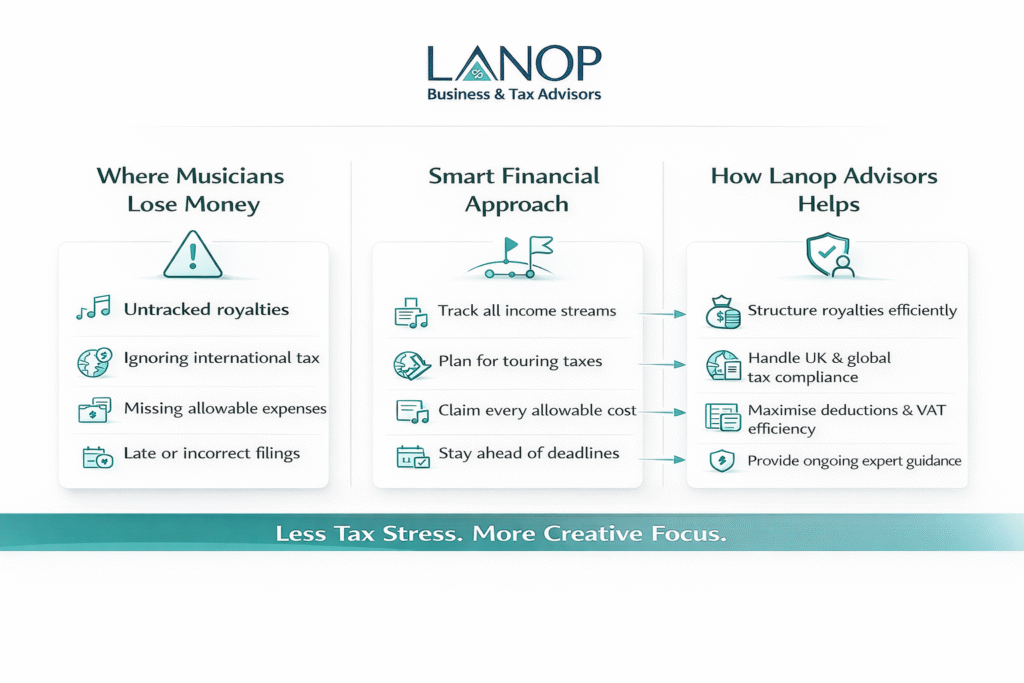
How Lanop Business & Tax Advisors Helps?
Icon: Shield / advisor
- Royalty tracking & tax-efficient income structuring
- UK & international touring tax compliance
- Expense optimisation & VAT guidance for musicians
- Proactive tax planning to reduce liabilities
- Ongoing support, HMRC compliance & advisory
Focus on Your Music. We Handle the Numbers.
Royalties, Touring & Tax: A Finance Guide for UK Musicians FAQs
How are music royalties taxed in the United Kingdom?
Royalties are treated as trading income by HMRC and must be declared on your Self Assessment tax return. Whether you earn from streaming, sync licensing, or publishing, all royalty income is subject to Income Tax and potentially National Insurance contributions. Keeping accurate records of every revenue stream is essential to avoid underpayment penalties.
Do I need to register as self-employed if I earn money from music?
Yes,if music is a source of income, HMRC requires you to register as self-employed, even if you also hold a salaried job. This applies to session musicians, songwriters, and performing artists alike. Registration must be done by 5 October following the end of the tax year in which you first earned income.
What expenses can UK musicians claim as tax deductions?
Musicians can deduct a wide range of allowable expenses including instrument purchases and repairs, studio hire, travel to gigs, marketing costs, and music software subscriptions. Clothing costs are only deductible if they are costumes exclusively for performance and not suitable for everyday wear. Always retain receipts and invoices to substantiate every claim.
How is touring income taxed when performing abroad?
Income earned from overseas performances is generally taxable in the country where the show takes place, and the UK also expects you to declare it. Many countries apply a Withholding Tax on performance fees paid to foreign artists before the money even reaches you. The UK has Double Taxation Agreements with numerous countries, which can prevent you from being taxed twice on the same earnings.
What is the difference between a PRS, PPL, and MCPS royalty, and are they all taxable?
PRS for Music collects performance and broadcast royalties for songwriters, PPL collects neighbouring rights royalties for performers and record labels, and MCPS handles mechanical royalties from physical and digital reproduction. All three are taxable income sources that must be reported to HMRC. Many musicians receive payments from multiple collection societies simultaneously, making consolidated record-keeping critical.
Conclusion: Strategy Over Compliance
Managing the finances of a music career is a marathon, not a sprint. The goal isn’t just to stay “compliant” with HMRC, the goal is to build a sustainable career where your money works as hard as your art does.
By separating your income, tracking every legitimate expense, and working with the specialist team at Lanop Business and Tax Advisors, you move from being a “starving artist” to a savvy creative professional. Don’t let the administrative burden quiet your creative voice. Plan your finances with the same precision you use to tune your instrument.
Ready to get your finances in harmony? Lanop Business and Tax Advisors brings together deep expertise in music industry taxation, royalty management, and touring finance giving UK musicians the clarity and confidence to focus on what they do best. Let’s talk about your specific music career goals today.
Visit More : widemagazine.co.uk
