
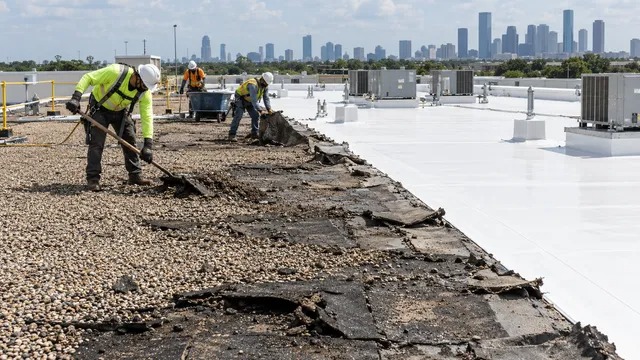
Houston’s commercial property market operates under a specific set of pressures that most other major cities don’t share in the same combination. Intense heat, high humidity, seasonal storm activity, and the ongoing cost of maintaining large-footprint buildings create a demanding environment for any roofing system. Over the past decade, building owners, property managers, and facilities teams across the region have been shifting toward a particular roofing material — not because of marketing trends or industry hype, but because the performance data from existing installations has been consistent enough to drive real operational decisions.
Thermoplastic polyolefin roofing, commonly known as TPO, has moved from being a recognized alternative to becoming the practical standard across warehouses, distribution centers, medical facilities, retail developments, and office complexes throughout the Houston metro area. This shift hasn’t happened overnight, and it hasn’t been driven by any single factor. It reflects a gradual accumulation of evidence from properties that have held up through summers that regularly push outdoor conditions past what most roofing systems were originally designed to manage.
Why TPO Has Gained Ground in the Houston Market
The decision to use tpo roofing houston projects isn’t typically made in isolation. It comes after property managers and building owners weigh the total cost of roof ownership — not just the installation price, but what happens over five, ten, and fifteen years. In a climate like Houston’s, where thermal cycling is extreme and moisture intrusion is a persistent concern, those long-term calculations tend to favor materials that can handle repeated stress without significant degradation.
TPO’s core advantage in this region is rooted in how the membrane behaves under sustained heat exposure. Unlike some single-ply systems that soften, crack, or lose adhesion integrity over time when subjected to prolonged high temperatures, TPO membranes maintain their structural properties through consistent thermal expansion and contraction cycles. This isn’t a minor operational detail — for a flat or low-slope commercial roof covering tens of thousands of square feet, membrane stability directly affects leak frequency, inspection costs, and the likelihood of interior damage to inventory, equipment, or occupied space.
Reflectivity as a Functional Property, Not Just an Efficiency Feature
Most TPO membranes are manufactured in white or light gray, which produces measurable surface reflectivity. In practical terms, this means that a significant portion of solar radiation bounces off the roof surface rather than being absorbed into the building envelope. For a Houston commercial building operating through a summer that can span five or six months of genuinely intense heat, this has a direct effect on cooling load.
The reduction in heat transfer through the roof deck means that HVAC systems serving the top floor or the space immediately below the roof are working against a lower thermal load. For large single-story facilities — distribution warehouses, manufacturing plants, or big-box retail — this effect extends across the entire occupied footprint. The Energy Star program, which maintains standards for reflective roofing products through the U.S. Environmental Protection Agency, has certified TPO membranes that meet specific reflectance and emittance thresholds, giving facility managers a consistent benchmark when evaluating products.
The operational implication for Houston properties is straightforward: reduced mechanical strain on cooling equipment, lower peak energy demand during the hottest months, and a longer service life for HVAC systems that no longer have to compensate for excessive radiant heat gain through the roof assembly.
Installation Compatibility with Houston’s Existing Building Stock
Houston’s commercial building stock is diverse in age, construction method, and structural capacity. Many properties in the industrial and suburban commercial corridors were built over several decades, which means they carry a range of existing roof assemblies — some in need of full replacement, others suitable for re-roofing over existing layers. TPO’s installation flexibility accommodates both scenarios without requiring significant structural modification.
The material can be mechanically attached, fully adhered, or ballasted depending on the substrate condition and the specific requirements of the structure below. This adaptability reduces the scope of work required before installation begins, which matters significantly for occupied properties where extended roof access or construction activity creates operational disruption. For a distribution facility that cannot tolerate inventory exposure or for a healthcare building where patient areas must remain functional, a roofing system that can be installed in defined phases with minimal interior impact is not a convenience — it is a requirement.
How Houston’s Climate Specifically Tests Commercial Roofing Systems
Understanding why tpo roofing houston installations have increased requires understanding what roofing systems are actually asked to do in this region. The Gulf Coast climate presents a combination of conditions that collectively place greater stress on roofing materials than either heat or moisture would create independently.
High ambient temperatures accelerate the aging process of many roofing materials. Ultraviolet exposure breaks down chemical bonds in organic materials over time. Humidity creates ongoing vapor pressure differentials that can push moisture into roof assemblies, particularly at seams, penetrations, and perimeter edges. Tropical storm systems — including hurricanes and tropical depressions — generate sustained wind uplift forces and driving rain that test both membrane adhesion and edge detail integrity. When all of these factors are present across the same roofing system, failure points tend to emerge at the weakest components first.
Seam Integrity Under Real Conditions
One of the more technically significant aspects of TPO’s performance in Houston is how its seams hold up over time. TPO membranes are joined using heat welding, a process that fuses the two membrane edges into a continuous bond rather than relying on adhesive or tape. When performed correctly by a trained installer, this creates a seam that is as strong as the membrane itself — meaning there is no inherent weak point at the joint.
This matters specifically in Houston because the most common failure modes for flat commercial roofs in storm-prone regions involve seam separation, lifting at perimeter edges, and water infiltration at points where different components of the roof assembly meet. A welded membrane system eliminates the adhesive degradation issue and reduces the number of seam failures that occur over the roof’s service life. For a property manager who has dealt with repeated interior water damage from seam failures on an older system, this is a meaningful shift in risk profile.
Performance Through Hurricane Season
Hurricane season creates a different kind of test than summer heat. Wind uplift is the primary structural concern, and the forces acting on a low-slope commercial roof during a significant storm event are substantial. The way a roofing system is attached to the deck — whether mechanically fastened, adhered, or a combination — determines how well it resists those uplift forces.
TPO systems can be specified and installed to meet wind uplift resistance requirements appropriate for Gulf Coast exposure categories. This is not a universal guarantee, and installation quality plays a central role in how any system performs in real conditions. But the material itself does not present the same wind vulnerability that some older built-up or modified bitumen systems show after years of thermal cycling have reduced the adhesion integrity of their surface layers.
The Role of Long-Term Cost Predictability
Commercial property decisions are rarely made on upfront cost alone. For tpo roofing houston applications specifically, the calculation that tends to close decisions involves lifecycle cost over a fifteen to twenty-year horizon — or in some cases, the expected hold period of the property itself.
A roofing system that requires frequent patching, annual inspections with significant repair expenses, or early replacement due to membrane degradation creates a cost profile that compounds over time. When facility managers compare the maintenance history of their existing roof against projected costs for a replacement, the unpredictability of a deteriorating system often becomes the deciding factor rather than the replacement cost itself.
TPO’s track record in comparable climates — and increasingly in Houston specifically — shows a maintenance profile that tends to be more consistent and less reactive than some alternative systems. Seams hold. Membranes retain their reflective properties longer than many earlier single-ply products. Surface cleaning restores performance levels that have declined due to debris accumulation. These characteristics don’t eliminate maintenance costs, but they make those costs more predictable — which allows facilities teams to plan and budget accurately rather than managing crisis expenditures.
What to Consider Before Committing to a TPO Installation
The growing adoption of tpo roofing houston projects reflects genuine performance data, but the material is not a universal solution that performs identically across all installation contexts. There are conditions under which other systems remain appropriate, and a proper evaluation should account for the specific characteristics of the building in question.
Key factors that influence whether TPO is the right choice for a specific property include:
• The condition and composition of the existing roof deck, which affects what attachment method is appropriate and whether a re-roof or full tear-off is required before installation can begin.
• The building’s occupancy type and tolerance for disruption during installation, since phased installation schedules require planning that should be established before work begins.
• The existing drainage configuration, because even the most durable membrane will fail prematurely if standing water accumulates due to inadequate slope or blocked drains.
• The quality and experience level of the installing contractor, since heat-welded seams require trained operators with properly calibrated equipment to achieve the bond strength that makes TPO’s performance claims valid.
• Local code requirements and any insurance carrier specifications that may affect the minimum wind uplift ratings required for the installation.
None of these considerations are arguments against TPO. They are the normal due diligence that any responsible roofing decision requires, regardless of the material selected.
Closing Perspective
The shift toward TPO across Houston’s commercial roofing market reflects something more durable than a product trend. It reflects accumulated operational experience from properties that have tested the material across the full range of conditions the Gulf Coast climate produces — heat, humidity, storms, and everything in between.
For building owners and facilities managers evaluating their next roofing decision, the pattern is worth understanding in full. TPO has not become a default choice because of how it is marketed. It has become a default choice because the properties that installed it have generally not needed to revisit the decision on an accelerated timeline. In commercial real estate, where roofing decisions carry significant financial weight and where unexpected failures create cascading operational consequences, that kind of consistency carries more weight than any specification sheet.
The right next step is a thorough assessment of the specific building — its deck condition, drainage performance, occupancy requirements, and exposure classification — before any material decision is finalized. TPO earns consideration on its merits. Whether it is the right choice for a particular building is a determination that should always be grounded in the specifics of that building rather than in general market trends.
