
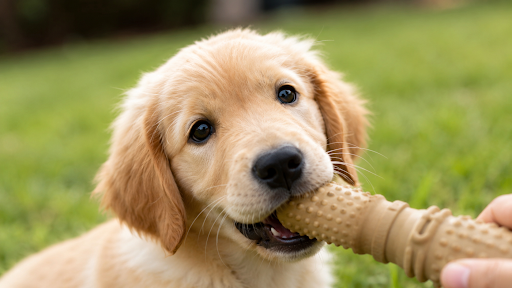
Stop Puppy Biting is one of the most reported frustrations in the first few months of ownership, and it catches a lot of people off guard because the puppy seems to be having the time of its life.
Most puppies learn this behaviour after just a few training sessions, as long as you stay consistent with your approach. Puppy mouthing and nipping are completely normal parts of early development, but that doesn’t mean you have to put up with teeth on skin indefinitely. The right response, repeated consistently, teaches bite inhibition faster than most owners expect.
Why Stop Puppy Biting In The First Place
Puppy play biting starts in the litter. Puppies learn how hard they can bite by reading the reactions of their siblings. That feedback loop is how bite inhibition naturally develops. When a puppy arrives in a human home, that same learning process continues, except now you’re the one providing the feedback.
Puppy biting peaks between twelve and sixteen weeks, coinciding with a critical developmental window for socialization and bite inhibition. This is also when teething ramps up and puppies explore everything with their mouths. Some bite more intensely when overstimulated or overtired, if your puppy escalates quickly from playful nipping to hard biting, a short calm-down period in a crate or pen can reset things within minutes.
The ASPCA is clear that stopping mouthing entirely should come second. The first priority is teaching a puppy that people have very sensitive skin, so he must be gentle when using his mouth. A puppy who skips this step never learns to recognize how easily human skin is hurt — and ends up biting too hard even during play.
Understanding the cause helps you pick the right response rather than reacting to every bite the same way. That consistency is what accelerates progress.
How to Get a Puppy to Stop Biting with Redirection
Redirection is the foundation of any positive reinforcement puppy training plan for biting. The moment teeth touch skin, calmly remove your hand and immediately offer a chew toy or tug toy instead. No yelling, no pulling away sharply — that actually increases arousal and encourages more nipping.
Keep a toy within reach in every room where you spend time with your puppy. That single habit makes redirect puppy biting easy to do consistently, which is what produces results. When the puppy takes the toy, let it chew and tug freely. The puppy learns that biting the toy gets the game to continue, while biting skin ends the interaction.
If your puppy ignores the toy and goes back to your hand, stand up, turn your back, and wait ten seconds before re-engaging. Most puppies figure out the pattern within three to five repetitions. Puppy training built on clear cause-and-effect moves quickly when the consequence is immediate and consistent.
For a full step-by-step breakdown, including what to do when redirection isn’t working yet, PawChamp’s guide on how to stop puppy biting covers the complete process, from first sessions through the more persistent cases.
Quick tips for redirecting puppy biting:
- Swap teeth on skin for a tug toy immediately — not after a warning
- Keep toys in every room so redirection is always within reach
- Turn your back for ten seconds if the puppy returns to your hand
- Let the puppy win with the toy — free chewing and tugging reinforce the right choice
- Stay calm throughout: raised energy escalates biting, not the other way around
The principle is simple: the toy wins, the hand doesn’t. Every repetition that follows that rule moves your puppy closer to a mouth it can trust.
Stop Puppy Biting Managing the Environment to Reduce Puppy Nipping
How you manage your puppy’s environment has a direct impact on how often biting happens. A tired, overstimulated puppy bites more. A puppy with an appropriate outlet for energy bites less.
Before each play session, make sure your puppy has had a chance to burn off some energy with a short walk or sniff session. Five focused minutes of sniffing in the garden tires a puppy out more effectively than ten minutes of high-energy chasing. Going into playtime already a little calmer means the puppy is less likely to tip into frantic nipping.
Puppy socialization also plays a role here. Puppies that have regular positive exposure to people, surfaces, and other dogs develop better impulse control over time. That broader social learning supports bite inhibition in ways that direct training alone can’t fully replicate.
Structured play sessions with a clear start and end also help. Teaching your puppy that play begins when you pick up the toy and ends when you put it away gives you a simple tool for managing arousal before it builds into hard biting. Puppies adapt to these routines faster than most owners expect.
When Puppy Biting Starts to Look Like Something More
Most puppy biting is enthusiastic, mouthy play from a young dog still learning the rules. Occasionally it comes with growling, stiff posture, or resource guarding and that combination is worth taking seriously.
Genuine aggression has distinct markers. A playful puppy usually has a loose, relaxed posture and a calm facial expression. A puppy in a temper tantrum may stiffen, expose teeth, or deliver bites noticeably more painful than typical play. Fatigue and pain can push a puppy in the same direction, so if intensity spikes at certain times of day or after handling, that’s worth noting.
These patterns don’t resolve on their own, and they’re not always easy to read without a framework.
PawChamp’s guide Why Is My Puppy So Aggressive? is built around exactly that. It includes a scored self-assessment quiz that places your puppy on a spectrum from normal arousal to patterns needing professional input, with a different action plan for each range.
The guide explains why fatigue, fear periods, and early socialization mistakes during the 8–12 week window can mimic or compound aggression. It also covers why corrections and yelling tend to intensify biting rather than reduce it — the most common mistake owners make when intensity increases.
For puppies in the normal-but-intense range, there’s a step-by-step redirection protocol applied specifically to escalating and overstimulated cases.
Signs that warrant closer attention:
- Biting that leaves marks or bruises, not just light mouthing
- Freezing or hard staring when you reach to touch or collar your puppy
- Growling that escalates rather than fades when play slows down
- Stiffening around food, toys, or sleeping spots on approach
- Inability to settle within five minutes after excitement
When biting intensifies despite consistent redirection, the cause is usually a management or reinforcement issue a professional can identify quickly. Early attention costs far less than correcting it later.
Building a Daily Habit with Bite Inhibition Training
Consistency beats intensity every time with puppies. A three-minute training slot twice a day produces better results than a single long session once in a while, because the puppy’s brain is making connections across many small repetitions spread through the day.
Manage puppy biting by keeping sessions short and ending them before the puppy gets frustrated or overtired. If you notice teeth coming out more frequently toward the end of a play session, that’s a signal to wrap up, not to push through. Stopping while things are still positive keeps the puppy’s association with training sessions strongly positive.
Tracking progress helps, especially in the first few weeks when the improvements can feel invisible day to day. PawChamp logs each training session and sends reminders, which makes it easier to stay on schedule when life gets busy. Watching the pattern across a week usually shows more progress than any single session suggests.
Puppy biting tips that work are almost always simple. Redirection, calm feedback, short sessions, and a consistent environment do more than any elaborate protocol. The habits you build in these first few weeks set the tone for how your dog handles excitement and frustration for years to come.
Once biting is under control, the next skill worth building is basic impulse control: teaching your puppy to pause before grabbing food, toys, or attention. That foundation makes every other area of training noticeably easier.
If puppy biting feels overwhelming right now, you’re far from alone. Almost every puppy owner goes through this stage, and while those sharp little teeth can test your patience, biting is a normal part of how puppies explore the world and learn self-control.
Key Takeaways
Puppy biting is a developmental stage, not a behavior problem. Most puppies significantly reduce biting between four and six months as bite inhibition develops with consistent training, noticeable improvement typically comes within a few weeks.
The method matters more than the effort. Calm, immediate redirection to a toy, repeated consistently by everyone in the household produces faster results than any correction-based approach.
Dr. Ian Dunbar, veterinarian and animal behaviorist, is unequivocal: teaching bite inhibition is the single most important item on the educational agenda of any puppy. Gentleness comes first. Stopping mouthing entirely comes second. That sequence is what makes the difference long-term.
For owners who want structured support beyond this stage, PawChamp covers the full lifecycle of dog ownership — from puppy foundations through adult behavior and senior care. Certified trainer-led programs, step-by-step training plans, and 24/7 access to dog behavior experts mean the guidance doesn’t stop when the biting does.
Every positive interaction is shaping the companion your puppy will become. This isn’t bad behavior — it’s a young dog learning how to be a dog. The consistency you build now carries through every stage that follows.
