
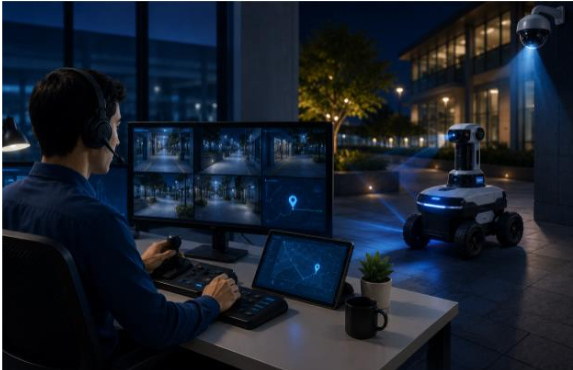
Security patrol robots are becoming an increasingly common sight in office buildings, warehouses, campuses, hospitals, and commercial facilities. Equipped with cameras, sensors, and artificial intelligence, these autonomous robots help organizations improve surveillance coverage, monitor large areas, and enhance overall security operations.
While security robots can perform many patrol functions independently, real-world environments often present situations that require human judgment and intervention. This is where remote robot operators play a critical role. Through teleoperation and monitoring services, trained operators provide the human oversight needed to ensure security robots operate safely, efficiently, and reliably.
The Rise of Security Patrol Robots
Organizations are investing in security robotics to supplement traditional security operations and improve facility monitoring. Security patrol robots can perform a variety of tasks, including:
Monitoring designated patrol routes
Capturing video footage
Detecting unusual activity
Monitoring restricted areas
Providing situational awareness
Supporting incident reporting
These robots help security teams maintain visibility across large facilities while reducing repetitive patrol tasks.
Challenges Faced by Security Robots
Although autonomous robots use advanced technologies to navigate and monitor environments, they can still encounter situations that require human assistance.
Common challenges include:
Unexpected obstacles
Crowded areas
Changes in patrol routes
Sensor limitations
Construction zones
Unusual environmental conditions
Situations requiring human judgment
Without human oversight, these situations could disrupt patrol operations or reduce the effectiveness of security monitoring.
What Do Remote Robot Operators Do?
Remote robot operators monitor security robots through live video feeds, sensor information, and operational dashboards. Rather than manually controlling robots at all times, operators supervise robot activity and provide support when necessary.
Responsibilities often include:
Monitoring live camera feeds
Reviewing sensor data
Responding to alerts
Assisting with navigation issues
Escalating incidents
Documenting operational events
This human-in-the-loop approach helps maintain consistent and reliable security operations.
Improving Security Coverage
Security robots can patrol large areas continuously, but remote operators help maximize their effectiveness by providing real-time oversight.
Operators can:
Verify alerts and notifications
Assess unusual situations
Monitor multiple robots simultaneously
Provide additional situational awareness
This combination of automation and human supervision strengthens overall security coverage.
Enhancing Incident Response
When a robot detects unusual activity, immediate evaluation is often necessary. Remote operators can quickly review camera feeds and determine the appropriate response.
Human oversight allows organizations to:
Investigate alerts faster
Reduce false alarms
Escalate security concerns efficiently
Improve response coordination
Faster incident assessment can help security teams act more effectively.
Supporting Safe Robot Operations
Security robots frequently operate in environments shared with employees, visitors, contractors, and customers. Human monitoring helps ensure robots navigate safely and appropriately.
Remote operators can assist when robots encounter:
Blocked pathways
Unexpected pedestrian traffic
Navigation challenges
Environmental changes
This support improves operational safety and reliability.
Managing Large Security Robot Fleets
Many organizations deploy multiple security robots across different facilities. Remote monitoring services make it possible to supervise numerous robots from a centralized operations center.
Benefits include:
Centralized oversight
Improved fleet visibility
Faster issue resolution
Consistent operational performance
Scalable security operations
Centralized monitoring supports efficient management of large robotic deployments.
Reducing Downtime and Operational Interruptions
Robot downtime can create gaps in security coverage and reduce the effectiveness of patrol operations. Remote operators help identify and address issues before they significantly impact performance.
Continuous monitoring supports:
Increased robot uptime
Faster troubleshooting
Improved patrol consistency
Better operational efficiency
Reliable robot performance helps organizations maintain stronger security programs.
Supporting the Future of Autonomous Security
As robotics technology continues to evolve, human oversight will remain an important part of security operations. Autonomous systems can perform routine tasks efficiently, but human operators provide the adaptability and decision-making capabilities needed for complex situations.
The combination of robotics and remote human support allows organizations to deploy security technologies with greater confidence and effectiveness.
Why Businesses Invest in Robot Teleoperation & Robot Monitoring
Many security technology providers and facility operators rely on professional Robot Teleoperation & Robot Monitoring services to provide human oversight for autonomous security systems. Dedicated remote operators monitor robot activity, review alerts, assist with navigation challenges, and help maintain continuous security operations.
Professional monitoring services enable organizations to scale robotic security deployments while maintaining reliability, safety, and operational efficiency.
Conclusion
Security patrol robots are transforming the way organizations monitor facilities and protect assets. However, remote robot operators play a vital role in ensuring these systems perform effectively in real-world environments.
By combining autonomous robotics with human oversight, organizations can improve security coverage, enhance incident response, reduce downtime, and support safer operations. For businesses seeking dependable support for autonomous security systems, professional Robot Teleoperation & Robot Monitoring services provide the expertise needed to maximize the benefits of robotic security technology.
Visit More : widemagazine.co.uk
