
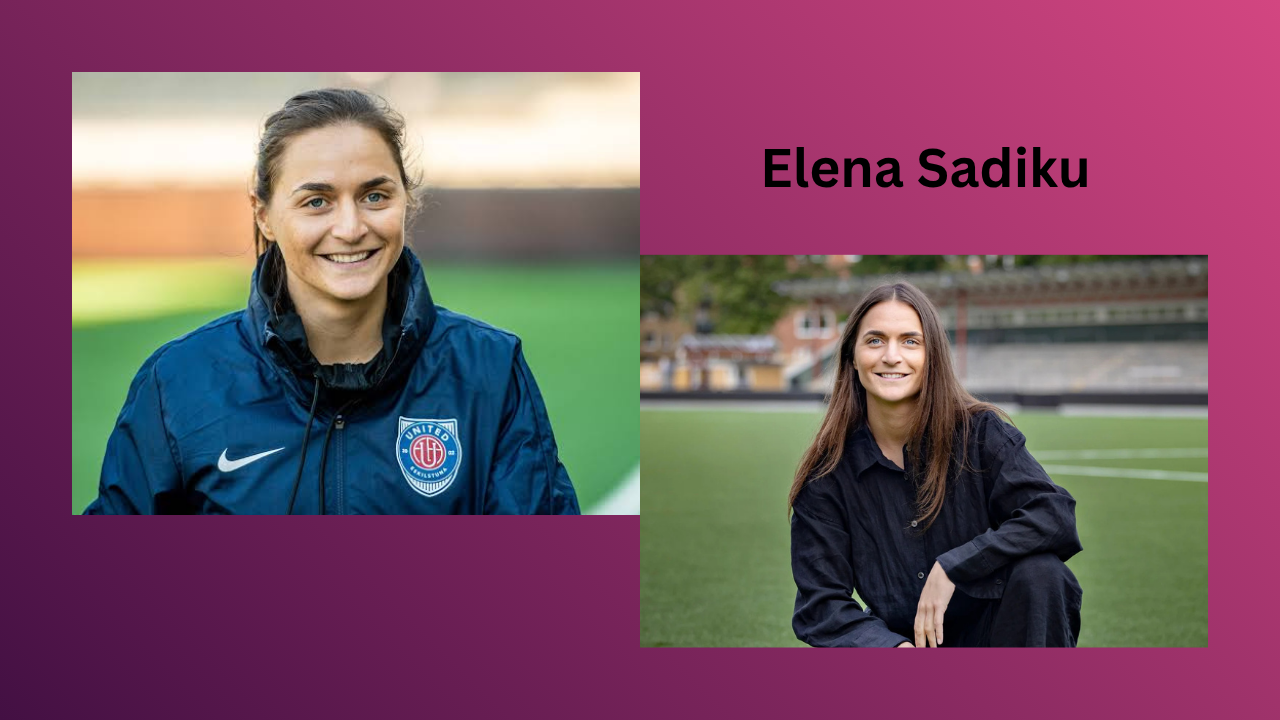
Elena Sadiku has built an impressive career in women’s football, progressing from a promising young player to a respected coach on the European stage. Born in Germany and raised in Sweden, Sadiku’s playing career was cut short by serious injuries, but the setback eventually redirected her towards coaching. Her determination, education and willingness to learn helped her establish herself as a coach at a remarkably young age. She later made history at Celtic before taking charge of Swedish club BK Häcken. This article explores Elena Sadiku’s age, partner, salary, career achievements and life story, while separating confirmed information from details that have not been publicly disclosed.
Who Is Elena Sadiku?
Elena Sadiku is a Swedish football coach and former player who has worked across several European countries. She was born on 6 November 1993 in Bocholt, Germany, and grew up in Sweden. As of August 2026, Elena Sadiku’s age is 32. Her football journey began when she was young, and she eventually progressed through Sweden’s youth football system before representing Sweden at under-19 level.
Sadiku’s playing career included spells with clubs such as LdB Malmö, Kristianstad, Eskilstuna United and Hammarby. However, recurring knee injuries eventually forced her to stop playing competitively. Rather than ending her involvement in football, the experience became a turning point. She moved into coaching and gradually developed a career that would take her from academy football to senior management.
Her rise has been particularly notable because of how quickly she moved into significant coaching positions. UEFA has highlighted her development through coaching education and support programmes, including her work towards obtaining her UEFA Pro Licence.
Elena Sadiku Age and Early Life
Elena Sadiku was born on 6 November 1993. Although she was born in Germany, she grew up in Sweden, where football became an important part of her childhood. Celtic’s official profile notes that she became involved in football from a young age and entered the playing pathway at around 16.
Her early years helped establish the foundation for a career that would eventually span playing, coaching and leadership. She represented Sweden at under-19 level, gaining international experience before focusing increasingly on club football.
Her background has also contributed to her perspective as a coach. Moving through different environments and experiencing both the positive and difficult sides of professional sport gave Sadiku an understanding of the pressures faced by players. This experience later became valuable when she began working with developing footballers and senior teams.
Elena Sadiku’s Playing Career
Before becoming known as a coach, Sadiku was a professional footballer. She began her senior career with LdB Malmö, now known as FC Rosengård, and subsequently played for Kristianstad, Eskilstuna United and Hammarby. She also represented Sweden’s under-19 team.
Her playing career was unfortunately affected by major knee problems. A serious injury in 2014 kept her out for a prolonged period. After returning to action, she suffered further damage, and another ACL injury later contributed to the premature end of her playing career.
Sadiku ultimately retired from playing in her early twenties. UEFA describes her career as having been cut short by injury at the age of 23. The experience could have marked the end of her involvement in professional football, but instead it pushed her towards a new direction.
The Transition From Player to Coach
Sadiku began coaching soon after retiring. One of her early coaching positions came with the Hammarby academy, where she started gaining experience working with developing players. She then moved abroad and worked as an assistant coach with Beijing BG Phoenix in China.
After her time in China, Sadiku returned to Sweden and became involved with Rosengård. She worked within the academy structure before moving into the women’s first-team environment. She also gained experience working alongside established coaches, helping her develop her tactical and managerial knowledge.
Her next important opportunity came with Fortuna Hjørring in Denmark. She initially worked as an assistant before taking on a senior coaching position. She later managed Eskilstuna United, adding further experience to her growing coaching résumé.
Elena Sadiku’s Career at Everton
Sadiku’s career continued to develop internationally when she moved to England. In 2023, she joined Everton’s women’s setup, working with the club’s academy. This role gave her experience in the English football environment and allowed her to work with younger players.
The position was an important step because it came before her breakthrough at Celtic. By this stage, Sadiku had already worked in Sweden, China, Denmark and England, giving her a broad coaching background for someone still in her twenties.
Her progression demonstrated that her career was not based on a single opportunity. Instead, she built her reputation through a series of coaching roles, education and experience across different football systems.
Elena Sadiku at Celtic
One of the defining chapters of Sadiku’s career began in January 2024, when she became head coach of Celtic’s women’s team. Celtic described her appointment as historic because she became the club’s first female head coach of the women’s side.
The appointment quickly proved significant. Just a few months after taking charge, Sadiku guided Celtic Women to their first Scottish Women’s Premier League title. The club secured the championship in May 2024 after a dramatic final stage of the season.
The achievement was particularly important for both Sadiku and Celtic. It showed that the young coach could handle the pressure of managing a major club while delivering results in a competitive domestic league.
During her Celtic tenure, she also helped the team reach the UEFA Women’s Champions League group stage, another major milestone for the club. UEFA described her time at Celtic as a period in which she led the team to its first Scottish championship and a debut Champions League group-stage appearance.
Elena Sadiku and BK Häcken
After leaving Celtic in December 2025, Sadiku moved back to Sweden to take charge of BK Häcken. Celtic confirmed her departure on 22 December 2025, stating that she was leaving to pursue a new opportunity.
Her move to Häcken represented another important stage in her career. Returning to Swedish football as a senior head coach allowed her to apply the experience she had gained abroad.
The move quickly produced significant results. UEFA reported that Sadiku led Häcken to victory in the 2025/26 UEFA Women’s Europa Cup, marking another major achievement in her developing managerial career.
This success further strengthened her reputation as one of the younger coaches making an impact in European women’s football.
Elena Sadiku Salary: How Much Does She Earn?
Elena Sadiku’s exact salary has not been publicly confirmed by reliable sources. Unlike some high-profile men’s football managers, the contractual earnings of women’s football coaches are often not publicly disclosed in detail.
There are online claims and estimates concerning Sadiku’s salary, but these should be treated carefully because they are not supported by an official Celtic, Häcken or other authoritative salary disclosure. A precise figure would therefore be speculative.
Her earnings are likely influenced by factors such as her coaching experience, club level, contract terms, bonuses and performance-related incentives. Her career progression—from academy coaching to senior management and European competition—would naturally affect her professional value, but it would be inappropriate to present an unverified figure as her confirmed salary.
For readers searching for Elena Sadiku salary, the safest conclusion is that no dependable public source currently establishes her exact annual income.
Elena Sadiku Partner and Personal Life
Interest in Elena Sadiku’s partner is understandable given her growing public profile, but there is limited reliable information available about her private relationships.
Sadiku has generally maintained a relatively professional public profile, with much of the available coverage concentrating on football, coaching development and her career achievements. Major club profiles and UEFA coverage focus primarily on her work rather than providing details about a spouse or romantic partner.
Because there is no reliable public confirmation of a current partner, it would be misleading to identify someone based on online speculation. Her relationship status should therefore be considered private or publicly unconfirmed unless Sadiku herself chooses to disclose such information.
This distinction is important when discussing public figures. A lack of publicly confirmed information does not mean that a person has no partner; it simply means there is insufficient reliable information to state who that person might be.
Elena Sadiku’s Coaching Philosophy and Development
One of the most interesting aspects of Sadiku’s career is her commitment to coaching education. UEFA has highlighted the importance of her coaching licences and professional development. Sadiku has spoken about how education, licences and exchanging knowledge with other coaches have helped her continue improving.
Her experience as a former player also gives her an understanding of the demands placed on athletes. Having personally experienced serious injuries and the uncertainty surrounding a playing career, she has experienced the emotional and professional challenges that can accompany elite sport.
Her coaching journey also demonstrates the value of gaining experience at different levels. Academy football, assistant coaching, senior management and international environments have all contributed to her development.
Major Achievements in Elena Sadiku’s Career
Sadiku’s coaching career has already produced several important milestones despite her relatively young age. Her achievements include becoming Celtic Women’s head coach, winning Celtic’s first Scottish Women’s Premier League title and helping the club reach the Women’s Champions League group stage.
Her later move to BK Häcken brought another major accomplishment when the Swedish club won the 2025/26 UEFA Women’s Europa Cup under her leadership.
These achievements are especially notable when considered alongside her difficult transition from player to coach. Rather than allowing repeated injuries to define her career, Sadiku built an entirely new professional identity and continued moving into increasingly influential roles.
What’s Next for Elena Sadiku?
At 32, Elena Sadiku still has considerable time to develop her coaching career further. Her experiences in Sweden, China, Denmark, England and Scotland have given her exposure to different football cultures and coaching approaches.
Her work at BK Häcken represents another opportunity to establish herself at the highest level of European women’s football. Winning a major UEFA competition so early in her managerial career has also raised expectations for what she might accomplish next.
If her career continues on its current trajectory, Sadiku could become an increasingly prominent figure in European football management. Her combination of playing experience, coaching education, international exposure and leadership experience provides a strong foundation for future opportunities.
Final Thoughts on Elena Sadiku
Elena Sadiku’s story is ultimately one of resilience and reinvention. A promising playing career was interrupted by serious injuries, but instead of walking away from football, she transformed herself into a coach. Her journey through academy football, assistant roles and senior management eventually led to historic success at Celtic and European silverware with BK Häcken.
For those searching for Elena Sadiku age, she was born on 6 November 1993 and is 32 years old in 2026. Regarding Elena Sadiku partner, no reliable public information confirms a current relationship. As for Elena Sadiku salary, her exact earnings have not been officially disclosed, making online salary estimates difficult to verify.
What is much clearer is her professional record. From overcoming career-threatening injuries to winning major honours as a coach, Sadiku has already created a distinctive career story. Her continued development at BK Häcken will be an important chapter in what remains a relatively young but increasingly accomplished coaching career.
