
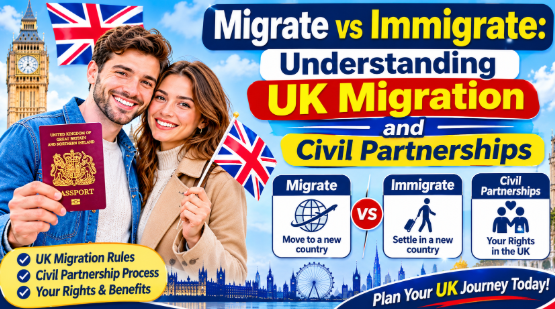
Moving to another country can involve important personal, legal and practical decisions. People relocate for employment, education, family relationships, business opportunities or a better quality of life. During this process, understanding immigration terminology is essential, particularly when completing official documents or researching legal requirements. One common question is migrate vs immigrate, as these words are often used interchangeably despite having different meanings. Understanding the distinction can help individuals describe their circumstances accurately, understand official immigration information and make better decisions when planning a move to the United Kingdom.
The UK attracts people from many countries who want to establish new lives, pursue professional opportunities or reunite with family members. Some arrive through employment routes, while others apply for family visas, student permission or other immigration categories. Each route has specific requirements that applicants must understand before submitting an application.
Relationships can also influence immigration decisions. Couples who want to live together in Britain may consider marriage, civil partnership or an eligible unmarried partner route. Understanding the legal differences between these arrangements is important because relationship status can affect which family immigration category is available.
This article explains the difference between migration and immigration, explores the main types of international movement and introduces civil partnerships in the UK, including their legal meaning, registration requirements and relevance to family visa applications.
1. Understanding the Meaning of Migration
Migration refers broadly to the movement of people from one place to another, usually to establish a new place of residence.
It can happen within a country or across international borders. People may migrate temporarily or permanently depending on their circumstances and objectives.
There are several common reasons why people migrate:
- Employment and career development.
- Higher education and professional training.
- Family reunification.
- Marriage or partnership.
- Business and investment opportunities.
- Safety and protection.
- Retirement or lifestyle changes.
Migration is not limited to people moving between countries. Someone relocating from Birmingham to Manchester is also migrating, even though they remain within the United Kingdom.
The term is widely used in population studies, government statistics and discussions about demographic changes.
According to the Office for National Statistics, long-term international migration estimates generally consider people who move to another country for at least 12 months. This statistical definition helps distinguish long-term relocation from ordinary holidays and short visits.
2. What Is the Difference Between Migrate, Immigrate and Emigrate?
Although these three words describe related activities, they focus on different aspects of movement.
Migrate
Migrate is the general term for moving from one place to another.
It can describe domestic or international movement and does not necessarily identify a particular destination or starting point.
Example:
A family moving from one city to another for employment has migrated to a new location.
Immigrate
Immigrate describes entering another country to live there.
The emphasis is on the destination country.
For example, someone moving from Pakistan to the United Kingdom to establish a new life has immigrated to the UK.
Emigrate
Emigrate describes leaving one’s home country to settle somewhere else.
The emphasis is on the country being left.
For example, someone leaving India to establish permanent residence in Britain has emigrated from India.
Understanding the Difference Through Examples
| Situation | Appropriate term |
| Moving from London to Manchester | Migrate |
| Moving from Pakistan to the UK | Immigrate to the UK |
| Leaving Pakistan to settle abroad | Emigrate from Pakistan |
| Moving from France to Canada | International migration |
| Leaving the UK to settle in Australia | Emigrate from the UK |
These distinctions are particularly useful when completing forms, reading government reports or discussing international relocation.
3. Why Migration and Immigration Are Important in the UK
The United Kingdom has a long history of international migration.
People have moved to Britain for employment, education, family connections and other personal reasons. International movement has contributed to the country’s workforce, cultural diversity and population development.
Today, people can enter the UK through several immigration routes, depending on their circumstances.
Some of the main categories include:
Work immigration: Individuals with qualifying employment opportunities may apply through eligible work visa routes.
Family immigration: Eligible spouses, partners, children and other qualifying relatives may apply to join family members in the UK.
Student immigration: International students can apply for permission to study at approved educational institutions.
Visitor immigration: Eligible individuals can visit Britain temporarily for tourism, family visits and permitted business activities.
Protection routes: Individuals seeking international protection may apply under the relevant asylum and humanitarian arrangements.
It is important to understand that migration terminology does not automatically determine someone’s legal status. A person may be described as an immigrant in everyday language while holding a student visa, work visa, settlement status or British citizenship.
The legal rights of an individual depend on their nationality, immigration permission and the rules applicable to their circumstances.
4. Important Considerations Before Moving to the UK
Relocating to Britain requires preparation, particularly when someone intends to remain for an extended period.
Before making arrangements, individuals should consider several important factors.
Choosing the Correct Visa Category
The first step is identifying the appropriate immigration route.
Someone moving for employment may need a work visa, while a person joining their spouse may need a family visa.
Selecting an unsuitable category can lead to delays or refusal.
Understanding Financial Requirements
Certain immigration routes require applicants to demonstrate that they meet specific financial conditions.
Depending on the visa category, evidence may include employment income, savings, sponsorship arrangements or other qualifying financial resources.
Preparing Educational and Employment Records
People relocating for professional reasons may need educational certificates, employment references, professional qualifications or other relevant documents.
Arranging Accommodation
Finding suitable accommodation is another important part of relocation.
Applicants should understand any accommodation requirements associated with their particular immigration route.
Understanding Daily Living Costs
Housing, transportation, food, utilities and other expenses can differ significantly between UK cities.
Preparing a realistic budget can help newcomers manage their finances after arrival.
5. Understanding Different Relationship Arrangements in the UK
Relationships can play an important role in immigration decisions.
People who want to establish a life together in Britain may choose different legal arrangements depending on their personal circumstances and preferences.
The main relationship arrangements relevant to UK family immigration include:
- Marriage.
- Civil partnership.
- Unmarried partnership.
Although these arrangements can provide different legal rights and responsibilities, each may be relevant to certain family immigration applications.
Marriage is a legally recognised relationship between two people. A civil partnership is another formal legal arrangement that provides recognised rights and responsibilities to the registered partners.
An unmarried partner may also qualify under the relevant immigration rules if the relationship satisfies the required conditions.
Understanding these options can help couples identify which legal arrangement best reflects their circumstances.
6. What Is a Civil Partnership in the United Kingdom?
A civil partnership is a legally recognised relationship between two people who formally register their partnership under the applicable legislation.
People researching what is a civil partner should understand that a civil partnership is more than an informal relationship or private agreement. It creates a recognised legal status and gives partners important rights and responsibilities.
Civil partnerships were originally introduced in the UK to provide same-sex couples with a formal legal relationship.
The law has since changed, and opposite-sex couples can also enter civil partnerships.
A civil partnership is formed through a legal registration process. Once registered, the two individuals become civil partners under the relevant law.
Civil partnerships can provide legal recognition in several areas, including:
- Financial responsibilities.
- Inheritance rights.
- Pension arrangements.
- Property and financial matters.
- Next-of-kin recognition.
- Certain tax and legal responsibilities.
The exact legal consequences depend on the applicable legislation and individual circumstances.
7. Who Can Enter a Civil Partnership in the UK?
Civil partnership laws allow eligible couples to formalise their relationships.
In England and Wales, both same-sex and opposite-sex couples can register a civil partnership.
Similar arrangements are available in Scotland and Northern Ireland under their respective legal frameworks.
However, couples must satisfy the applicable eligibility requirements before registration.
Generally, individuals must:
- Be at least 18 years old.
- Not already be married or in another civil partnership.
- Not be closely related within prohibited degrees.
- Have the legal capacity to enter the partnership.
- Follow the applicable registration procedure.
People planning to register a civil partnership should check the requirements in the part of the UK where they intend to complete the process.
Some couples may also need to consider immigration status or residence-related requirements when giving notice.
8. How Does a Civil Partnership Differ From Marriage?
Civil partnership and marriage are both legally recognised relationships, but they are formed through different legal procedures.
Formation
Marriage generally involves a formal marriage ceremony or an approved legal procedure.
A civil partnership is created through registration under civil partnership legislation.
Legal Recognition
Both arrangements provide important legal recognition and responsibilities.
The precise rights and procedures can depend on the jurisdiction and the circumstances of the couple.
Terminology
People who enter a marriage are described as spouses or married partners.
People who register a civil partnership are known as civil partners.
Ending the Relationship
A marriage normally ends through divorce or annulment.
A civil partnership generally ends through a legal dissolution or annulment.
Conversion
In England and Wales, certain civil partnerships can be converted into marriages through the applicable legal process.
Couples should consider their preferences and understand the legal consequences before selecting either arrangement.
9. How to Register a Civil Partnership in the UK
Registering a civil partnership involves several stages.
Although the detailed procedure differs across the UK, the general process includes the following steps.
Step 1: Check Eligibility
Both individuals should confirm that they meet the legal requirements.
They should also ensure that neither person is already married or in a legally recognised civil partnership.
Step 2: Choose a Registration Location
Couples should decide where they want to register their partnership.
This may be at a register office or another approved venue, depending on local rules.
Step 3: Give Notice
Both individuals generally need to give formal notice to the relevant registration authority.
The required notice period is normally at least 28 clear days, although additional Home Office referral procedures can extend this period in certain cases.
Step 4: Provide Supporting Documents
The registration authority may request documents such as:
- Passports or accepted identification.
- Proof of address.
- Evidence of immigration status.
- Details of previous marriages or civil partnerships, where relevant.
- Documents relating to name changes.
Additional documents may be necessary depending on individual circumstances.
Step 5: Register the Partnership
Once the legal requirements have been satisfied, the couple can complete the registration process.
They will receive an official civil partnership certificate as evidence of their legal relationship.
10. Can a Civil Partnership Help With a UK Partner Visa?
A legally recognised civil partnership can be relevant to certain UK family immigration applications.
The UK Immigration Rules recognise civil partners as an eligible partner category for applicable family and other immigration routes.
This means that an individual in a valid civil partnership with an eligible British or settled sponsor may be able to apply for permission to join or remain with their partner in Britain.
However, entering a civil partnership does not automatically provide immigration permission.
Applicants must still meet the requirements of the relevant visa category.
These may include:
- Evidence that the civil partnership is legally recognised.
- Evidence that the relationship is genuine and continuing.
- Confirmation that both partners meet the age requirements.
- Evidence that previous relationships have permanently ended.
- Compliance with applicable financial conditions.
- English language evidence where required.
- Other suitability and eligibility requirements.
For couples whose partnership was registered overseas, the Home Office must also be satisfied that the relationship is recognised under the applicable rules.
The Immigration Rules contain specific requirements relating to partner relationships, including civil partnerships, and should be checked before submitting an application.
11. Civil Partners and Unmarried Partners: Understanding the Difference
A civil partnership and an unmarried partnership are not the same legal arrangement.
Civil partners have formally registered their relationship under the applicable legislation.
Unmarried partners have not entered a marriage or registered civil partnership, even if they have been together for several years.
Under the current UK partner immigration rules, an unmarried partner may qualify if the relationship has been similar to a marriage or civil partnership for at least two years before the application, subject to the applicable requirements.
The Home Office also assesses whether the relationship is genuine and continuing.
Evidence may include:
- Joint tenancy agreements.
- Shared household bills.
- Joint financial records.
- Evidence of living together.
- Communication records.
- Photographs and travel records.
- Other documents showing the development of the relationship.
The exact evidence needed depends on the circumstances.
Couples should not assume that registering a civil partnership is the only way to qualify for a UK partner visa.
12. Documents Required for a Civil Partner Visa Application
Individuals applying through a civil partnership may need to provide several documents to demonstrate their eligibility.
Common examples include:
Identity documents: Valid passports and other accepted identification.
Civil partnership certificate: Official evidence that the partnership has been legally registered.
Relationship evidence: Documents demonstrating that the relationship is genuine and continuing.
Financial documents: Relevant income, savings or other evidence required under the applicable family visa rules.
Accommodation evidence: Information showing that suitable accommodation is available where required.
English language evidence: An approved qualification or another accepted form of evidence, unless an exemption applies.
Immigration history: Previous visa decisions and relevant immigration records.
Applicants should review the official document checklist for their specific route before submitting their application.
13. Common Mistakes When Planning Immigration Through a Relationship
Couples sometimes experience immigration difficulties because they misunderstand the legal requirements or submit incomplete evidence.
Some common mistakes include:
Assuming registration guarantees a visa: A civil partnership establishes a legal relationship but does not automatically provide permission to live in the UK.
Using an unsuitable visa category: Applicants should identify the immigration route that matches their circumstances.
Providing insufficient relationship evidence: A civil partnership certificate may establish the legal relationship, but additional evidence may be required to demonstrate that the relationship is genuine and continuing.
Ignoring financial requirements: Applicants must satisfy the relevant financial conditions where applicable.
Failing to disclose previous relationships: Previous marriages or partnerships may need to be documented, including evidence that they have legally ended.
Relying on outdated information: Immigration rules and registration procedures can change.
Careful preparation can help couples identify potential problems before submitting an application.
14. The Importance of Professional Immigration Guidance
Immigration applications involving family relationships can become complicated, particularly when couples have registered partnerships overseas, have previous immigration refusals or have different nationalities.
Professional guidance can help individuals understand which rules apply and what documents are required.
An appropriately authorised immigration professional may assist with:
- Reviewing the couple’s immigration circumstances.
- Assessing whether an overseas civil partnership is recognised.
- Identifying the correct family visa route.
- Reviewing relationship evidence.
- Understanding financial requirements.
- Preparing supporting documentation.
- Responding to refusal decisions where appropriate.
Anyone seeking regulated UK immigration advice should check that their solicitor or adviser is authorised to provide it.
Professional advice cannot guarantee approval, but it can help applicants understand their legal position and prepare more carefully.
Frequently Asked Questions
1. What is the difference between migrate and immigrate?
Migrate is the general term for moving from one place to another. Immigrate specifically describes moving into another country to live there.
2. What does emigrate mean?
Emigrate describes leaving one’s home country to establish residence somewhere else. For example, someone moving from India to the UK emigrates from India.
3. What is a civil partner in the UK?
A civil partner is someone who has entered a legally registered civil partnership with another person under the applicable UK legislation.
4. Can opposite-sex couples enter a civil partnership in the UK?
Yes. Opposite-sex couples can register civil partnerships in England and Wales, Scotland and Northern Ireland, subject to the applicable legal requirements.
5. Is a civil partnership the same as marriage?
No. Both are legally recognised relationships, but they are formed through different legal procedures and have different terminology. They provide many similar legal protections and responsibilities.
6. Can civil partners apply for a UK spouse or partner visa?
Yes. A person in a qualifying civil partnership may apply through the relevant partner immigration route if the sponsor and applicant meet all applicable requirements.
7. Is a civil partnership certificate enough for a UK partner visa?
Not necessarily. The certificate provides evidence of the registered relationship, but applicants may also need to provide financial, identity, English language and other supporting documents.
8. Can an overseas civil partnership be recognised in the UK?
An overseas civil partnership may be recognised if it meets the applicable legal requirements. Recognition depends on the law under which it was registered and the relevant UK rules.
Conclusion
Understanding the difference between migration, immigration and emigration helps individuals communicate more accurately about international movement and relocation.
Similarly, understanding civil partnerships is important for couples considering a formal legal relationship in the United Kingdom. Civil partnerships provide legal recognition and can be relevant to family immigration applications, provided the applicable requirements are satisfied.
Whether someone is planning to move to Britain, register a civil partnership or join a partner through a family visa, accurate information and proper preparation are essential.
Checking official guidance, maintaining reliable documentation and seeking appropriately regulated professional advice when necessary can help individuals make informed decisions about their immigration and relationship plans.
