
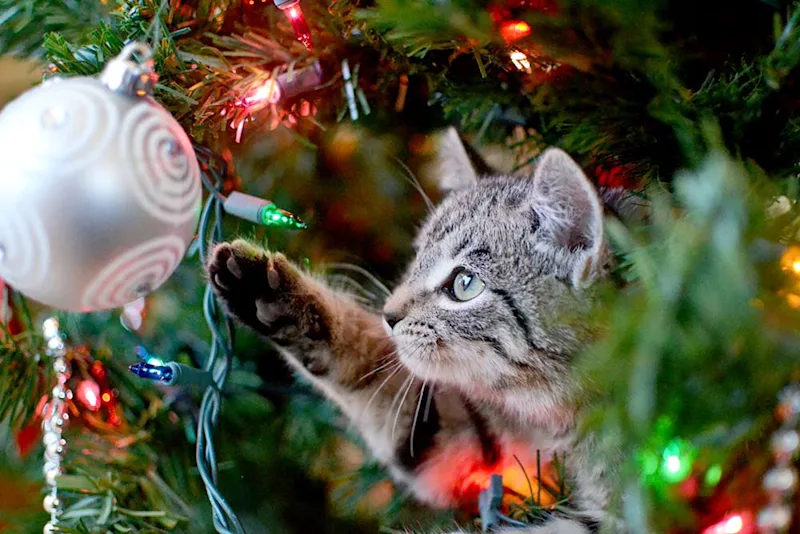
Every December, somewhere in Britain, a cat takes a run at a Christmas tree and brings the whole thing down. It is a reliable seasonal genre online and a reliably expensive morning for whoever has to sweep up the baubles.
It is also, in a few specific ways, genuinely dangerous. Here is why cats do it, which parts of the tree are worth worrying about, and which of the usual remedies are worth bothering with.
Why the tree is irresistible
Three things are happening at once.
A cat reads a Christmas tree as vertical territory. Cats climb to feel safe, and a new structure two metres tall appearing in the living room is an upgrade nobody asked them about but which they will certainly take.
The decorations move. Anything that dangles, catches the light and swings when touched sets off the same response as something small and alive. This is not naughtiness. It is the animal doing what it is built to do.
And the trunk is scratchable. Cats scratch upright surfaces to leave scent, stretch out the spine and shed the worn outer layer of claw. A rough, bark-covered column standing in the middle of the room is close to exactly the thing they have been looking for.
The parts that actually matter
Most tree damage is irritating rather than serious. Four things are not.
Tinsel and ribbon are the main one. If a cat swallows a long thin strand, the intestine can bunch along it, and that is a surgical emergency rather than something that passes on its own. Vets see it every year. The simplest answer is not to have tinsel in the house.
Lilies are the other. They turn up in Christmas bouquets and they cause kidney failure in cats. Pollen landing on the fur and licked off during grooming is enough. No part of the plant is safe, and there is no safe amount.
The water in the tree stand often has preservative in it, and standing water at floor level is exactly the sort of thing a cat will drink from. Cover it.
And the cables. A chewed string of lights is an electrical burn at best.
What works
Anchor the tree before you decorate it. Fishing line from the top third to a hook or a curtain rail costs almost nothing and turns a falling tree into a leaning one.
Leave the bottom third bare. Everything breakable, everything shiny and everything small enough to swallow goes above cat height. The tree looks slightly odd for about a day and then you stop noticing.
Bring the tree in bare and leave it a few days before decorating it. Much of the appeal is novelty, and novelty fades if nothing interesting happens.
Then redirect rather than deter, which is the part most people skip and the part that works. A cat going for the tree wants height and something to scratch, so the reliable fix is to put a better version of both in the same room. A cat scratching post tall enough for the cat to stretch out fully against, placed within sight of the tree, takes most of the pressure off inside a fortnight. Height matters more than price. A post a cat cannot stretch out on will be ignored, however much it cost.
What does not work
Shouting. The cat learns not to climb the tree while you are in the room.
Spray bottles. The same problem, and it costs you the thing you actually want, which is a cat that is relaxed around you.
Citrus peel and foil at the base get recommended every December. Some cats dislike both, plenty are unbothered, and neither does anything about why the cat wants to be up there in the first place. Try them by all means, but do not rely on them.
The tree will probably still get climbed once. The aim is a cat that has a look and moves on, rather than one that has decided it is the best thing in the house.
Visit More : widemagazine.co.uk
