
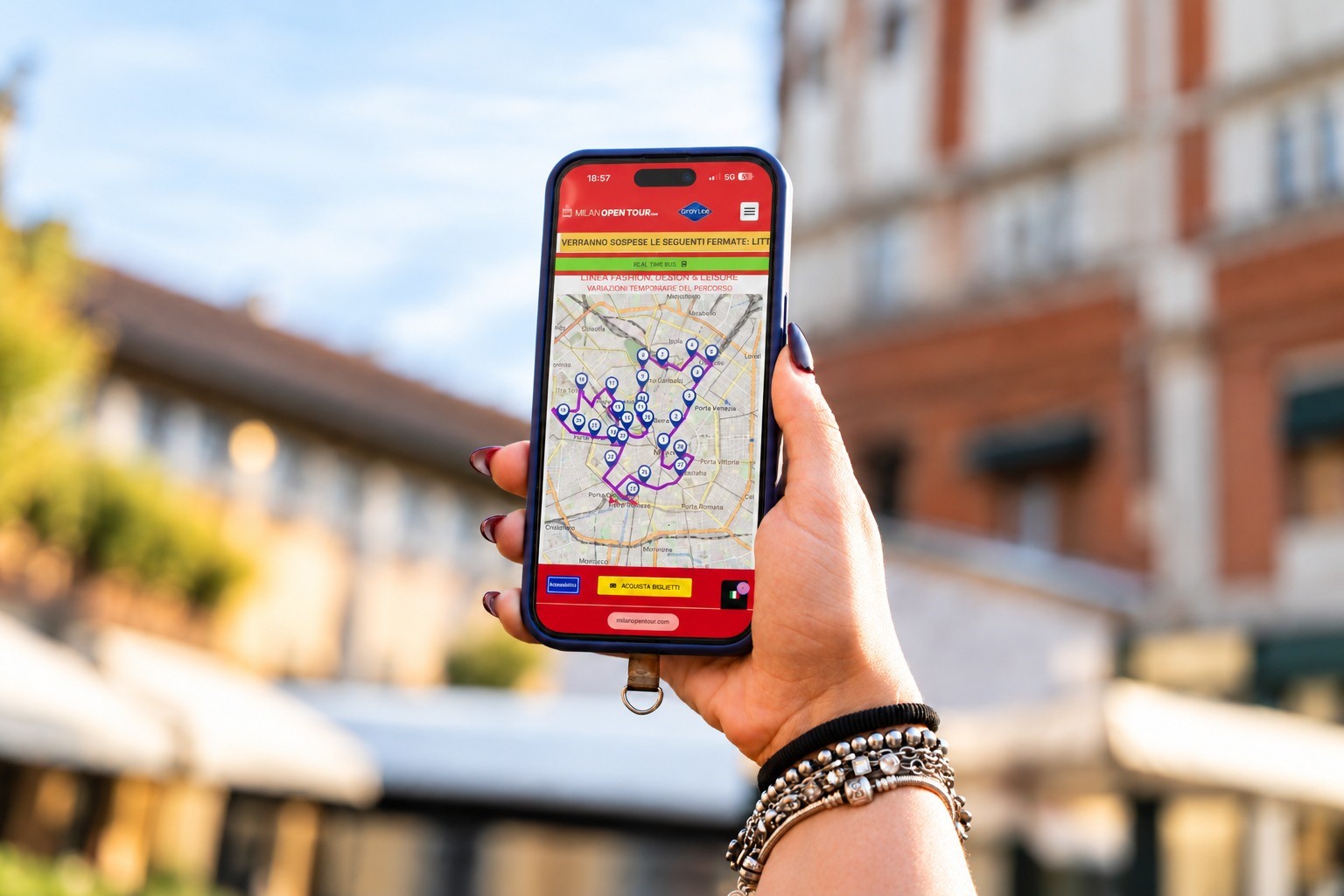
The evening before the tour, the scene rarely changes: phone in hand, route map open, a finger tracing the coloured lines and counting the dots. That is when the day gets decided, often without anyone noticing. A Milan hop on hop off route map holds more information than a first glance reveals, and anyone who looks no further than the number of stops risks picking the right line for the wrong reasons, or the wrong line for the right ones. The useful question is a different one: what should you actually look for on that map to know where to get off?
Why the Shape of the Route Matters More Than the Number of Stops
Counting stops seems to measure what a line is worth: more dots, more city. But a stop only earns its place if it sits close to somewhere you genuinely want to see. Milan does not gather around a single centre from which everything is within walking distance. Around the historic core lie neighbourhoods with their own character, from the canals of the Navigli to the skyscrapers of Porta Nuova, from the streets of Brera to the towers of CityLife, and each one asks for a different amount of time. A line linking them in sequence draws a distinct shape on the map: a tight loop around the centre, or a wide sweep that pushes outwards. It is that shape, far more than any tally, that tells you whether the route passes the places you care about. The next step is learning to read it when there are three lines to compare.
A Detailed Milan Hop On Hop Off Route Map Makes the Three Lines Easier to Compare
Side by side, the three sightseeing lines tell different stories about the city. Fashion, Design & Leisure leans towards the canals and contemporary architecture, Milan Highlights stays close to the historic heart and its monuments, and Sporting follows the city’s passion for football and racing. On paper, that difference in theme becomes a difference in direction. Following all three routes on a detailed Milan hop on hop off route map lets you decide in advance where to get off, rather than working it out from the upper deck after the bus has pulled away. Anyone with the famous monuments of the centre in mind soon realises they are not what separates one line from another: the choice depends more on the outer districts than on the centre. First, though, the map reveals one detail straight away: at certain points the three routes meet.
Stops That Appear on All Three Lines Make a Safe Bet for a First Visit
Sforza Castle and The Last Supper sit on the route of all three lines, and so does Piazza del Duomo, where every line begins and ends. The castle and Santa Maria delle Grazie, home of Leonardo’s fresco, lie a short distance apart in the same part of the city. For first-time visitors, this area works as a fixed point of reference. Step off here for a long visit and there is no need to worry about which bus comes next, since all three lines pick up from these stops; get off at the wrong one and you still have a familiar spot to regain your bearings. These places also tend to call for longer visits. It makes sense, then, to mark these three on the map as the main stops of the day. As soon as you move away from them, each line goes its own way.
Where the Three Lines Actually Diverge
Fashion, Design & Leisure and Sporting share a northern stretch through Porta Nuova, Piazza Gae Aulenti and the Monumental Cemetery. From there, the first swings south to the Basilica of Sant’Ambrogio and the Navigli, while the second heads west, past Fiera Milano City, to the stadium and racecourse of San Siro. Milan Highlights stays tied to the historic centre and the streets of Brera, then from the Arco della Pace reaches out as far as CityLife. Read this way, the map turns an abstract choice into a concrete question: which part of the city do you want to spend the afternoon in? A stroll along the canals points to the first line, an afternoon among the galleries of Brera to Highlights, a close look at the stadium to Sporting. Picking one line does not rule out the others.
One Milan Hop On Hop Off Route Map, Three Lines, One Ticket
The ticket covers all three sightseeing lines, and the map shows where to use it. The shared stops become changeover points: you can spend the morning between the Duomo and Brera on Highlights, get off at the castle and carry on along the Fashion, Design & Leisure route towards Sant’Ambrogio and the Navigli, without returning to where you started. It is the hop on hop off principle applied to the city’s geography: step off, look around, get back on the line heading where you want to go next. So the map should stay unfolded once you are on board. Kept to hand, it shows where to change direction. The answer to the previous evening’s question lies right there: what counts is not the number of dots but the shape of the lines, the points where they cross and the points where they part.
