
I. What are LoRa, BLE, and WiFi?
LoRa Technology
LoRa is a Low-Power Wide-Area Network (LPWAN) technology that utilizes spread-spectrum modulation to achieve a balance between long-range transmission and low power consumption. It offers a single-hop transmission range of 5–15 km and a sleep current as low as 0.7 μA, allowing for 3–5 years of operation on two AA batteries. A single gateway can connect tens of thousands of nodes, making it suitable for large-scale deployments, such as in smart cities and smart agriculture.
BLE (Bluetooth 5.0) Technology
BLE is a short-range wireless communication technology characterized by excellent control over power consumption and hardware costs. Its operating current is approximately 15 mA during active connection, and devices can remain on standby for weeks in deep sleep mode. With a communication range of 10–100 m, it is ideal for consumer devices requiring direct smartphone connectivity; typical applications include wearables and smart locks.
WiFi (2.4 GHz) Technology
WiFi is a high-speed wireless transmission technology widely adopted in home and office environments, capable of supporting high-bandwidth applications such as HD video and large data streams. It offers a transmission range of 10–100 m and high data rates, making it suitable for devices with external power supplies that are not sensitive to power consumption; smart cameras and smart TVs are typical examples.
II. Core Characteristics of the Three Wireless Technologies
1. Transmission Range Differences: Typical ranges are 500 m–15 km for LoRa, and 10–100 m for BLE and WiFi. LoRa has strong wall-penetration capabilities; BLE is weak in this regard, while WiFi falls in the middle.
2. Power Consumption Levels: LoRa has extremely low power consumption; BLE is low; WiFi is high. Regarding sleep current, LoRa is in the ~0.7 μA range, BLE is in the ~1 μA range, and WiFi is in the ~10 μA range. 3. Data Rate: LoRa rates range from 0.3 to 62.5 kbps (suitable for small data packets); BLE rates range from 125 kbps to 2 Mbps; WiFi rates range from 11 Mbps to over 1 Gbps (suitable for high-speed, high-volume data transmission).
4. Transmit Power: LoRa transmit power is 10–37 dBm; BLE transmit power is 0–10 dBm; WiFi transmit power is 15–20 dBm.
5. Node Access Capacity: A single LoRa gateway can connect tens of thousands of nodes; a single BLE device connects 7–10 nodes; a single WiFi device connects 10–30 nodes.
6. Real-time Performance Limitations: LoRa latency ranges from hundreds of milliseconds to several seconds; it is unsuitable for voice, video, or scenarios requiring strict real-time control.
III. Technology Selection and Application Scenarios
LoRa Application Scenarios
Suitable for projects requiring coverage exceeding 100 meters, long-term maintenance-free battery operation, high node density within an area, and transmission limited to sensor data and control commands. Typical applications: smart meter reading, smart agricultural monitoring, industrial equipment data acquisition, and smart city street light control.
BLE Application Scenarios
Suitable for consumer-grade devices requiring a communication range of within approximately 10 meters, compact size, strict low-power requirements, and direct control via smartphone. Typical applications: Bluetooth headsets, smartwatches, smart locks, and indoor positioning.
WiFi Application Scenarios
Suitable for projects involving large file or HD video transmission, external power supply, no low-power requirements, and primarily indoor deployment. Typical applications: home broadband internet access, smart cameras, smart TVs, and robot vacuums.
Note: Actual projects often utilize a combination of technologies—for example, LoRa collects data and uploads it to a gateway, the gateway connects to the internet via WiFi, and Bluetooth enables local control via smartphone.
IV. Ebyte Product Recommendation
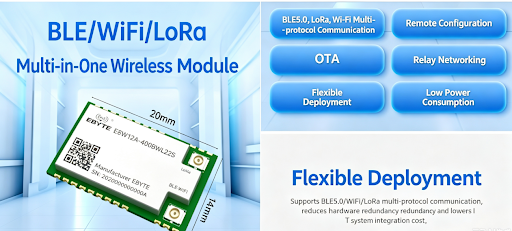
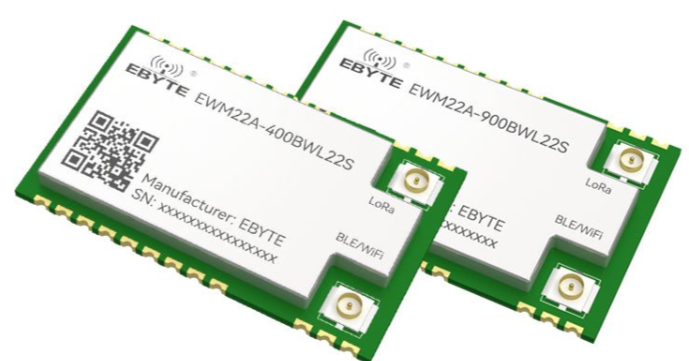
EWM22A-BWL Series: An integrated 3-in-1 wireless module combining BLE, Wi-Fi, and LoRa technologies. It features a LoRa transmit power of 22dBm, enabling transmission ranges of several kilometers in open environments. The BLE and Wi-Fi components operate in the 2.4GHz band, while the LoRa component supports 433MHz and 868/915MHz bands. Utilizing a TTL-level UART interface, the module supports flexible configuration via AT commands and allows for on-demand switching between communication modes. It is compatible with the E22X and E90-SL series DTUs, facilitating system expansion. Key features include combined BLE 5.0/LoRa/Wi-Fi communication, remote configuration, OTA upgrades, and relay networking capabilities. These features ensure flexible deployment and excellent power efficiency, helping to reduce hardware redundancy and lower system integration costs for IoT applications.
Ebyte possesses over a decade of experience in wireless communication R&D and maintains a dedicated R&D team of more than 60 professionals. Its products are exported to over 50 countries and hold SRRC, FCC, and CE certifications. With over 5 million LoRa units shipped and a customer repurchase rate exceeding 90%, the company has successfully implemented numerous projects in fields such as smart metering, smart agriculture, and industrial automation.
