

Bitcoin has returned to the centre of attention following a notable rally in 2026.
BTC has gained around 20% during the week, briefly trading above $79,000 and reaching a level not seen for roughly three months. Renewed activity in U.S. spot Bitcoin ETFs has also contributed to market optimism, with fresh inflows strengthening expectations that positive momentum could continue.
The recovery has encouraged crypto investors to look beyond price appreciation. For holders who already own digital assets, another question is becoming increasingly relevant: can those assets be used to pursue an additional source of potential income rather than simply being held?
Cloud mining is one avenue attracting interest.
Cloud Mining Gains Fresh Attention
Running a conventional Bitcoin mining operation can require a substantial investment in ASIC machines, electricity, cooling systems, internet connectivity and maintenance. Cloud mining takes a different approach by giving customers access to mining capacity operated remotely by data-centre providers.
SHRMiner offers cloud mining contracts for BTC, ETH, DOGE/LTC, ZEC and other supported cryptocurrencies.
Rather than purchasing and installing specialised mining equipment, customers select a suitable contract and access the computing resources associated with that plan. The underlying infrastructure and operational requirements are managed remotely.
According to the platform, its offering includes features such as:
- No requirement for customers to purchase mining hardware
- Support for multiple cryptocurrencies
- Remote allocation of computing resources
- Large-scale data-centre infrastructure
- Contract-based settlement
- Access through desktop and mobile devices
For people who intend to hold cryptocurrency for the longer term, this type of arrangement can provide an alternative to actively trading during periods of market volatility. Instead, users can allocate a portion of their holdings toward a cloud-mining contract and receive payouts according to the applicable contract conditions.
How the Process Works
Starting with a cloud-mining platform generally involves a straightforward sequence. With SHRMiner, the process is presented in four main stages.
1. Open an Account
Users first create an account using an email address. Promotional offers, such as a potential $15 new-user bonus, may be available subject to the platform’s terms and eligibility requirements.
2. Select a Contract
After registering, users can review the available contracts and choose one based on factors such as the amount they want to commit, contract duration and the projected return shown by the platform.
3. Activate the Mining Capacity
Once a contract is activated, the associated computing capacity is allocated remotely. The mining infrastructure is operated through data centres rather than being installed at the customer’s home or business.
4. Receive Applicable Payouts
Returns are calculated and credited according to the conditions and settlement schedule attached to the selected contract.
This approach means customers do not have to deal directly with ASIC installation, electricity bills, cooling requirements or routine equipment maintenance.
Higher-Value Cloud Mining Contracts
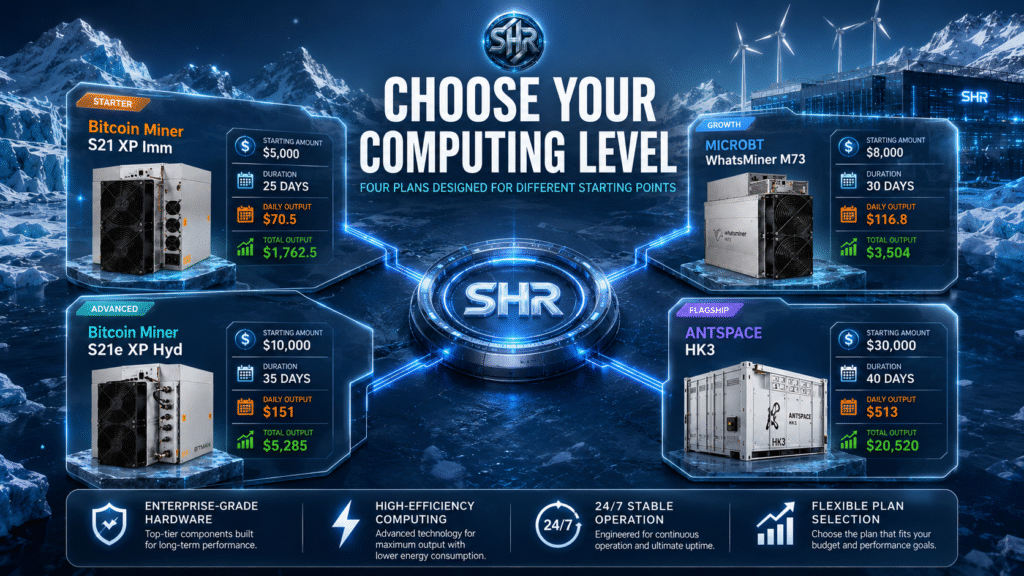
Cloud-mining providers can offer plans aimed at different investment levels and contract periods. SHRMiner, for example, lists several contracts with different funding requirements and projected returns.
Examples presented by the platform include:
| Contract | Price | Stated Profit | Duration |
|---|---|---|---|
| New User Experience Agreement | $100 | $42 | — |
| Bitdeer Sealminer A2 Pro | $500 | $6.25 | 5 days |
| Litecoin Miner L9 | $1,000 | $13 | 10 days |
| Bitcoin Miner S21 XP Imm | $5,000 | $70.50 | 25 days |
| Bitcoin Miner S21e XP Hyd | $10,000 | $151 | 35 days |
| ANTSPACE HW5 | $50,000 | $905 | 45 days |
Some higher-value plans may display projected cumulative returns exceeding $27,700, depending on the contract selected and its stated terms.
Anyone considering a contract should review the current pricing, payout calculations, duration, fees and other conditions carefully before committing funds. Projected returns are not the same as guaranteed investment profits, and cryptocurrency-related services can involve significant financial risk.
Why Cloud Mining Is Appealing to Some Crypto Holders
A strong Bitcoin market can create both opportunities and difficult decisions for investors.
Selling BTC can provide immediate liquidity, but doing so may reduce a holder’s exposure if the cryptocurrency continues to appreciate. On the other hand, simply keeping Bitcoin in a wallet does not automatically create recurring income.
Cloud mining presents a different model.
Rather than relying entirely on short-term price movements, crypto holders can investigate whether allocating a portion of their assets toward remotely managed mining capacity fits their broader strategy. The potential attraction is the ability to participate in mining without purchasing physical equipment or building and maintaining a private mining operation.
However, the decision should not be based solely on advertised returns. Users should consider contract terms, platform reputation, cryptocurrency price volatility, payout conditions, fees and the possibility of losing funds.
Bitcoin’s 2026 Rally Changes the Conversation
As Bitcoin’s market momentum gathers attention again, the discussion among crypto holders is expanding beyond the question of where BTC’s price could go next.
Some investors are also considering how their existing digital assets might be used more actively.
Cloud mining is one potential route for those interested in accessing mining infrastructure without managing physical machines themselves. Platforms such as SHRMiner aim to simplify that process by combining remote computing resources with contract-based mining arrangements.
For anyone exploring this option, the most important step is to understand exactly what a contract provides, how projected earnings are calculated and what risks apply before depositing cryptocurrency.
Cloud mining may offer an alternative way to participate in cryptocurrency mining, but it should be approached as a speculative activity rather than a guaranteed source of income.
