
Watch someone play piano, and it’s easy to wonder if you missed your shot at learning. That thought crosses a lot of minds. Plenty of adults assume musical ability only develops in childhood, that there’s no room left for beginners later on. And yet people in their thirties, forties, fifties — even well beyond — keep picking up the instrument.
Some want to rediscover a childhood interest. Others are after a creative outlet once the workday ends, or simply want to challenge their brain in a new way. Whatever the reason, adult learners are now a well-established part of the music education world. Online learning, more flexible teaching methods, and a growing respect for lifelong learning have made piano more accessible than it’s ever been. And modern teaching has caught on to something: many adults bring clear personal goals, life experience, and an ability to organise their own learning. Life experience can shape how many adults approach musical learning in ways that differ from younger beginners.
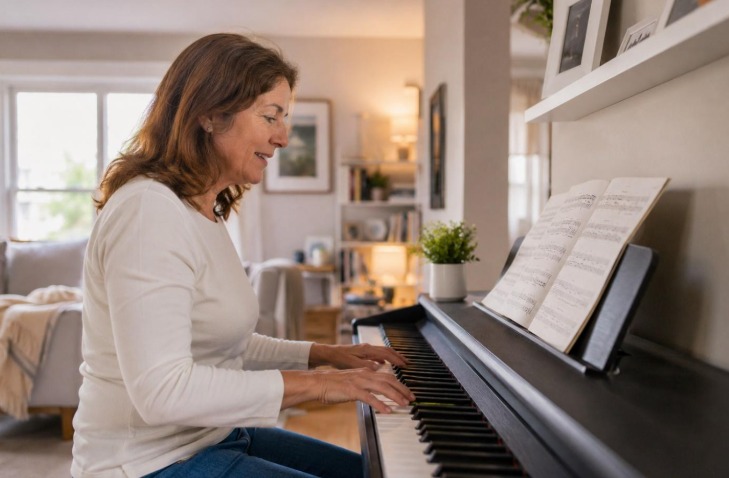
Alt tag: Adult learning piano at home with sheet music in a bright living room
The Adult Return to Music
School or university ending doesn’t mean learning has to stop. Adults are picking up creative hobbies across the board — for the enjoyment, for the growth — and music fits right into that.
For a lot of people, piano feels both familiar and full of possibility. It’s an instrument you hear everywhere — films, concerts, cafés, churches, homes around the world. Even people with zero musical training can usually recognise a melody and imagine themselves playing it.
Unlike a lot of competitive pursuits, piano offers progress you can actually measure without demanding perfection. Learn a new chord, a scale, a favourite song — each one becomes its own small milestone, building confidence rather than inviting comparison. It’s that gradual sense of progress that makes the instrument so appealing to adults who want something patient, something consistent.
What Adult Learners Bring to the Table
Here’s a misconception worth retiring: that adults learn slower simply because they’re older. Sure, children absorb information differently. But many adults make up for it through life experience, personal motivation, and an ability to organise their own learning.
Ask most adult learners why they started, and they’ll usually have a clear answer. Some want to accompany a singer. Others are after relaxation. Plenty just enjoy the challenge of mastering something new. That clarity of motivation tends to show up as more focused practice.
Adults tend to ask thoughtful questions — about technique, music theory, interpretation. They’re not content just following instructions; they want to know how the music actually works. This curiosity tends to pay off over the long run, making practice feel a lot more meaningful.
Experienced piano teachers may adapt lessons around an adult’s goals — prior experience, preferred pace, musical taste, practical circumstances — rather than reusing the exact same approach built for kids.
Keeping Practice Sustainable
For many adults, finding consistent time to practise can be as challenging as learning the instrument itself.
Work, family, everyday life — none of it leaves much room for long practice sessions. Fortunately, modern teaching leans more toward consistency than duration these days.
For many beginners, short focused sessions of around twenty minutes several times a week may be more manageable than occasional lengthy practice sessions.
Practice ends up becoming something a lot of adults genuinely look forward to. It’s not one more obligation tacked onto the list — it’s a chance to step away from work emails, social media, daily pressure, and focus on nothing except the music.
Technology’s Impact on Piano Education
Technology has broadened the ways in which piano lessons can now be delivered.
Digital keyboards offer many beginners a practical alternative to a full acoustic piano, particularly where space, volume, or maintenance is a concern. Video lessons, interactive apps, online sheet music, virtual teachers — all of it adds flexibility that fits modern schedules.
Online learning has knocked down a lot of geographical barriers, too. Someone out in a rural area can now find an experienced instructor from almost anywhere, and people with unpredictable schedules can learn whenever it actually suits them.
When researching lesson formats and common beginner questions, resources such as 1on1 Piano can provide additional background on online lessons and issues prospective learners may wish to consider.
Building Musical Confidence
Mistakes are something a lot of adult beginners worry about.
For some, that fear becomes an actual obstacle to practising consistently — some adults place considerable pressure on themselves to avoid mistakes, particularly when they are accustomed to feeling competent in other areas of life.
But mistakes are actually fundamental to getting better. They can highlight areas involving rhythm, coordination, reading, or technique that may need further practice.
Even professional musicians keep refining their playing throughout their careers — proof that improvement never really stops for anyone. Treating practice like exploration instead of a test tends to let confidence build more naturally.
Over time, some learners find that the confidence they develop at the piano also carries over into other areas of life. Push through a tough passage until it finally clicks, and some learners feel that working through difficult passages also strengthens patience, persistence, and confidence.
Why No Two Learners Progress the Same Way
Some learners gravitate toward classical repertoire early on.
Others lean toward film scores, jazz standards, pop songs — or picking out favourite melodies entirely by ear.
No single path leads to becoming a pianist. Whatever someone’s personal goals are, those end up shaping the teaching approach and what gets prioritised in practice.
Reading sheet music is the main goal for some. For others, it’s improvisation, chord playing, or accompanying a singer. Tie the lessons to whatever a learner genuinely enjoys, and motivation tends to stick around — right alongside the more structured technical work.
Music as a Form of Wellbeing
Ask a lot of adults what piano gives them beyond technical skill, and ‘restorative’ comes up often.
Rhythm, dynamics, expression — focusing on rhythm, dynamics, and expression can shift attention away from everyday concerns, which some learners find absorbing or restorative.
Researchers continue to explore how music participation connects to stress reduction, emotional wellbeing, and cognitive engagement — though of course, everyone’s experience with it varies.
Unlike a lot of hobbies built around performance or competition, piano can stay entirely personal. Someone might never perform in public and still get real satisfaction out of regular practice at home.
For learners who do not wish to perform publicly, keeping piano as a private hobby may reduce performance pressure.
Finding the Right Learning Environment
How someone chooses to learn matters almost as much as the decision to start.
Some adults do best with traditional weekly lessons — they like the structure and the accountability. Others prefer self-paced online learning, which gives them more flexibility around a schedule that’s always shifting.
Hybrid setups are getting more common too — combining online resources with the occasional lesson from an instructor, so learners get personalised feedback while still having independence between sessions.
Whatever format someone lands on, finding genuinely supportive instruction tends to matter more than chasing the fastest route. Encouragement, clear explanations, realistic expectations — that combination is what keeps motivation alive over months and years, not shortcuts.
Creativity Has No Expiration Date
One of the most encouraging things about adult music education? There’s no deadline for starting.
Retirement is when some people finally pick it up, after decades in a completely different career. Others start during a career change, after raising kids, or simply while hunting for a new creative outlet.
Music doesn’t require prior experience to be meaningful. Every learner starts out curious, and confidence builds gradually from there — through regular practice and patient instruction.
A lot of adults skip past ‘is it too late’ and land on a better question instead: what happens if they finally give themselves permission to start?
Lifelong learning has never been valued more than it is now, and piano offers something that’s stood the test of time regardless. Intellectual challenge, emotional expression, artistic creativity, personal achievement — few hobbies combine all of that quite the way piano does. Approach it with patience instead of chasing perfection, and the journey tends to be every bit as rewarding as wherever it leads.
