
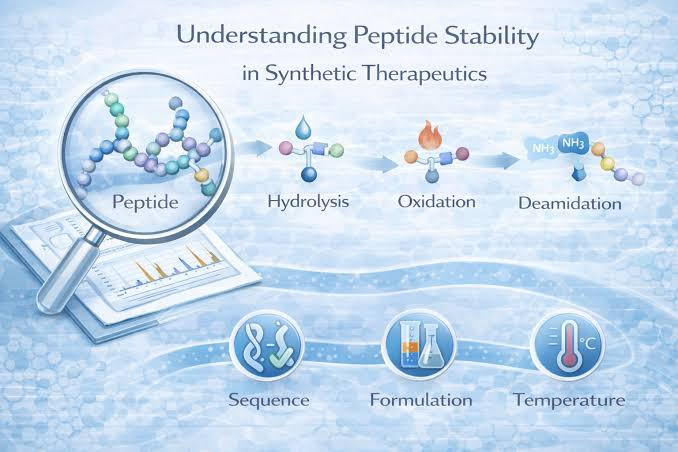
A synthetic peptide can retain its expected molecular identity during one analytical investigation and show evidence of chemical change in another. Temperature exposure, moisture, oxidation and other environmental influences can affect peptide stability, making sample integrity an important consideration in laboratory research.
These changes are not always visible. A sample may retain its general appearance while developing chemical modifications or degradation products that influence its analytical profile.
Understanding the chemistry behind peptide degradation helps researchers investigate sample changes, interpret laboratory findings and distinguish genuine stability differences from analytical variation.
1. Peptide Stability Is a Chemical Property, Not a Visual One
Peptide stability describes how well a molecule maintains its chemical structure and relevant properties under defined environmental conditions.
A stable analytical profile does not simply mean that a sample looks unchanged. Molecular changes may occur without obvious differences in colour, clarity or physical appearance.
Researchers therefore examine several characteristics when investigating stability:
- Whether the expected molecular mass remains detectable.
- Whether additional chromatographic peaks appear.
- Whether the peptide’s chemical structure changes.
- Whether degradation products can be identified.
- Whether analytical results remain consistent over time.
Stability is also compound-specific. Different amino acid sequences and chemical modifications can influence how peptides respond to environmental conditions.
This means that findings from one peptide cannot automatically be applied to another.
2. The Chemistry Behind Peptide Degradation
Peptide degradation can involve several chemical processes. Understanding these mechanisms helps researchers investigate why a sample’s analytical characteristics may change.
Hydrolysis
Hydrolysis involves the reaction of a chemical bond with water.
In peptides, hydrolysis can affect peptide bonds and contribute to fragmentation or the formation of smaller molecular species.
The extent of degradation depends on factors such as molecular structure and environmental conditions.
Oxidation
Oxidation involves chemical reactions that alter susceptible molecular groups.
Certain amino acid residues are more vulnerable to oxidation than others. Methionine, tryptophan and cysteine are examples of residues that can undergo oxidative modifications.
These changes may influence molecular mass, structural properties and chromatographic behaviour.
Deamidation
Deamidation involves the conversion of certain amino acid side-chain groups, particularly those associated with asparagine and glutamine.
This process can produce structural changes that may affect the chemical characteristics of a peptide.
The rate and extent of deamidation depend on the sequence and surrounding chemical environment.
Aggregation
Some peptides may associate with one another to form larger molecular assemblies.
Aggregation can complicate analytical interpretation because the resulting material may behave differently from individual peptide molecules.
It is important to distinguish aggregation from chemical degradation, although both can influence sample characteristics.
3. Environmental Factors That Influence Stability
Environmental conditions can influence the rate and type of chemical changes occurring in peptide materials.
Researchers commonly investigate several variables.
Temperature: Temperature can influence reaction rates and the development of chemical degradation pathways. Its effects depend on the peptide’s structure and surrounding conditions.
Moisture: Water availability can influence hydrolysis and other chemical processes. Moisture-related changes may be particularly relevant when studying different material presentations.
Light exposure: Certain molecules or chemical groups can be sensitive to light. Photochemical reactions may produce structural changes that require analytical investigation.
Oxygen exposure: Oxygen can contribute to oxidative processes involving susceptible amino acid residues.
pH: The chemical environment can influence reaction pathways, including hydrolysis and deamidation.
These factors may interact rather than operate independently. A stability investigation should therefore consider the complete experimental environment rather than focusing on one variable alone.
4. Why Different Peptides Show Different Stability Profiles
There is no universal stability profile that applies to every synthetic peptide.
Molecular structure plays an important role in determining susceptibility to chemical changes.
For example, a peptide containing oxidation-sensitive amino acid residues may require different analytical considerations from one with a different sequence.
Other structural factors can also influence stability:
- Amino acid sequence.
- Molecular size.
- Terminal modifications.
- Side-chain chemistry.
- Molecular conformation.
- Presence of additional formulation components.
Researchers should avoid assuming that two peptides with similar commercial descriptions will have identical stability characteristics.
A meaningful comparison requires compound-specific evidence.
5. Detecting Stability Changes Through Analytical Methods
Stability investigations rely on analytical techniques capable of identifying changes in molecular characteristics.
Different methods provide different types of evidence.
Chromatographic Profiling
High-performance liquid chromatography (HPLC) can help researchers examine changes in chromatographic profiles over time.
The appearance of additional peaks or changes in relative peak areas may indicate that the sample’s detectable composition has changed.
However, chromatographic differences do not automatically identify the chemical process responsible.
Mass Spectrometry
Mass spectrometry can provide information about the molecular masses of detected species.
Changes consistent with oxidation, fragmentation or other modifications may become apparent through mass-based analysis.
Additional structural investigations may be needed to establish the exact modification.
Spectroscopic Analysis
Depending on the research question, spectroscopic techniques may provide information about molecular structure and changes in chemical environments.
These methods can complement chromatographic and mass-based investigations.
6. Building a Meaningful Stability Study
A useful stability investigation requires a defined experimental design.
Researchers should establish what they intend to measure before comparing analytical results.
A typical research framework may include:
| Study element | Purpose |
| Initial characterisation | Establishes the starting analytical profile |
| Defined test conditions | Documents the environment being investigated |
| Time-based measurements | Identifies changes across the study period |
| Analytical comparison | Examines differences between measurements |
| Degradation assessment | Investigates possible chemical changes |
| Data reporting | Records methods, observations and limitations |
A control or reference material may also help distinguish genuine changes from analytical variation.
Without a clearly documented starting point, it becomes more difficult to determine whether an observed difference developed during the investigation or was already present in the original material.
7. Product Specifications and Stability Research
Commercial product descriptions can identify the material being listed, but they do not independently establish its stability profile.
Researchers reviewing Retatrutide GLP-3 from Pure Peptides UK should distinguish its product description from evidence generated through a dedicated stability investigation.
A stability claim requires relevant experimental information, including the conditions examined, analytical methods and reported observations.
A general product specification cannot replace this evidence.
8. Why Transparent Supplier Information Matters
When reviewing research peptide suppliers, it is useful to distinguish general product information from documented analytical findings.
Researchers can consider British Peptides as another supplier reference when comparing product descriptions and available specifications.
However, supplier identity alone does not establish the stability of an individual peptide material. Stability-related claims should be assessed through product-specific evidence rather than broad commercial statements.
This distinction helps maintain scientific accuracy when comparing materials from different sources.
9. Interpreting Stability Data Without Overstating Results
Stability results can be misleading when analytical observations are interpreted without considering the study design.
For example, a change in chromatographic peak area may indicate a difference in the sample profile, but it does not independently identify the cause.
Likewise, the absence of a new detectable peak does not prove that no chemical change has occurred.
Researchers should consider:
- The sensitivity and limitations of the analytical method.
- Whether measurements were performed under comparable conditions.
- Whether the starting material was adequately characterised.
- Whether degradation products were identified.
- Whether the study period and environmental conditions were clearly documented.
Careful interpretation prevents limited analytical findings from becoming unsupported stability claims.
Frequently Asked Questions
What factors influence peptide stability?
Temperature, moisture, oxygen, light exposure and pH can influence peptide stability. Their effects depend on the molecular structure and surrounding environment.
What is peptide degradation?
Peptide degradation refers to chemical or structural changes that alter the original molecular characteristics of a peptide.
Can HPLC detect peptide degradation?
HPLC can reveal changes in chromatographic profiles, including additional or altered peaks. Further analysis may be needed to identify the specific degradation products.
Why is mass spectrometry used in stability studies?
Mass spectrometry provides molecular mass information that can help researchers investigate oxidation, fragmentation and other chemical modifications.
Do all peptides have the same stability characteristics?
No. Stability depends on factors including amino acid sequence, chemical modifications and environmental conditions.
Final Perspective
Peptide stability research requires an understanding of both molecular chemistry and analytical measurement. Hydrolysis, oxidation, deamidation and aggregation can influence peptide characteristics, while environmental factors may affect the likelihood and extent of these changes.
HPLC, mass spectrometry and complementary analytical techniques help researchers investigate changes that may not be visible through physical inspection alone.
The most meaningful stability conclusions come from well-documented studies that identify the material, define the experimental conditions and interpret analytical findings within the limits of the methods used.
