
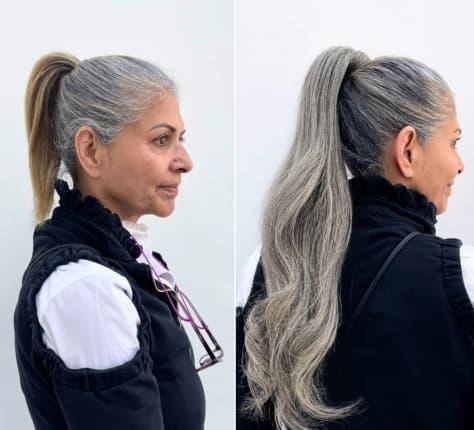
A ponytail should feel effortless. It should swing when you walk and settle softly against the neck. Yet many women find that their clip-in ponytail looks stiff, bulky, or separate from their own hair.
The issue is rarely the idea of a ponytail itself. More often, it comes down to weight balance, placement, cutting, and texture matching.
With a few practical adjustments, a clip-in ponytail can move in a far more natural way.
Understanding Weight Balance
One of the main reasons a clip-in ponytail looks heavy is excess density.
Many ready-made ponytail pieces are produced with uniform thickness from top to bottom. While this may look full in packaging, it can feel solid once attached.
Natural hair does not behave like a block. It has variations. Slight tapering towards the ends allows movement and softness.
If a clip in ponytail contains too much hair for your natural density, it will:
- Pull at the base
- Sit stiffly rather than flow
- Create a visible contrast between your hair and the extension
Choosing moderate weight is often more flattering than choosing maximum volume. If your own hair is fine or medium, a lighter piece will blend more easily and feel more comfortable during the day.
When in doubt, hold the ponytail piece upright. If it feels unusually dense or heavy in your hand, it may not move naturally once fitted.
Placement Height and Face Shape
The height of a ponytail has a strong effect on how it looks and moves.
High ponytails can appear lifted and youthful, but they also create tension. If placed too high without proper blending, the extension may stick out rather than fall smoothly.
Mid-height ponytails tend to offer balance. They sit around the back of the head and allow the hair to drop in a softer line.
Low ponytails create elegance but require careful anchoring to prevent sagging.
Face shape also plays a role. A round face may benefit from slight height at the crown. A longer face may look better with a mid placement that avoids extra lift.
Incorrect placement can make even a well-made clip-in ponytail appear unnatural. The goal is alignment with your head shape and natural hair growth pattern.
Before securing the piece, look at your profile. The ponytail should extend from the curve of your head, not just out at an angle.
Why Layer Cutting Makes a Difference
A common mistake is wearing a clip-in ponytail straight from the packaging without shaping it.
Natural haircuts contain layers. A ponytail extension with blunt, even ends can look separate from your own hair.
Light layer cutting after fitting helps integrate the piece. This does not mean removing significant length. It simply softens the outline.
A stylist may trim small sections vertically to create movement. This technique reduces heaviness and prevents the base from looking thick compared to the ends.
Layering also improves how the ponytail curls or bends. Hair that is slightly shaped will fall more naturally when styled.
Even a subtle adjustment can transform how a clip-in ponytail behaves.
Matching Texture, Not Just Colour
Colour matching is important, but texture is often overlooked.
A perfectly matched shade will still look obvious if the texture differs. For example, sleek straight extension hair attached to naturally wavy hair creates separation.
When fitting a clip-in ponytail, consider:
- Is your natural hair smooth, wavy, or slightly coarse?
- Does it have a body or lie flat?
- Does it hold curl easily?
If your natural hair has a gentle bend, add a soft wave to the extension before attaching. This allows both to merge visually.
Texture alignment improves movement as well. When both hair types respond similarly to styling, the ponytail swings and settles in a unified way.
A mismatch in texture often causes the heavy, stiff look many women notice.
Securing the Base Without Bulk
The base of a clip-in ponytail must feel stable but not bulky.
If wrapped too tightly around the elastic, it can create a thick ridge at the attachment point. This makes the ponytail appear artificial.
Instead, secure your natural ponytail first with a firm elastic. Then attach the extension so it sits flush against the base.
Wrap a small section of hair around the joint to conceal the attachment. Pin discreetly underneath.
This simple technique softens the transition and prevents the base from looking oversized.
Comfort as a Sign of Correct Fit
A clip-in ponytail that feels heavy will often look heavy.
If you notice strain at the scalp or constant pulling, the piece may be too dense or positioned too high.
Comfort supports natural movement. When the weight is balanced and placement is correct, the ponytail should feel secure yet light.
Some British hair ateliers, including Tatiana Karelina, focus on tailoring density to individual hair types rather than relying on uniform production. This approach reduces bulk and improves integration.
Even small adjustments in weight and placement can improve how the ponytail moves.
Final Thoughts
A stiff or bulky clip-in ponytail is usually a matter of structure rather than style.
Balanced weight, thoughtful placement, gentle layering, and texture matching all play a part. When these elements align, the ponytail flows more naturally and feels part of your own hair.
Subtle refinement often makes a greater difference than adding more volume. With the right approach, a clip-in ponytail can feel light, fluid, and comfortable throughout the day.
