
Synthetic peptides and peptide blends belong to the same broad research category, but they are not the same type of material. An individual synthetic peptide is designed around a defined amino acid sequence, whereas a peptide blend combines two or more separate components within one formulation.
This difference affects how researchers examine molecular identity, understand product specifications and interpret laboratory testing. A blend introduces additional analytical considerations because each ingredient has its own molecular characteristics.
Understanding these differences helps researchers compare research materials more accurately and avoid treating individual peptides and combined formulations as interchangeable products.
What Are Synthetic Peptides?
Synthetic peptides are produced through chemical synthesis using defined amino acid sequences. Their structures are designed to represent a particular molecular specification, which provides a reference for identification and analytical evaluation.
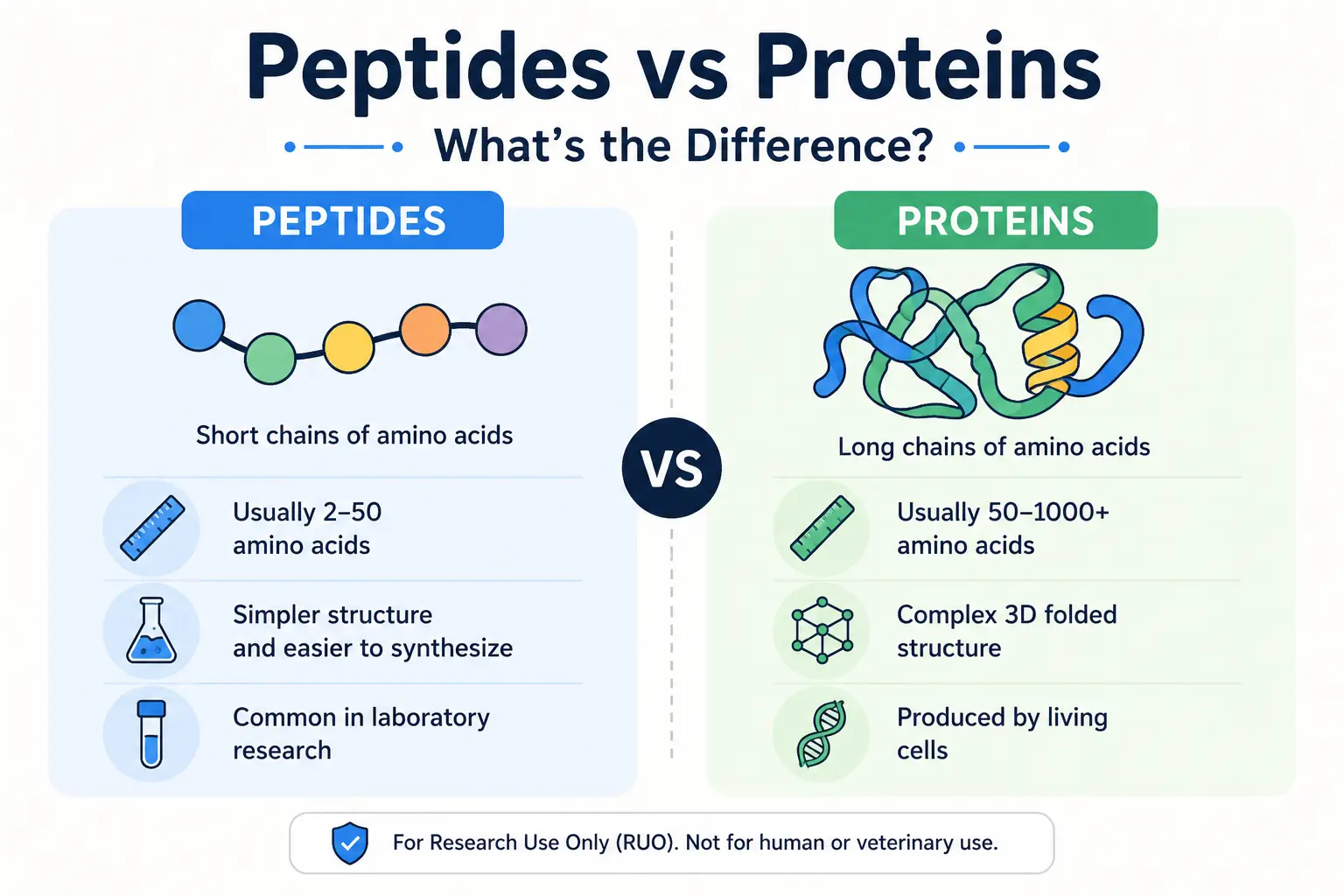
Unlike proteins, which can contain hundreds or thousands of amino acids, many synthetic research peptides are relatively short chains.
The sequence determines the primary structure of the peptide. Additional modifications may also be introduced to influence specific molecular characteristics.
How Synthetic Peptides Are Produced
Solid-phase peptide synthesis (SPPS) is an established technique used to produce many synthetic peptides.
During this process, amino acids are added sequentially to a growing peptide chain attached to a solid support. Repeated chemical reactions build the intended sequence.
After synthesis, the peptide is generally separated from the support and subjected to appropriate processing and purification steps.
The final material can then be evaluated using analytical techniques to investigate its identity and composition.
Molecular Identity
An individual synthetic peptide has a defined molecular identity based on its sequence and any relevant modifications.
Researchers can use this information to establish expected molecular characteristics and compare them with laboratory findings.
This makes individual peptides relatively straightforward to describe at the composition level, although accurate identification still requires suitable analytical evidence.
What Are Peptide Blends?
A peptide blend is a formulation containing two or more individual peptide components.
Each ingredient retains its own molecular identity, amino acid sequence and chemical characteristics. Combining these ingredients does not automatically produce a new peptide molecule.
For example, a formulation containing BPC-157 and TB-500 contains two separate peptide-related components rather than one newly synthesised compound.
Why Are Peptides Combined?
Multi-component formulations bring several peptide ingredients together within one product. From a research perspective, this creates a formulation that must be assessed both as a whole and through its individual components.
Researchers should establish:
- Which peptides are included.
- The stated quantity of each ingredient.
- Whether the components have clearly defined molecular specifications.
- How the formulation is described in product documentation.
- Whether analytical information addresses individual components or the combined sample.
These details help distinguish a clearly specified blend from a product description that provides limited compositional information.
Synthetic Peptides vs Peptide Blends: Main Differences
The most important differences relate to composition, molecular identity and analytical complexity.
| Characteristic | Synthetic peptide | Peptide blend |
| Composition | One defined peptide component | Two or more components |
| Molecular identity | Based on one sequence and its modifications | Each ingredient has its own identity |
| Formulation | Individual compound | Combined formulation |
| Analytical focus | Identity and purity of the target peptide | Identity and composition of multiple ingredients |
| Documentation | Specifications for one peptide | Specifications for individual components and the blend |
| Testing complexity | Generally more focused | Requires consideration of multiple components |
A single peptide does not necessarily have simpler chemistry, particularly when it contains structural modifications. However, a blend generally introduces additional questions because researchers must account for several different compounds.
Manufacturing and Formulation Considerations
Synthetic peptide production and peptide blending involve different stages of material preparation.
Individual Peptide Production
The production of an individual synthetic peptide focuses on building the intended amino acid sequence.
Manufacturing considerations can include synthesis conditions, incomplete reactions, purification and the removal of unwanted components.
The resulting material is assessed against its intended molecular specification.
Multi-Component Formulation
A blend requires the combination of separately identified ingredients.
In addition to understanding the individual peptides, researchers may need information about the formulation process, stated component quantities and the consistency of the combined material.
A blend’s total quantity does not automatically reveal the amount of every individual ingredient. Clear specifications are therefore important when comparing different formulations.
Analytical Testing: Why the Approach Can Differ
Analytical testing helps researchers investigate whether a material matches its expected characteristics. However, the analytical approach needs to reflect whether the sample contains one peptide or several.
HPLC for Individual Peptides
High-performance liquid chromatography (HPLC) separates sample components according to their interactions with a chromatographic system.
For an individual synthetic peptide, HPLC can help assess its chromatographic profile and identify additional detectable components.
The resulting purity estimate depends on the analytical method and should not automatically be treated as complete proof of molecular identity.
HPLC for Peptide Blends
A blend may contain multiple compounds with different chromatographic properties.
Researchers need to consider whether the selected method can adequately separate the individual components. Overlapping peaks can complicate interpretation and make individual assessment more difficult.
A single chromatogram should not automatically be interpreted as confirmation of every ingredient.
Mass Spectrometry
Mass spectrometry provides information about the mass-to-charge ratios of detected ions.
For individual peptides, this information can support comparison with the expected molecular mass.
For blends, researchers need to consider the expected characteristics of each component. Identifying one peptide does not independently confirm the identity or quantity of the remaining ingredients.
LC-MS combines chromatographic separation with mass analysis, providing complementary information that can support more detailed investigations.
Product Examples: Individual Peptides and Combined Formulations
The distinction becomes clearer when comparing actual research product categories.
Retatrutide is an individual engineered peptide with a defined molecular structure and activity across GLP-1, GIP and glucagon receptors. Researchers interested in this product can Buy Retatrutide GLP-3 from UK Peptide and review its listed product specifications.
A Wolverine-style formulation represents a different category because it combines BPC-157 and TB-500 as separate ingredients. Researchers looking for a Wolverine Peptide Blend can purchase the listed formulation from Research Peptides UK.
These examples illustrate why product composition should always be checked before comparing specifications or analytical results.
How to Evaluate a Peptide Product or Blend
Whether examining an individual peptide or a combined formulation, researchers should follow a consistent evaluation process.
1. Confirm the product identity. Check the listed compound and relevant molecular specifications.
2. Examine the composition. Establish whether the material contains one peptide or several components.
3. Review stated quantities. Check whether amounts refer to individual ingredients or the complete formulation.
4. Assess analytical documentation. Identify the methods used and understand what their results demonstrate.
5. Check batch information. Where available, ensure the documentation relates to the specific material being evaluated.
This approach makes it easier to distinguish product descriptions from analytical evidence and reduces the risk of unsupported comparisons.
Frequently Asked Questions
Are synthetic peptides and peptide blends the same?
No. An individual synthetic peptide contains one defined peptide component, while a blend combines two or more separate ingredients.
Does combining peptides create a new molecule?
Not automatically. The individual components generally retain their molecular identities within the combined formulation.
Are peptide blends harder to analyse?
They can introduce additional analytical complexity because researchers need to consider the identity and characteristics of multiple components.
Can HPLC test both individual peptides and blends?
Yes. HPLC can be used for both, but the method must be suitable for the compounds being analysed.
Why are individual component quantities important?
They help researchers understand the actual composition of a blend rather than relying only on its total stated quantity.
Final Thoughts
Synthetic peptides and peptide blends differ mainly in their composition and the analytical questions they create. Individual peptides have a defined molecular identity, while blends contain multiple compounds that require separate consideration.
Understanding these differences helps researchers review product specifications, interpret laboratory results and assess research materials more accurately. The key is to evaluate each ingredient while also considering the characteristics of the complete formulation.
