
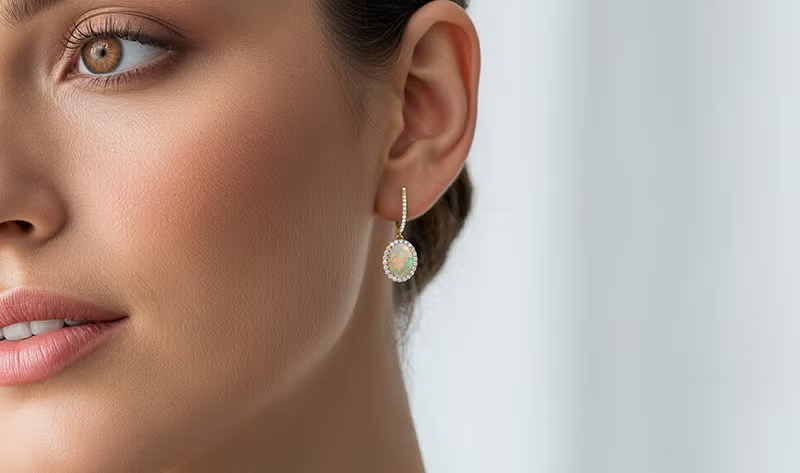
It is easy to begin with a clear picture of the earrings you want: perhaps a bright pair of studs or a delicate drop with a pale stone. Then another design catches your eye, and the original choice feels less certain. That change need not send you back to the beginning. It may simply reveal something useful about how you want the earrings to look and feel. Rather than searching through more options at random, work through a few decisions in sequence. Each one gives you a reason to keep, reconsider or set aside a pair.
Identify what changed in your preference
Start by describing the first style you liked without naming a particular product. Was it the compact shape, the visible flash of colour, the understated setting or the way it would sit close to the ear? Then ask what drew you to the newer option. You may find that your taste in opal has not changed at all; you may simply have realised that you want more movement, a different metal colour or a pair suited to another occasion.
Looking across an opal earring range can help make that distinction visible: compare designs by shape and setting first, then notice whether your preferred stone appearance stays consistent. Keep two or three examples in mind rather than building an ever-growing shortlist. If you cannot say what each example offers that the others do not, it is probably too early to choose between them.
Set the practical boundaries before comparing colours
Once you know what has shifted, decide what the earrings need to do. A pair for frequent wear may call for a different size or level of movement from one reserved for an occasional event. Think about your usual hairstyle, whether you wear headphones or hats, and whether long drops tend to catch on clothing. These are personal comfort questions, not universal rules about which design is best.
It also helps to separate firm requirements from preferences. You might require a particular type of fastening because it is comfortable for you, while remaining open to several stone colours. Or you might be set on a small stud but flexible about its setting. Writing down one or two non-negotiables prevents a striking photograph from distracting you from an option you would actually enjoy wearing.
If you are buying for someone else, be especially careful about treating your own favourite as theirs. The earrings they already choose to wear may offer better clues about scale, movement and metal colour than a general description of their taste.
Compare the opals as a pair, not as identical stones
Opal can show colour differently as light and viewing angle change. That is part of its appeal, but it can make quick comparisons difficult. Look at the overall effect of both earrings together: do they feel balanced in size, brightness and pattern, even if the stones are not identical? Exact visual matching may matter less to you than a pleasing relationship between the two.
Try not to reduce the decision to a single favourite colour. A blue flash might be vivid in one image but subtler in another; a lighter-looking stone might complement the setting better than expected. Photographs can help you narrow a shortlist, although lighting and screens can affect how colours appear. If the appearance of the actual pair is central to your decision, ask what images or descriptions are available for that pair rather than assuming every example of a style will look the same.
Check the details that a style change can hide
Changing from studs to drops, or from a simple setting to a more decorative one, can change the questions worth asking. Check the listed dimensions and consider how far the earrings are likely to hang. Look at the fastening, the metal described and how the stone is held. If you have a known sensitivity to certain metals, do not rely on colour alone to identify the material; seek clear product details.
It is also reasonable to ask how an opal is described. Terms such as solid opal, doublet and triplet refer to different constructions, which can affect how a piece is assessed and cared for. Do not infer construction or treatment solely from a picture. Where a listing leaves an important detail unclear, pause and seek clarification before letting the design settle the decision for you.
Make a shortlist that can survive a change of mind
Now return to your original choice. Does it still meet your practical needs, even though a newer style has caught your attention? If so, keep it beside the strongest alternative. Compare those two on the same questions: comfort, scale, appearance as a pair, fastening and the details you have been able to confirm. A short comparison is more useful than repeatedly browsing without a clear test.
You can also allow for a provisional answer. Perhaps you prefer the movement of a drop earring but have not found a length that feels right. That tells you what to look for next, without forcing a purchase or abandoning the idea. If an option fails a firm requirement, remove it from the shortlist, however appealing its colour may be.
Know when you have enough to decide
Before making a final choice, imagine wearing each remaining pair in the situations you identified at the start. Which details would you notice in daily use, and which mattered mainly in the photograph? Check any unanswered product questions and give yourself room to reconsider if the answers differ from your assumptions.
A changing preference is not a problem to solve by finding a single perfect style. It is a chance to learn which features are essential and which can vary. Once the shortlist reflects that distinction, choosing an opal pair becomes a more manageable decision.
