
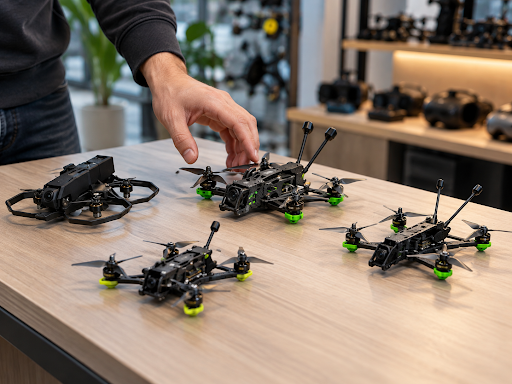
The best drone on paper is rarely the one you should buy. I’ve watched new pilots spend €900 on a race-grade 5-inch, snap two arms in the first week and park it for good. Not because the quad was bad — because it was the wrong class for where they were.
So this ranking of drones starts with fit, not specs. Eight picks, from a sub-50g whoop to a GPS-equipped 7-inch, each with the reason it earned its spot.
Pick the class before the model
Prop size decides almost everything — speed, crash damage, flight time, even which rules apply to you.
Whoops and micros (1–2 inch)
Ducted, light, nearly harmless. You can crash one into a kitchen cabinet fifty times and lose nothing but pride. That’s why every pilot I trust learned on one.
Cinewhoops (2–3.5 inch)
Ducts again, but built to carry a camera through gaps a 5-inch can’t touch. Slow, stable, smooth footage. Not a freestyle machine.
5-inch freestyle and racing
The standard. Around 120 km/h flat out, 3–5 minutes racing, a bit more cruising. Parts are everywhere, so a broken arm costs €10 and ten minutes.
7–10-inch long-range
Bigger props turn slower and more efficiently. On a 6S Li-ion pack, a 7-inch cruises 15–25 minutes. The catch: more mass means more damage when it goes wrong.
RTF, BNF or PNP
RTF ships with goggles, radio and batteries. BNF has a receiver but no radio, so its protocol must match your transmitter. PNP leaves the receiver to you. Already own an ExpressLRS radio? BNF saves money. Starting from zero? RTF.
Top 8 drones, ranked
| # | Drone | Class | Video | Package | Best for |
|---|---|---|---|---|---|
| 1 | iFlight Nazgul Evoque F5 V3 O4 Pro | 5″ freestyle | DJI O4 Pro | BNF | All-round freestyle |
| 2 | DJI Avata 2 | Cinewhoop-style | DJI digital | RTF | First FPV drone |
| 3 | iFlight Nazgul Evoque F7 O4 Pro GPS | 7″ long-range | DJI O4 Pro | BNF | Mountains, distance |
| 4 | GEPRC Mark5 | 5″ freestyle | Analog or digital | BNF / PNP | Bashing and repairs |
| 5 | iFlight Defender 20 Lite O4 | 2″ cinewhoop | DJI O4 | BNF | Indoor and tight shots |
| 6 | GEPRC CineLog35 | 3.5″ cinewhoop | Analog or digital | BNF | Carrying a GoPro |
| 7 | BetaFPV Meteor75 Pro | 1S whoop | Analog or digital | BNF | Learning |
| 8 | iFlight Mach R5 Sport | 5″ racing | Analog | BNF | Racing on a budget |
1. iFlight Nazgul Evoque F5 V3 O4 Pro
If I could own one quad, it’d be this class. 6S, 5-inch, the O4 Pro recording 4K up to 120fps on board — so the flight you just did is the footage you post, no GoPro needed. The BNF ships with a TBS receiver, so check your radio first.
2. DJI Avata 2
The honest answer for someone who’s never flown FPV. Goggles, motion controller and battery in one box, prop guards built in, around 23 minutes of flight. Purists sneer at it. Their first month of crashes cost more than this whole kit.
3. iFlight Nazgul Evoque F7 O4 Pro GPS
A 7-inch with GPS rescue, a Crossfire diversity receiver and a water-resistant build. GPS rescue is the part that matters — lose video 3 km out and the quad flies itself home instead of into a valley.
4. GEPRC Mark5
The frame everyone recommends when you ask what survives concrete. Thick arms, simple layout, and spares you can find in any European shop. Less polish than the Nazgul. More forgiving of bad days.
5. iFlight Defender 20 Lite O4
A 2-inch ducted quad with a digital O4 feed — light enough to fly indoors without anyone flinching. Real-estate walkthroughs, gym flythroughs, the living room in January.
6. GEPRC CineLog35
When the shot needs a full-size GoPro and the Defender can’t lift it. 3.5-inch ducts, stable under weight, loud as a hairdryer. That noise is the trade.
7. BetaFPV Meteor75 Pro
One-cell brushless whoop on 450–550mAh packs. Buy three batteries and a cheap USB charger, fly it every evening for a month. Nothing on this list will teach you more per euro.
8. iFlight Mach R5 Sport
A 6S racing frame on analog video — not because analog looks better (it doesn’t), but because spec races still run on it and the latency stays predictable. Cheap entry to a race gate.
What to check before you pay
Video system
DJI O4, Walksnail and HDZero give you sharp digital video; analog gives you cheap goggles and the lowest latency. Pick one ecosystem and stay there. Mixing means buying goggles twice.
Radio link
This is where most first orders go wrong. A BNF with a TBS Crossfire receiver won’t bind to an ExpressLRS radio, and swapping receivers means soldering. Match the protocol before checkout, not after.
Weight and the 250g line
Under 250g, EU rules loosen noticeably. Over it, you’re into operator registration and the online A1/A3 test at minimum. Weigh the quad with battery and camera fitted — a sub-250 frame plus a 1300mAh pack is not sub-250.
Before your first flight
Put in simulator hours
Ten hours in Liftoff or Velocidrone cost less than one set of props. Skip them and the first outdoor pack usually ends in a tree. Every time.
Order spares with the drone
Props, a spare arm and at least four batteries. A 5-inch eats propellers the way a car eats tyres, and waiting a week for a €3 part kills momentum.
Sort the paperwork
Register as an operator with your national aviation authority, pass the test your weight class needs, and get insurance if you fly anywhere near people. It’s an evening’s work. Getting caught without it costs far more.
Start small, learn in the sim, and move up one class at a time. The right drone is the one you’ll still be flying next spring.
Visit More : widemagazine.co.uk
