
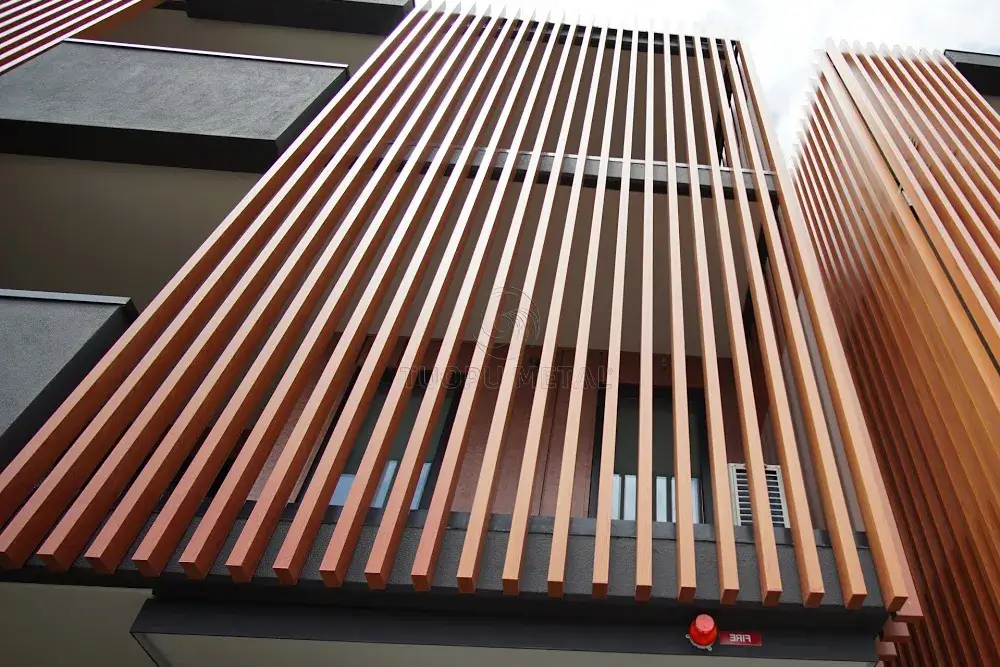
A facade has to work at several scales. From the street, it establishes the building’s shape and character. Up close, it reveals how entrances, windows and materials meet. Vertical battens can help at both distances: their repeated lines bring order to a broad elevation, while their depth creates changing shadows throughout the day.
That visual simplicity takes planning. The width and spacing of the battens, the surface behind them and the treatment of each edge all influence the result. For an Australian home, there is another question too: how will the design respond to sun, rain and the conditions of its particular site?
Start with the building, not the pattern
Vertical lines can make a low facade feel taller, but covering every surface in battens is rarely necessary. A single feature plane may be enough to mark an entry, connect two storeys visually or distinguish a new extension from an older part of the house. Leaving quieter areas of render, masonry or other cladding gives the eye somewhere to rest.
Before choosing a profile, look at the elevation as a whole. Where does the roofline end? Which windows should stand out? Is the front door easy to find? Battens are most convincing when they support these existing cues rather than compete with them. On a long, plain wall, for example, a battened section can provide a measured break without adding another colour or complicated shape.
Get the rhythm right
The character of a batten facade depends as much on the gaps as on the battens themselves. Narrow, closely spaced members tend to read as a more continuous surface. Wider spacing makes individual lines prominent and draws attention to the backing material. Neither approach is inherently better; the choice should reflect the scale of the wall and the view from which it will usually be seen.
Try comparing full-size samples on site rather than judging spacing from a small image. Stand back to check the overall rhythm, then move closer to see how the gaps, shadows and finish appear at the entrance. If battens cross several windows or levels, decide whether their spacing should align with openings or continue independently. An intentional rule makes inevitable interruptions look considered.
Depth matters alongside spacing. A shallow profile can add texture without strongly changing the wall’s outline, while a deeper one produces more pronounced shadows. Those shadows shift with the sun, so a facade that looks restrained in the morning may have a stronger striped effect later in the day.
Choose materials for the setting
Battens may be made from timber, metal or other suitable products, each with a different appearance and maintenance profile. Timber can bring warmth and natural variation, but its finish and upkeep need to suit the exposure. Factory-finished alternatives may offer a more consistent look, although colour, surface treatment and fixing details still deserve scrutiny.
For a project considering wall battens for cladding, it helps to assess samples beside the other facade materials in daylight. A finish that looks neutral on its own may appear warmer or cooler against brick, concrete or painted walls. Ask how corners, cut ends and joints will be finished; these small areas can be more noticeable than the main run of battens.
In coastal locations, discuss corrosion exposure and compatible fixings with the supplier and designer. In bushfire-prone areas, material selection and construction details should be checked against the requirements applicable to the site. Appearance alone is not a reliable guide to suitability.
Design for weather as well as shade
Vertical battens can add depth around an opening, but they should not automatically be treated as effective sun control. Their shading depends on orientation, spacing, depth and the sun’s angle. A north-facing window and a west-facing window may call for quite different responses. If reducing heat gain is a goal, consider the battens as part of a broader design that may also include glazing choices, eaves or other shading.
Rain is just as important. Water needs a clear way to drain, and the wall assembly behind a decorative batten layer must be detailed appropriately. A facade that appears open between battens may still rely on a separate weatherproof surface. Confirm the intended system, ventilation or drainage provisions, and maintenance access before settling the visual layout.
Give the edges attention
The strongest batten schemes usually have straightforward answers to awkward questions. What happens where the lines meet a roof or parapet? Do they stop above paving? How are downpipes, lights, doorbells and house numbers accommodated? Sketching these points early can prevent a tidy concept from becoming a collection of compromises on site.
It can help to agree on a small set of rules:
- Set a consistent starting point for the batten layout, particularly near the main entrance.
- Decide how the pattern ends at corners and beside openings.
- Allow for the backing wall, fixings and any required clearances.
- Place services deliberately rather than fitting them into whatever gap remains.
These decisions are also relevant to retrofits. Adding battens to an existing facade changes its depth and may affect window reveals, thresholds or access for future repairs. Check the condition and capacity of the underlying wall before assuming it can accept a new layer. A designer or suitably qualified installer can help resolve structural and compliance questions for the specific project.
Leave room for the facade to age well
A lasting result is not simply one that looks good on completion day. Think about which surfaces can be cleaned, whether damaged pieces can be replaced and how the finish may change over time. Request installation and care guidance for the chosen product, then keep those requirements in mind when deciding where battens belong.
Used with restraint, vertical battens offer a way to give a contemporary facade definition without making it visually busy. Their impact comes from proportion, placement and careful detailing: the lines are simple, but the decisions behind them are what make the design feel resolved.
