
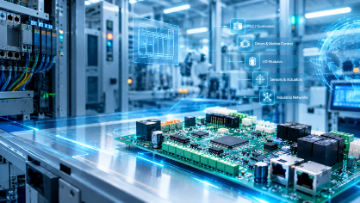
Industrial automation is increasingly software-driven. PLC programs coordinate machines, motion algorithms control motors, and communication protocols connect equipment across a production line. Yet perfect software cannot compensate for unstable hardware. Behind every controller, I/O module, drive, and sensor interface is a physical electronic system. Building production-ready electronics assembly for these applications requires a different mindset, particularly when dealing with PCB assembly for industrial automation where equipment may operate continuously for years.
The Factory Floor Is Different From the Development Bench
A control board can work perfectly during development and still encounter very different conditions after installation.
Inside an industrial cabinet, electronics may experience elevated temperatures, electrical noise, vibration, dust, repeated switching, and long operating hours. Nearby motors, relays, contactors, and variable-frequency drives can also create electrical disturbances that are rarely reproduced by simply powering a prototype on a laboratory desk.
Reliability therefore depends partly on how well the physical hardware handles the environment in which the software will eventually run.
Industrial Connections Take Real Physical Abuse
Industrial automation hardware connects constantly with the outside world.
Terminal blocks carry power and signals. Connectors link sensors and actuators. Communication ports connect controllers with other machines. Some connections may remain untouched for years, while others are disconnected repeatedly during installation and maintenance.
These components introduce mechanical considerations that small SMD circuits do not face in the same way.
Through-hole connectors, relays, terminals, and other mechanically loaded components may require different assembly processes and stronger solder connections. Their positioning and seating also need to remain consistent so that the finished board fits correctly into its enclosure.
One Control Board May Handle Very Different Signals
Automation boards frequently combine several electrical environments.
Low-level sensor signals may sit relatively close to relay outputs, motor-control circuits, industrial communication interfaces, or higher-current power sections. Digital processing, analog measurement, isolation, and power conversion can all exist on the same assembly.
That makes PCB assembly for industrial automation more than a matter of placing components accurately. Component orientation, isolation areas, connector installation, soldering quality, and cleanliness can all affect how the board behaves once installed in a working machine.
Replaceability Is Part of Industrial Reliability
Industrial equipment is often expected to remain serviceable far longer than consumer electronics.
A failed control board may need to be replaced several years after the original machine was installed. The replacement should fit the same enclosure, accept the same connectors, run the correct firmware, and behave consistently with the original hardware.
This makes revision control and production consistency especially important.
Changing a connector, relay, power component, or substitute part without considering the complete product can create problems for field maintenance even when the replacement is electrically acceptable.
Production-Ready Means Repeatable, Not Merely Functional
A successful engineering sample demonstrates that a design can work. Industrial production requires something more: the same hardware needs to be built repeatedly without introducing uncontrolled variation.
That is where production-ready electronics assembly becomes important. Manufacturing documentation, approved materials, assembly instructions, inspection criteria, programming files, and test requirements should describe a repeatable product rather than depend on knowledge held by one engineer or operator.
For automation equipment that may be installed across many machines or facilities, consistency between boards can be just as important as the performance of an individual unit.
Reliability Continues After Installation
The real test of automation hardware begins after it enters service.
A controller may spend thousands of hours monitoring inputs and switching outputs. A communication board may continuously exchange data with PLCs, HMIs, sensors, and drives. Maintenance technicians may unplug terminals, replace modules, or troubleshoot equipment years later.
Reliable hardware therefore needs to support not only initial operation, but also long-term use and practical maintenance.
Conclusion
Software determines what an automation system should do, but hardware determines whether those instructions can continue reaching sensors, motors, relays, and other equipment under real industrial conditions.
Effective PCB assembly for industrial automation must account for electrical, mechanical, environmental, and service-life requirements together. Combined with production-ready electronics assembly, these considerations help transform a working control-board design into hardware capable of supporting industrial equipment well beyond its first successful power-on.
