
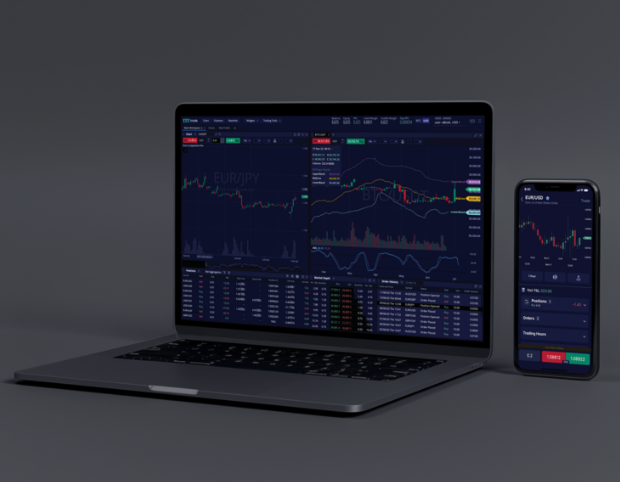
Trading software solutions cover far more than the platform a trader sees. They include the matching engine underneath, the CRM that manages clients, the bridge that routes liquidity, and the processor that moves money. The best solutions connect these into one working system, and the weakest leave you stitching them together yourself.
Key Takeaways
- The best trading software solutions cover the whole stack: platform, CRM, liquidity bridge, and payments, not just the trading screen.
- An open ecosystem lets you connect the CRM, bridge, and payment tools you choose instead of a vendor shortlist.
- One integrated vendor reduces cost, setup time, and the reconciliation work of running separate systems.
- Transparent pricing without B-Book turnover fees protects margins as volume grows.
- A hybrid solution that serves both FX/CFD and prop trading avoids paying for two parallel stacks.
What Trading Software Solutions Include
A trading platform is only the visible layer. A platform that scores well on the front end but connects poorly to the rest of the stack creates operational problems that no interface polish can hide. Behind the screen, a broker or prop firm needs several layers working together:
- A trading platform with risk management and A-Book and B-Book flow control
- A CRM for onboarding, KYC, and client lifecycle
- A liquidity bridge for pricing and execution
- Payment processing for deposits and withdrawals
- Compliance and reporting tooling
Open Ecosystem Versus a Closed Stack
A closed ecosystem forces custom development for every new integration. An open one exposes public APIs and documented paths, so your CRM, bridge, payment gateway, and risk tools connect without rebuilding them. An open ecosystem lets a broker launch a new jurisdiction or asset class in weeks rather than quarters, because most connections already exist. For an established operator switching vendors, openness decides how much existing infrastructure carries across.
One Vendor or Assembled Point Solutions
Assembling tools from many vendors gives control but multiplies integrations, contracts, and failure points. The strongest trading software solutions land in the middle: an open core that bundles the essentials and still connects to outside services. Most operators do better with a bundled core than with a dozen point tools stitched together by hand.
| Factor | Integrated stack | Assembled point tools |
|---|---|---|
| Launch time | Faster | Slower |
| Integration work | Low, pre-connected | High, custom per tool |
| Monthly cost | One predictable fee | Multiple contracts |
| Flexibility | Moderate | High |
| Failure points | Fewer | More |
What an Integrated Stack Looks Like in Practice
When the platform, CRM, liquidity, and payments share one data model, a broker sees positions, clients, and funding in one place instead of reconciling exports. Ask which components are bundled into the platform fee and which are separate services billed by outside vendors, because that split drives your real monthly cost. TradingView charting on a mobile client and crypto payments that settle in fiat are common expectations rather than extras in 2026.
The best trading software solutions arrive as a working system, not a parts list. Judge them on how the platform, CRM, liquidity, and payments connect, and how much of your existing stack carries across, rather than on any single feature.
FAQ
What are the best trading software solutions for a broker?
The best solutions cover the platform, CRM, liquidity bridge, and payments as one connected system, with an open API so you can add the tools you already use. For most operators, a hybrid platform that serves both FX/CFD and prop trading gives the widest coverage. Judge stability and integration by client references, not feature lists.
Should I buy an all-in-one solution or separate tools?
An integrated stack launches faster and costs less to run, while separate tools give more control at the price of heavier integration work. An open core platform is a practical compromise: bundled essentials plus documented connections to outside services that are billed directly by their providers.
Do trading software solutions include payment processing?
Not always, so check before you buy. Some solutions include crypto and fiat payment processing, while others leave it to a separate provider. Confirm which components are bundled and which carry separate vendor fees.
Visit More : widemagazine.co.uk
