
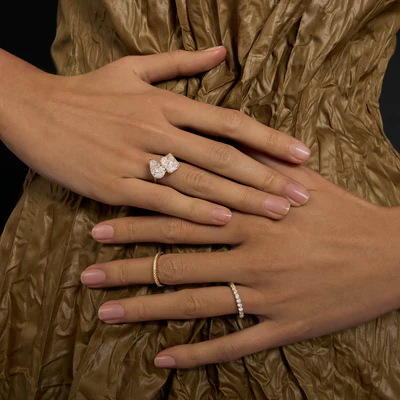
There’s a quiet but genuinely interesting shift happening in how people think about fine jewellery. The goal is not to replace tradition, but to evolve it. Engagement rings in particular are no longer treated as pieces that sit in one fixed role. They move with people now, through airports, beach holidays, long train journeys, and daily routines that don’t always feel like the right setting for something deeply sentimental.
That’s where travel rings have started to feel less like a niche idea and more like a sensible part of modern jewellery life. The intention behind them is straightforward: not to replace meaning, but to carry it differently in moments where wearing the original ring feels impractical or just a bit risky.
And honestly, once you understand that framing, the whole thing makes a lot of sense.
A response to how life actually works now
Engagement rings were once worn in a fairly predictable rhythm. Day-to-day life was more settled, travel less frequent, and the range of environments people moved through was narrower. That’s not really the case anymore.
Life now is layered. A single week might include office days, a weekend trip somewhere, a gym session, and an impromptu flight to somewhere warmer. Jewellery moves through all of that whether it’s designed to or not. In that context, having a second ring for specific situations isn’t a strange idea. It’s a practical one that still feels connected to the original intention.
It’s less about replacing the engagement ring and more about being honest that not every setting is ideal for wearing it.
Protection without losing the thread
One of the main reasons people turn to travel rings is straightforward protection. Losing or damaging an engagement ring isn’t just inconvenient. For most people it would feel genuinely awful in a way that’s hard to put into words.
Travel in particular introduces small risks that quietly add up. Hotel sinks. Swimming pools. Luggage checks. Unfamiliar places where you’re generally less settled and more distracted. Even just moving around somewhere new can make you far more aware of what you’re wearing and whether it’s safe.
A travel ring offers a kind of low-level reassurance. The original ring stays somewhere safe, and you still have the visual habit of wearing something meaningful on your finger. What’s interesting is that this doesn’t seem to dilute sentiment at all. If anything, it can sharpen it. The engagement ring becomes something you’re actively protecting rather than just passively wearing.
Why simplicity makes sense here
Most travel rings share a common visual quality: they’re simple. That’s not accidental. A minimal design suits the purpose in pretty much every way.
Smooth bands and subtle profiles are more comfortable for constant movement. They’re less likely to catch on things, less likely to draw attention when discretion actually matters, and easier to wear without constantly thinking about them. That last point is underrated. Part of the whole idea is that the travel ring just gets on with it quietly.
But there’s also a broader cultural reason behind this simplicity. Jewellery tastes generally have been moving towards understatement for a while now. Across fashion and accessories, there’s a growing appreciation for pieces that feel considered rather than loud. Travel rings sit comfortably within that shift. They’re not trying to compete with anything. They’re responding to a different context entirely.
The emotional side of switching rings
What makes travel rings genuinely interesting isn’t just their practicality. It’s the subtle way they change the emotional rhythm of wearing jewellery at all.
There’s usually a small adjustment the first time someone swaps their engagement ring for a travel ring. The hand feels different. Something familiar is missing. Even if the replacement is perfectly comfortable, there’s a moment of noticing that the usual piece isn’t there.
Over time that feeling tends to soften. The travel ring becomes part of a routine, associated with certain contexts rather than a permanent substitute. Meanwhile, the engagement ring takes on a slightly different quality. It becomes associated with home, with familiar settings, with moments where it’s consciously chosen rather than automatically put on.
That separation doesn’t weaken anything. It actually adds a layer. The same object can feel different depending on when and where it’s present, and there’s something quietly meaningful about that.
Practicality as a form of care
The way people think about luxury has shifted. It used to be defined mostly by rarity and visual impact, and while that hasn’t gone away entirely, there’s now a much stronger appreciation for things that work well in real life. Ease, longevity, and genuine usefulness have become part of the picture.
Travel rings fit into that thinking. A simple band worn in place of a more intricate ring can feel like a considered choice rather than a lesser one. It reflects an awareness of environment and risk. It prioritises the long-term safety of something valuable over the short-term habit of wearing it everywhere regardless.
That kind of thinking is becoming more common generally, and jewellery is catching up with it.
What the shift actually says
It’s worth noting how quickly travel rings have gone from a fairly niche idea to something that feels increasingly normal. Part of that is down to travel being more frequent and more casual than it used to be. But it’s also about jewellery habits evolving in a broader sense.
People are more comfortable with the idea that jewellery can serve different purposes depending on context. Just as clothing moves between formal and informal settings without losing its connection to personal style, jewellery is starting to do something similar.
A simpler piece worn in place of a more elaborate one isn’t a downgrade. It’s a deliberate adjustment that reflects an understanding that meaning doesn’t always need visual reinforcement to stay intact. The contrast between the two rings can actually make both feel more distinct. One becomes associated with permanence, the other with movement. Both sit within the same emotional framework, just doing different jobs.
That’s not a dramatic reinvention of anything. It’s just jewellery quietly catching up with modern life.
Visit More : widemagazine.co.uk
