
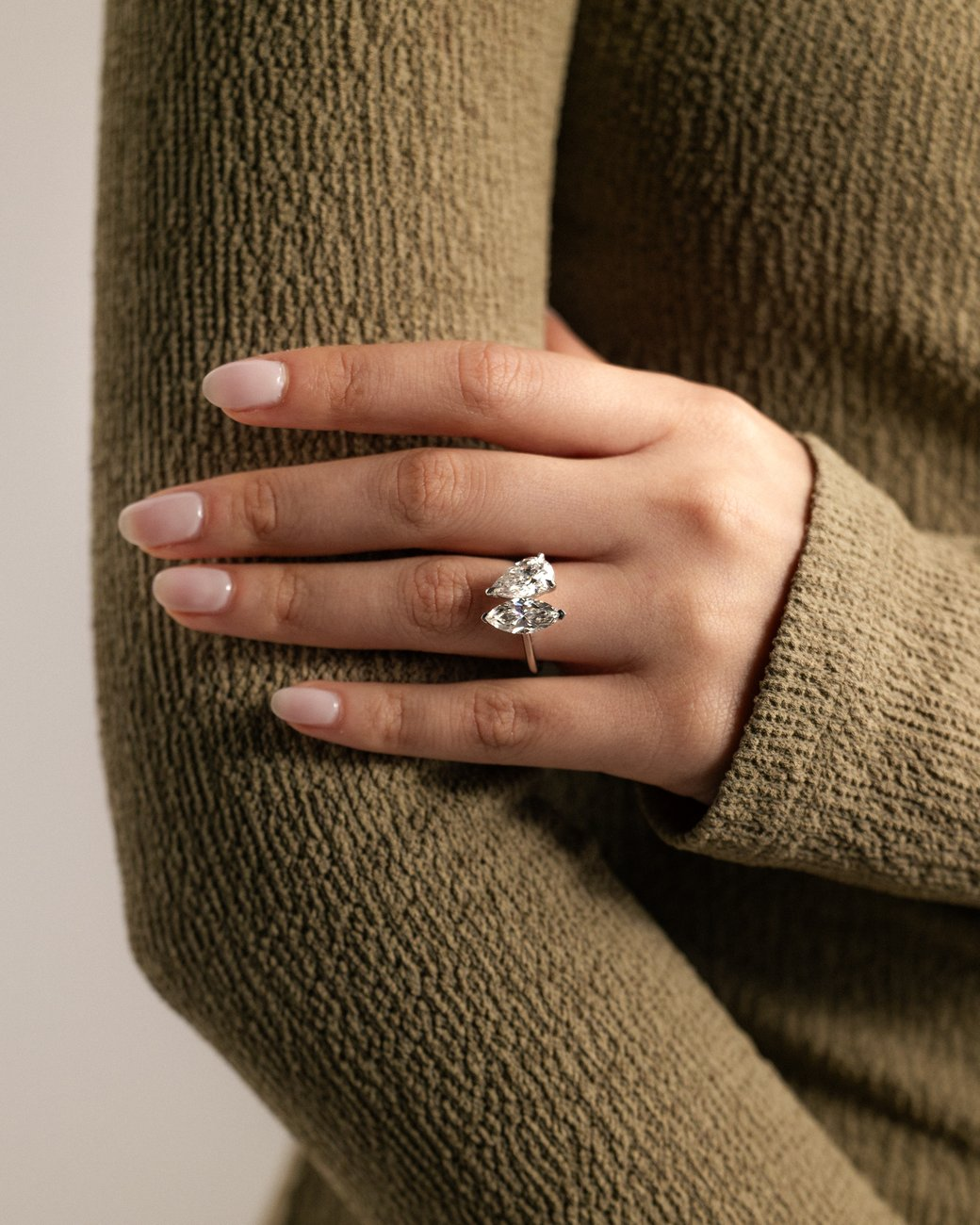
Most ring shapes sit on the hand. A marquise runs along it, and that’s why it has become the go-to cut for anyone who wants their fingers to look longer and more slender.
Why a Marquise Engagement Ring Makes Fingers Look Longer
When a marquise is set north to south, it draws the eye along the length of your finger. Your brain reads that vertical line as extra length. It works like a pinstripe, only smaller and far more sparkly. You can see this clearly in the marquise engagement rings from Cullen Jewellery UK, where the styles range from a classic solitaire to a toi et moi that pairs a marquise with a pear, and the carat filter shows how much more of the finger the stone covers as it gets bigger.
There’s a size bonus too. A marquise is long and fairly shallow, so it shows more face-up area than most shapes of the same carat weight. That also makes it good value. Round diamonds generally cost the most, partly because so much of the rough stone is lost during cutting. With a marquise you get the same weight, more presence and often a friendlier price.
Getting the Ratio Right
The length-to-width ratio is where most of the effect comes from. Most marquise stones fall between 1.75 and 2.25. That range sounds narrow on paper, but it covers everything from a soft, rounded shape to a sleek, needle-like one.
If your fingers are on the shorter side, aim for 2.0 or above, because the extra length does most of the work. For wider fingers, a ratio of around 1.85 to 1.95 keeps the stone in proportion and lets it read as elegant and substantial. Long, slim fingers suit almost any ratio, so you can choose on sparkle alone.
A Quick Word on the Bow-Tie
Nearly every marquise shows a darker band across its middle, known as the bow-tie. A faint one adds contrast and depth. A strong one can look like a shadow. Ask to see a video taken in natural light before you buy, since studio lighting tends to hide it.
Settings and Bands That Boost the Effect
Keep the Band Fine
A slim band, around 2mm or under, keeps the attention on the stone. A chunkier band adds horizontal weight at the base of the finger, which pulls against the vertical line you’re trying to create. If you plan to wear a wedding band alongside it, a curved or contoured band sits neatly against the tips and keeps the line unbroken.
Choose Claws That Cover the Tips
The pointed ends are the most delicate part of a marquise, and exposed tips can snag on knitwear. Claws that wrap over each tip protect the stone from everyday knocks. They also extend the outline slightly at each end, which adds a little more length.
Consider a Hidden Halo
A hidden halo sits beneath the stone, so it adds sparkle from the side while the face of the stone stays the same width. The outline stays clean and the lengthening effect stays sharp.
Sustainable Stones, Longer Shapes
Lab-grown diamonds, moissanite and lab-grown sapphires all come in marquise shapes, so choosing a sustainable stone is easy. They’re created above ground with no mining involved, and you can put any savings towards a longer stone. Going up half a carat in a marquise adds visible length in a way that’s hard to match with a round of the same weight.
Before you settle on a ring, try it at arm’s length. Hold your hand out flat with your fingers together and look at the ring from roughly where someone across a dinner table would see it. If the stone points cleanly towards your fingertip and the band almost disappears, you’ve found the version that makes your hand look its longest.
