
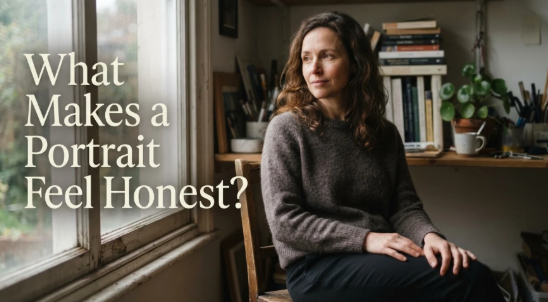
You’ve seen it in someone else’s archive: a face that stops you mid-scroll. Not because the lighting is perfect or the background flattering, but because the person in the frame looks like themselves.
That quality is harder to produce than it looks. So, here, we don’t offer you a complete how-to, but a map of the small choices that separate a sincere image from a technically correct one. We cover how trust gets built before the shutter clicks, how pose and setting pull in opposite directions, and how editing either preserves a person or erases them.
Build Trust before Taking the First Photograph
Hardly anything in portrait photography matters more than what happens before the shutter clicks. Faced with a photographer they don’t trust, most subjects perform a version of themselves, and the camera always catches the performance.
It’s useful to detour a bit from setup by giving the first ten or fifteen minutes to conversation. Ask what kind of photographs they usually hate of themselves, and why. The answer can tell you a lot about the person’s experience. For example, people who’ve been photographed badly often hold tension in specific places (shoulders, jaw, hands), and you can’t fix that with lighting.
Share something about yourself too. Trust works in both directions, and a subject who knows nothing about the photographer stays guarded. Mention why you wanted to photograph them, what you noticed about the light in the room, or what you’re hoping to try. The conversation doesn’t have to be deep, but should feel genuine.
Before you start shooting, explain the plan simply. Where you’ll stand, roughly how long it will take, and whether they can see images as you go. This will reduce uncertainty about the process, and the person in front of you might naturally lose a stiff expression and relax their body.
Guide the Pose Without Dictating the Emotion
Photographing people well means directing the body without staging the feeling. How can it be achieved?
Offer Simple Physical Prompts
Aiming to catch a moment doesn’t mean you can’t give pose instructions. Quite the opposite, but you should do it right. Vague instructions, like “relax” or “look natural,” produce vague results. Concrete, physical prompts work better:
- Shift your weight to your back foot.
- Turn your shoulders a few degrees away from me.
- Lower your chin slightly, then raise it back.
- Breathe out before I press the shutter.
- Look just past my left ear, not into the lens.
Leave Space for Their Own Gestures and Expressions
After the frame is roughly set, stop directing. Keep the camera up. Wait. The best moments in natural portraits usually arrive after the subject thinks the photo has already been taken. A hand goes to the face. The gaze drifts to something behind you. A smile fades, reappears, fades again. That window between takes is where honesty lives.
Shoot through it. You can edit later; you can’t recover what you missed.
Use the Setting to Reveal Personal Context
Where you photograph someone tells the viewer who they are. If it’s possible, work in places that mean something to the subject:
- Their own living space, arranged as they actually live in it
- A workplace they care about (a studio, a workshop, a desk with specific objects on it)
- An outdoor spot they return to regularly, not a generic landmark
Resist the urge to tidy the frame too thoroughly. A visible stack of books, worn furniture, or paint on a wall adds specificity. Over-cleaned environments erase the person along with the clutter.
Besides, pay attention to what the person reaches for when they’re nervous, be it a coffee cup or a pet. This thing usually carries some weight for the person you’re photographing. Include it in the frame, and the portrait gains a unique dimension.
Choose What Color or Black and White Contributes
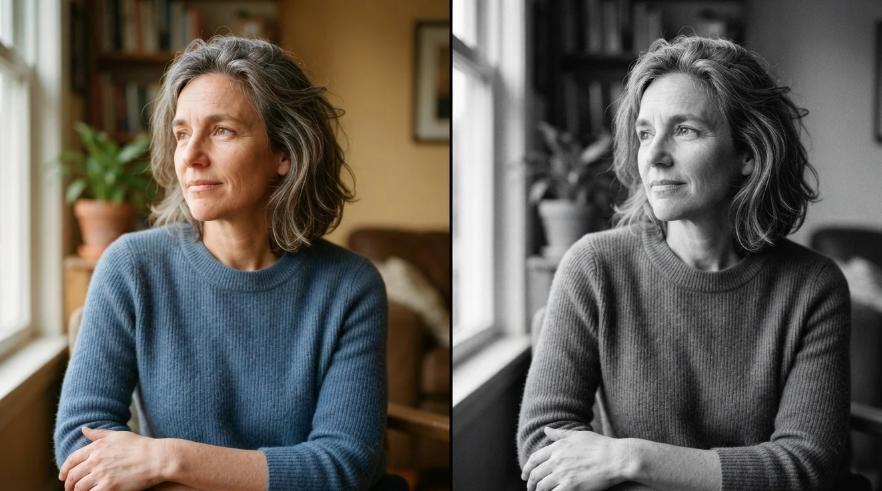
Color in photography anchors a portrait to a moment: the specific yellow of afternoon light in a particular room, the blue of a favorite sweater, skin tones as they actually are. Color roots the image in time and place.
BW photos switch the main topic. Black-and-white portraits strip away chromatic context and push attention onto expression, texture, and bone structure. A face that reads as busy in color often reads as composed in monochrome, because the eye stops sorting for hues and starts reading form.
Shoot both when you can. Decide later which version serves the subject. For anyone working in film, a dedicated lab offering black-and-white film developing that handles each stock individually will give you more usable frames to choose from.
Consider What the Final Image Says About the Person
The photograph isn’t finished when you lower the camera. Editing and selection shape whether the final image still reads as honest.
Retouch Without Erasing Defining Features
Light retouching removes distractions. Heavy retouching removes people.
A 101 guide: fix what wouldn’t be there in two weeks (a stray hair, a temporary blemish, a crumb on a shirt). Leave what will still be there (a scar, a mole, laugh lines around the eyes, the shape of someone’s nose). These aren’t flaws, but peculiarities that can make the subject identifiable to the people who know them.
The most common mistake is smoothing the skin until it looks almost plastic. The subject ends up looking thinner, younger, and more polished, but less like themselves. And that’s precisely what a photograph is meant to preserve: their resemblance.
Select a Representative Moment
Most shoots produce dozens of frames. The selection process is where honesty is finally decided.
What usually ends up on the wall isn’t the frame where the subject looks “best” in a conventional sense; it’s the one that most resembles the person you met. A slightly less flattering image that reads as them will tend to mean more to the subject, and to anyone who knows them.
When in doubt, show the subject three or four options and let them weigh in. People often choose differently than photographers do, and their instinct about their own face is usually accurate.
What Honesty Actually Looks Like in the Frame
An honest portrait isn’t necessarily flattering. It’s an image that shows the viewer the specific person, not a clean version of them. Whether you shoot digital or lean into film photography, whether you work in color or commit to analog photography in black and white, the discipline is the same. Pay attention to the subject before you pay attention to the frame. Keep what makes them recognizable. Let them stop performing, and photograph genuine moments.
