
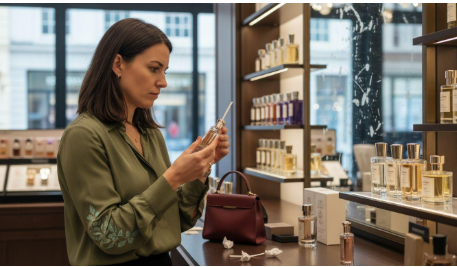
Your first choice in a perfume shop can give you a useful clue about your fragrance preferences. It might point to a liking for bright citrus, soft sweetness, dry woods or something familiar.
It cannot, on its own, tell you your personality or identify the perfume you will enjoy wearing most.
There is also a difference between the first bottle you reach for and the first scent you prefer. One might reflect a name you recognise or a bottle that catches your eye. The other gives you something to investigate.
That investigation need not be complicated. Instead of asking what your choice says about the kind of person you are, ask which part of the smell made you choose it.
You may discover that your supposed love of floral perfumes is really a preference for fresh, airy scents. Or that the vanilla you keep searching for matters less than the dry woods underneath it.
Which First Choice Are We Talking About?
Imagine three moments at a fragrance counter.
You pick up a bottle because a friend mentioned it. You smell its tester strip and prefer it to the next perfume. Later, after trying both on skin, you find yourself returning to the second one.
Each choice answers a different question.
The bottle tells you what attracted your attention. The strip tells you which initial smell appealed. Your later reaction tells you more about what you want to wear.
None of those reactions is meaningless. They simply carry different information.
Before drawing conclusions, identify yours:
- First bottle: What made me reach for it?
- First favourite on paper: Which quality stood out?
- Favourite after wearing: What did I continue to enjoy?
The last answer is usually the most useful when choosing a full bottle. The first two can help you decide what deserves a test.
Your Nose Gives You a Clue. Your Description Makes It Useful.
But it leaves a consultant guessing. Do you like the clean opening, the sweetness, the warmth or the fact that it reminds you of something you already wear?
Try completing this sentence:
“I prefer this because it smells more…”
Fresh. Dry. Soft. Green. Creamy. Less sweet. Less powdery.
You do not need to identify ingredients correctly. “It smells like orange peel rather than orange sweets” is more helpful than naming bergamot because you saw it in the notes.
Keep the description tied to your experience. ScentRepublic noted to us that a perfume that feels clean to you might smell soapy, citrusy or musky to someone else.
A Practical Way to Interpret That First Preference
The table below offers questions to test, rather than fixed rules about taste.
| What attracts you first | A preference worth investigating | A useful comparison |
| A bright citrus opening | Crispness, freshness or low sweetness | Another fresh scent with a different later finish |
| A sweet, creamy smell | Softness, sweetness or a comforting texture | A similarly creamy scent with less sweetness |
| A rose or jasmine impression | A particular floral character | A second floral with different sweetness and weight |
| A dry woody smell | Dryness, woodiness or restrained sweetness | A woody scent with and without a sweet base |
| A clean, soapy impression | Cleanliness, softness or familiarity | A fresher, less powdery interpretation |
| A rich spicy opening | Warmth, spice or a more noticeable scent | A warm fragrance with less spice or sweetness |
Your reaction becomes more informative when you compare one quality at a time.
If you prefer two very different perfumes because both feel dry and unsweet, that common feature may be a better guide than their fragrance-family labels.
You Might Like Freshness More Than Citrus
A citrus opening can be immediately appealing. But does that mean you want a citrus fragrance?
Perhaps. Or perhaps you enjoy the sense of brightness it gives you.
To find out, compare the first choice with another fragrance that feels fresh but takes a different direction. One might settle into woods; another might remain greener or become softer.
If you like both at first but favour only one later, you have learned something more precise.
“I like fresh scents that become dry and woody” gives you a stronger shopping brief than “I like lemon”.
The same reasoning works with sweetness. You might enjoy a sweet first impression but dislike wearing that sweetness for hours. Or you may like a creamy scent even when it is not especially sweet.
Do not let the most obvious opening feature become your entire definition of good perfume.
A Familiar Smell Can Feel Right Before You Know Why
Sometimes the first favourite feels easy to like because something about it is familiar.
It may resemble a perfume you have owned, a scented product you use or a smell you associate with a particular place. You do not have to identify the connection for it to influence your reaction.
Research offers a useful qualification here. A 2015 study on repeated exposure to odours found that familiarity increased across the tested smells. Pleasantness increased for neutral and mildly pleasant odours, while unpleasant and very pleasant odours did not show the same improvement. Familiarity did not make everything more enjoyable.
The study tested odours over separate sessions, not shoppers selecting commercial perfumes. Its practical lesson is limited: a scent you feel neutral about may deserve another encounter, but there is no reason to force yourself to like something you dislike.
A familiar favourite is also a valid choice. You do not have to buy something unusual to prove that you understand fragrance.
The useful question is whether familiarity explains all of the appeal, or whether you can name a quality you want to find again.
The Name Can Join In Before You Have Finished Smelling
Suppose you read that a perfume contains vanilla before you test it.
You may start looking for vanilla. If you already think vanilla perfumes are too sweet, that expectation can become part of the judgement.
This does not mean the smell is imaginary. It means the words around a smell can influence how it is experienced.
In a 2005 experiment published in Neuron, researchers presented the same test odour with different descriptions. Participants rated it as more unpleasant when labelled “body odor” than when labelled “cheddar cheese”.
That was a laboratory experiment with a specific stimulus, not a test of perfume branding. It nevertheless shows why a description should not be treated as separate from perception.
A simple shopping adjustment is to smell a strip before reading the notes, where practical. Write down your own reaction first.
Then use the note list to investigate it. You may find that a perfume containing an ingredient you normally avoid is still enjoyable as a whole.
A Real Retail Study: Perfume Choice Was Only Weakly Linked to Personality
Many fragrance articles attach personality types to scent families. Fresh scents are assigned to energetic people; rich perfumes to confident people; florals to romantic people.
Those descriptions can be entertaining. They are a poor substitute for smelling.
A published study by Wim Janssens and Patrick De Pelsmacker, Smells Like Me: Personality and Perfume Choice, examined purchase information and survey responses from 348 customers.
The shop offered its fragrances in identical numbered bottles. Customers narrowed their preferences through comparisons, reducing the influence of visible branding and packaging.
The researchers investigated relationships between fragrance choice and both actual and ideal-self personality. They reported only a weak relationship with actual personality and no support for a relationship with ideal-self personality.
This was one retailer’s selection process and customer sample, not a universal test. It also examined final choices rather than the first bottle a customer touched.
Still, it gives shoppers a useful reason to resist rigid personality advice. Choosing a woody perfume does not reliably establish that you are reserved, confident or adventurous.
Your preference tells you more directly about a smell you enjoy than about your character.
Liking It on Paper and Wanting It on You Are Different Decisions
A fragrance can be lovely to smell without becoming something you want to wear.
Think of it as two separate questions:
- “Do I enjoy this smell?”
- “Do I want this smell around me during my day?”
You might admire a rich fragrance on a strip but prefer something quieter at work. Another perfume may be less striking at first yet feel comfortable throughout an afternoon.
The Perfume Society’s shopping guidance recommends blotters for narrowing options and skin testing before deciding on a purchase. It advises allowing time for the first impression to settle.
There is also evidence that individual wear matters. A 2012 study in PLOS ONE found that mixtures of participants’ body odour with their own preferred perfumes were rated more pleasant and attractive than mixtures with an assigned perfume.
That result came from controlled body-odour sampling. It does not prove that a first instinct always identifies the best fragrance, or that everyone can predict how a perfume will wear.
It supports a narrower point: the perfume by itself is not the whole wearing experience.
Use Your First Favourite to Choose the Next Two Tests
Your first choice becomes more useful when it guides a small comparison.
Choose three candidates:
- The first favourite. Keep it as your starting point.
- A close alternative. Preserve the quality you liked, but change something you are unsure about.
- A different option with one shared quality. Look beyond the same brand or fragrance family.
For example, if you liked a sweet floral but worried about its sweetness, ask for a less sweet floral. Then try something from another family that shares the softness you enjoyed.
This is a practical comparison method, not a scientifically validated preference test. Its purpose is to make each additional sample answer a question.
An Example:
A shopper prefers a fruity floral on the first strip. Instead of concluding that they love all fruity florals, they notice that the appeal is its crispness. They compare it with a sweeter fruity scent and a green floral.
The sweeter option feels sticky to them. The green floral remains appealing.
Their useful conclusion is: “I like crisp, fresh scents with some floral character, and I prefer less sweetness.”
That description leaves room for several brands and fragrance families. It also makes the next search more focused.
Make a Short Record You Can Actually Use
You do not need a spreadsheet of ingredients. A note on your phone is enough. Record the exact perfume and concentration, followed by three observations:
| Stage | Question |
| First impression | What made me prefer it? |
| After it settled | What changed, and did I enjoy the change? |
| Later in the day | Would I want to wear it again? |
Add one line about anything you disliked.
An exclusion can be surprisingly useful: “I enjoy sweetness until it becomes powdery” is more precise than simply requesting something sweet.
For a South African shopper, include the intended use too. A perfume for an air-conditioned office is serving a different need from one you want for evenings outdoors.
Describe your actual routine rather than relying on a broad rule about summer or winter scents. You may want more than one fragrance because you want more than one experience.
FAQs
Does Choosing a Sweet Perfume First Mean I Prefer Gourmand Fragrances?
Not necessarily. You might enjoy a sweet opening, a creamy texture or fruitiness rather than a food-like scent. Compare the first choice with a less sweet option and check whether the appeal remains.
What If My First Favourite Changes Every Time I Visit?
Look for qualities shared by the favourites rather than expecting one permanent winner. You may also be shopping for different uses on different visits. Record what appealed each time before deciding that your taste is inconsistent.
Can I Like Floral Perfumes but Dislike Rose?
Yes. Floral is a broad description. You may also dislike some rose interpretations and enjoy others. Treat your reaction to a particular perfume as more useful than a blanket rule about a listed note.
Should I Buy the First Perfume I Love Immediately?
Give it a wearing test first when possible. An immediate positive reaction earns it a place on your shortlist; it does not tell you how you will feel about its later stages.
Does Picking the Same Brand Mean I Have Found My Fragrance Style?
It may mean you enjoy several of its perfumes, but the brand name alone does not explain why. Compare their smell, sweetness and later finish. Those shared qualities are more useful when exploring another brand.
How Do I Explore Something Different Without Buying Blind?
Ask for a fragrance that changes one feature of a favourite. Keep the freshness but try more woods, or keep the softness with less sweetness. Test it before committing to a full bottle, and ask whether a sample is available rather than assuming one will be offered.
Turn the First Reaction Into a Better Brief
Your first choice is worth paying attention to. The mistake is asking it to tell you everything.
Name what attracted you. Compare a close alternative. Check whether the same quality still appeals after the fragrance settles.
You might finish with a brief as simple as: “Fresh and green, with little sweetness.”
Or: “Soft florals, but nothing too powdery.”
That is something you can use.
When you browse women’s perfumes or unisex fragrances at Scent Republic, use the descriptions to build a shortlist around those preferences. Note lists can suggest candidates; your experience of wearing them makes the decision.
The goal is to understand why you liked the first perfume well enough to recognise the next one.
