
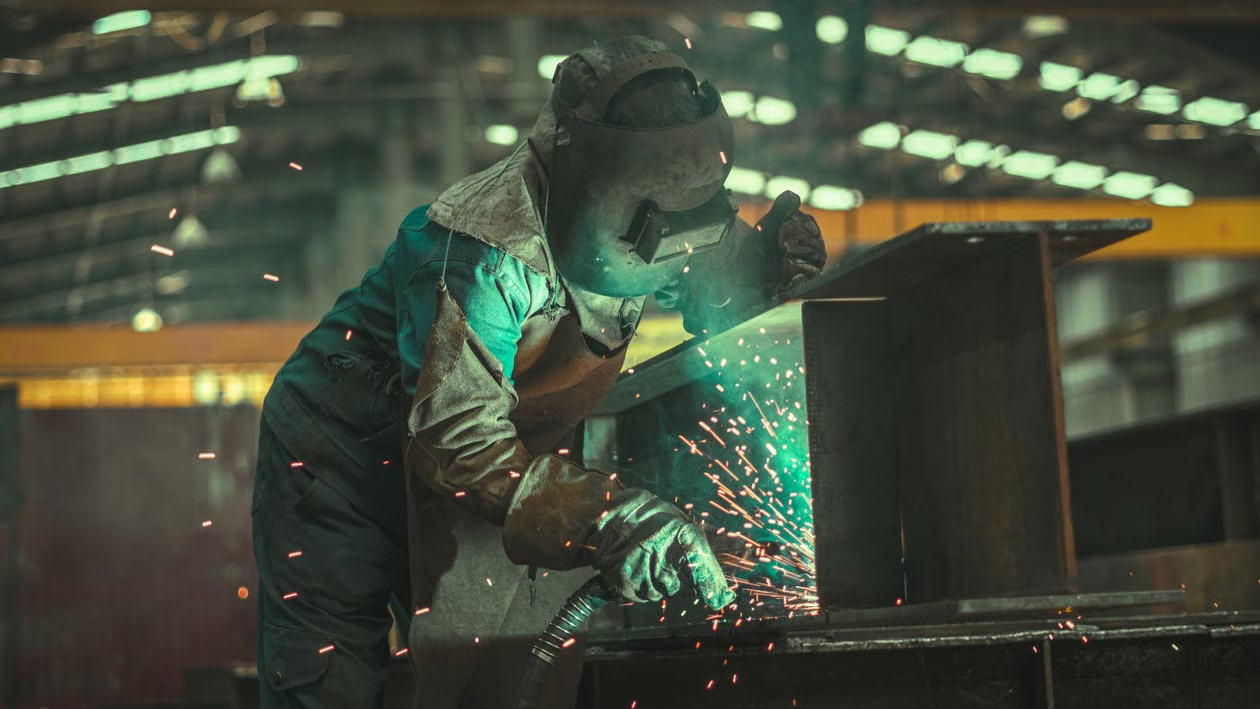
A welder on a building site and an artist in a studio do much the same thing: they melt metal with an electric ARC. The jobs are different, but the principle is the same. Today, a PATON ARC welder weighs about as much as a school bag, yet it handles thick structural steel and delicate metalwork alike.
How It All Began
Nikolai Benardos first used an electric ARC to join metals in 1881. In 1888, Nikolai Slavyanov introduced the consumable metal electrode, which allowed the process to scale up to an industrial level. Soon rivets began to give way to welding in factories and shipyards.
Ukrainian science played a key role in what followed. The E.O. Paton Electric Welding Institute developed automatic submerged-ARC welding, which made it possible to produce long, consistent seams on large structures. The Paton Bridge across the Dnieper in Kyiv, opened in 1953, became one of the world’s first large all-welded bridges.
Inverters Replace Transformers
Older transformer-based machines weighed tens of kilograms. They were noisy, prone to overheating, and very sensitive to voltage drops. Inverter technology changed that by converting mains voltage into high-frequency current, which let designers shrink the internal transformer without losing power. The practical benefits are easy to list:
- low weight, compact dimensions;
- smooth, precise current control;
- stable ARC despite voltage drops;
- easy ignition, minimal spatter;
- works from the mains or a generator.
These qualities matter most to people who work in different places in a single week, from a garage to an open field. The welder has stopped being a heavy fixture in a workshop and become a tool that travels with the person.
One Technology, Several Processes
Inverters waste far less energy as heat than transformer machines, so large workshops can see lower electricity bills quickly. Built-in protection against overheating and overload extends service life and means fewer replacements.
ARC welding isn’t a single method but a family of methods. Modern equipment often covers several of these processes at once:
- MMA — simple, works outdoors in the wind;
- MIG/MAG — fast wire feed, gas shielding;
- TIG — clean seams on thin metal;
- Plasma — precise cutting of various metals.
Multi-mode machines let one operator switch between these tasks without buying separate units. This is useful for small workshops and mobile crews, which often have limited space.
Choosing the Right Process
The best method depends on the material, its thickness and the place of work. Outdoor repairs and construction frames usually call for MMA, because coated electrodes tolerate dirt, rust and drafts. MIG/MAG saves time in steady workshop production. Stainless steel, aluminium and thin tubing respond best to TIG.
Precise current control and a stable ARC give sculptors and designers the confidence to work with thin tubes and sheets. A technique once associated with ships and bridges now appears in furniture, installations and public art.
Over a century and a half, ARC welding has grown from an experiment into a basic technology of modern construction and manufacturing. Inverters made it portable, precise, and economical. Those interested in inverter models can find them on PATON’s official website.
