
Hybrid work has changed the security perimeter. It may have even improved security. Now, employees connect from branch offices and home networks. They can even access from airports and shared workspaces.
Consequently, choosing SASE products requires more than comparing feature lists or accepting a vendor’s broad promise of “complete protection.”
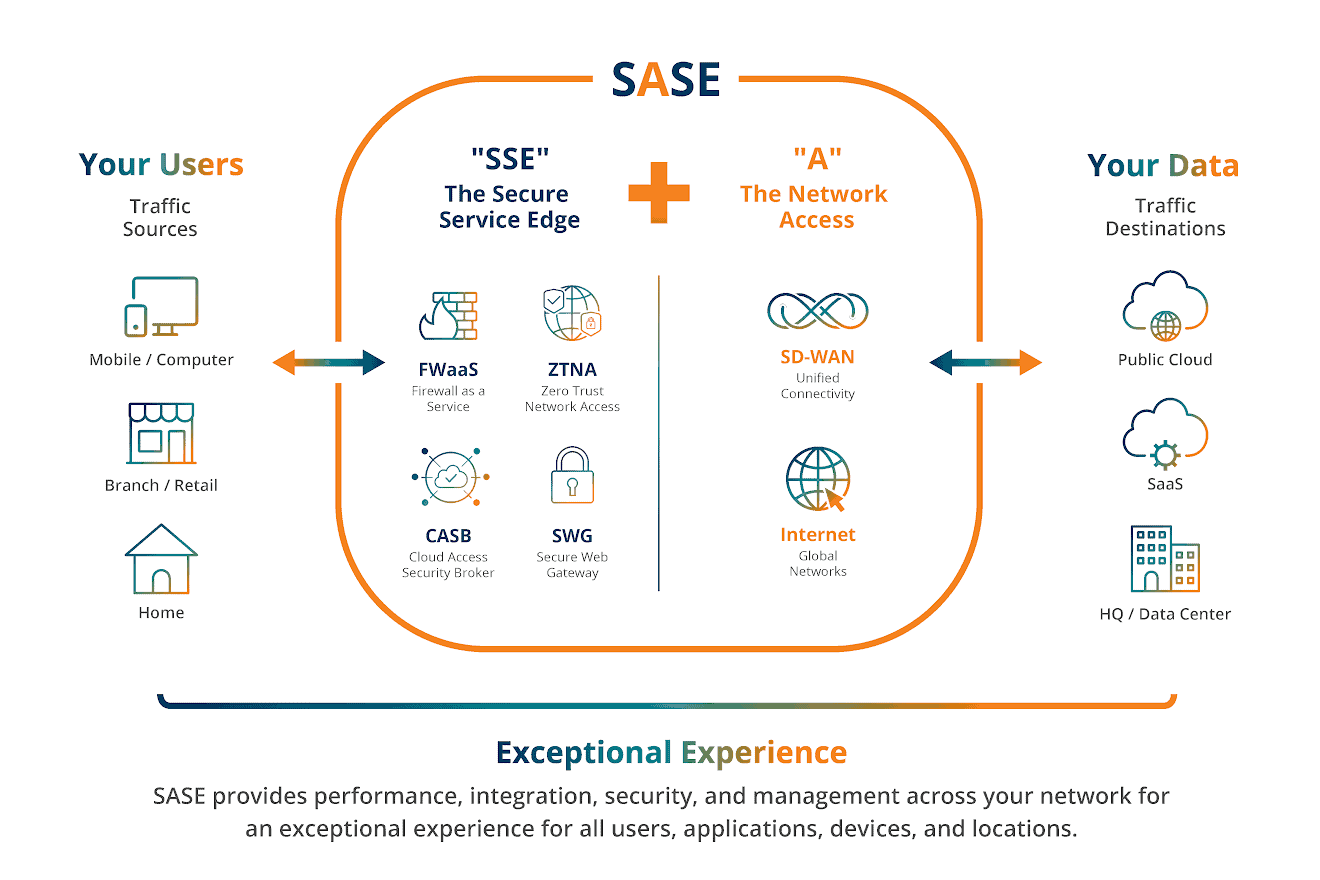
Secure access service edge combines networking and security functions through a cloud-delivered architecture. However, the label alone proves very little.
Buyers still need to examine identity controls, inspection capacity, policy consistency, operational effort, and the vendor’s ability to support real traffic patterns.
1. Start With the Workforce, Not the Product Catalogue
Before reviewing platforms, map how the following aspects connect:
- Employees
- Contractors
- Devices
- Applications
- Branch locations.
Otherwise, the selection process turns into a box-ticking exercise. A remote developer accessing cloud infrastructure creates different risks from a sales employee opening customer records through a managed laptop.
For growing organisations, unified SASE products for businesses can offer a clear path to simpler policy management and fewer disconnected controls.
Nevertheless, “unified” should mean shared policy, telemetry, enforcement, and administration. A single commercial bundle containing loosely connected tools does not really count.
Document the organisation’s connection paths first. Include cloud applications, private applications, software-as-a-service platforms, data centres, unmanaged devices, and third-party access. Then identify where latency, excessive privilege, weak authentication, or inconsistent inspection creates exposure.
Although this work is slightly tedious, it still prevents expensive guesswork later.
2. Examine the Architecture Behind the SASE Label
A credible platform should combine –
- Software-defined wide area networking
- Secure web gateways
- Cloud access security brokers
- Zero-trust network access
- Firewall-as-a-service
- Centralised management.
However, buyers should inspect how these capabilities work together. Do not just check whether they appear on a product page.
Some vendors built their offering on one cloud-native architecture. Others assembled it through acquisitions and later connected separate consoles.
Therefore, ask whether administrators can create one policy and apply it across users, devices, branches, and applications. Also, check whether reporting uses one data model or several stitched-together dashboards.
| Assessment Area | Stronger Indicator | Warning Sign |
| Policy management | One policy framework across network and security controls | Separate rules for every module |
| Traffic inspection | Single-pass inspection with consistent enforcement | Repeated inspection through multiple services |
| Identity context | User, device, location, and risk affect access | Access depends mainly on IP addresses |
| Administration | One console with shared telemetry | Frequent switching between portals |
| Global delivery | Distributed points of presence with transparent routing | Unclear infrastructure ownership or coverage |
3. Test Zero-Trust Access in Real Conditions
Zero-trust network access should grant access to specific applications. It is not merely about broad network segments. The platform should also evaluate the following before allowing a connection:
- Identity
- Device posture
- Location
- Session risk
- Application sensitivity.
Static login authentication is no longer enough for a dispersed workforce.
During a proof of concept, test managed and unmanaged devices separately. Also, simulate expired certificates, outdated operating systems, impossible travel events, and changes in user privilege.
The service should adjust access without forcing administrators to rebuild policies manually. If it cannot, the zero-trust claim starts looking rather thin.
Contractor access deserves particular attention. Ideally, external users should reach approved applications without receiving unnecessary visibility into the internal network.
Meanwhile, administrators should receive useful session records, not a swamp of logs that nobody can interpret during an incident.
4. Measure Performance Where Employees Actually Work
Security controls lose value when users bypass them to escape slow connections. Therefore, performance testing should include home broadband, mobile networks, branch links, and regions where the organisation has employees.
A polished demonstration from a nearby data centre says very little about everyday experience.
When evaluating SASE products, measure latency before and after inspection, application response time, tunnel stability, and failover behaviour.
In addition, test voice, video, large file transfers, and browser-based business applications. Average performance may look acceptable, but brief spikes can still wreck meetings and cloud sessions.
So, ask how the vendor routes traffic between its points of presence and application providers. Likewise, examine the following:
- Peering relationships
- Capacity planning
- Service-level commitments
- Regional redundancy.
The fastest-looking platform on paper may rely on awkward routing in the locations that matter most.
5. Judge Data Protection and Threat Inspection Together
A secure platform must inspect encrypted traffic, detect malicious content, control cloud application use, and prevent sensitive information from leaving approved environments.
Yet aggressive inspection can add latency, create privacy issues, and complicate certificate management. The balance needs practical testing, not marketing reassurance.
Review data loss prevention policies across web traffic, cloud applications, uploads, and collaboration tools. Then test whether the system recognises contextual differences.
For example, uploading a public brochure should not trigger the same response as transferring customer records to an unsanctioned storage account.
Equally, examine how the platform handles exceptions. Security teams need controlled bypass rules for applications that break under inspection.
However, those exceptions should remain narrow, visible, and reviewable. Permanent blanket exclusions often become forgotten security gaps.
6. Investigate Operations, Integration, and Skills
Even capable technology can fail under clumsy administration. Consequently, buyers should calculate how many consoles, policy objects, alerts, and specialist roles the platform introduces.
A manageable system reduces repetitive work. Meanwhile, it preserves enough control for experienced network and security teams.
Check integration with the following factors:
- Identity providers
- Endpoint detection tools
- Security information and event management platforms
- Ticketing systems
- Automation workflows.
Moreover, confirm that application programming interfaces expose meaningful functions. A small collection of read-only reports does not help.
Basically, a focused trial should answer several practical questions:
- Can administrators trace one user’s session from authentication to application access?
- Does the platform explain why it blocked or allowed an action?
- Can teams roll back policy changes without disrupting unrelated users?
- Do alerts move into existing investigation workflows with adequate context?
7. Compare Commercial Terms Beyond the Headline Price
Per-user pricing appears straightforward. However, the final cost may include –
- Bandwidth tiers
- Branch appliances
- Premium threat protection
- Log retention
- Support packages
- Regional services.
Therefore, model costs against actual users, locations, traffic volumes, and retention requirements.
Also, examine contract flexibility. Hybrid workforces change quickly through –
- Hiring
- Acquisitions
- Outsourcing
- Office closures.
For instance, a rigid multi-year commitment may leave the organisation paying for unused capacity. Conversely, an unusually cheap offer may exclude the controls needed for meaningful consolidation.
Choose for Consistency, Visibility, and Real-World Control
The right platform should make security policy more consistent without hiding technical complexity behind a shiny dashboard.
Ultimately, organisations should choose SASE products by testing architecture, access decisions, inspection quality, regional performance, integrations, and operational effort against genuine workforce conditions.
The sensible choice rarely comes from the longest feature list. Instead, it comes from evidence gathered during a disciplined proof of concept.
If employees can connect securely, the platform is doing the job. Applications must also remain responsive. Moreover, administrators can understand every decision.
