
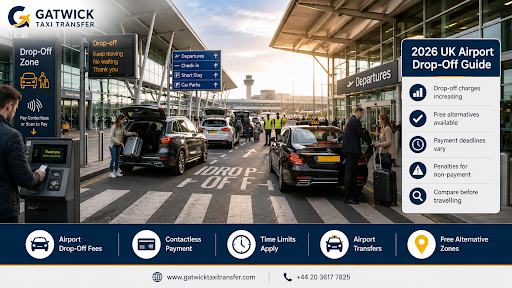
Airport Drop-Off Five years ago, pulling up outside a UK terminal to let someone out cost nothing. Today it costs up to £10 for a stop measured in minutes, and nearly every commercial airport charges something.
The fees arrived in 2021 as pandemic revenue recovery and have risen almost every year since. In the first five months of 2026 alone, six airports changed their pricing, and Gatwick’s jump from £7 to £10 was described by the RAC as the largest single increase any UK airport has made.
Most travellers discover the charge at the barrier, or weeks later when a penalty notice arrives because nobody realised payment was due online. The systems differ everywhere: some use cameras, some barriers, some allow ten minutes, some five.
Below is what each airport charges, what free alternatives exist, and how to avoid paying more than you need to.
UK Airport Drop-Off Charges 2026
| Airport | Charge | Time allowed | Free alternative | Notes |
| Gatwick | £10 | 10 min | Long Stay, 2 hrs, shuttle | £100 penalty |
| Stansted | £10 | 15 min | Mid Stay, 60 min | £28 for 15–30 min |
| Bristol | £8.50 | 10 min | Silver Zone, 1 hr, bus | Dearest outside London |
| Edinburgh | £8.50 | 10 min | Long Stay, 30 min, walk | Rose from £6 in May |
| London City | £8 | 5 min | None — DLR only | First charge, Jan 2026 |
| Southend | £8 | 10 min | None — rail adjacent | Pay after exit |
| Leeds Bradford | £8 | 10 min | Free zone, 1 hr | Short walk |
| Heathrow | £7 | 10 min | Park & Ride, 30 min | £80 penalty |
| Luton | £7 | 10 min | Long Stay, 2 hrs | Barrier, not cameras |
| Glasgow | £7 | 15 min | Long Stay, 1 hr | £50 at 30 min |
| Southampton | £7 | 20 min | Check availability | Rail station adjacent |
| Liverpool | £6 | 10 min | Drop Off 2, 20 min | 7-minute walk |
| Newcastle | £6 | 10 min | Callerton Parkway, 90 min | Generous free window |
| Manchester | £5.50 | 5 min | JetParks 1, no cap | Free 24/7 shuttle |
| Belfast International | £5 | 10 min | Long Stay, 15 min | |
| East Midlands | £5 | 15 min | Long Stay 2, 1 hr | |
| Bournemouth | £8 | 10 min | None confirmed | |
| Cardiff | £4.50 | 10 min | Car Park 2, 20 min | Among the cheapest |
| Birmingham | Free | 10 min | Drop Off zone | Only free major airport |
Figures compiled July 2026. Charges change frequently, so check the airport’s own site before travelling.
Why Airports Charge Drop-Off Fees
Airports give three reasons, each with some weight.
Congestion is the most defensible. Forecourts were designed for a fraction of current traffic, and free access encourages circling and idling in spaces meant for brief stops.
Environmental policy follows. Airports face pressure to shift passengers towards public transport, and pricing the kerb is the bluntest available lever.
Then there is revenue, mentioned less often. Business rates have risen sharply — Gatwick cited a doubling of its bill when justifying the 2026 increase, Edinburgh a 142% jump.
The counter-argument is straightforward. European hubs face comparable costs and recover them through landing fees. Amsterdam allows twenty minutes free; Frankfurt and Zurich charge nothing for a short stop. The RAC notes that charging hardest where public transport is poorest leaves drivers no real alternative.
London Airports
Heathrow
Heathrow charges £7 per entry, up from £6 in January 2026, and introduced a ten-minute maximum stay at the same time — its first ever time limit.
There are no barriers. Cameras read your plate and payment is due online by midnight the following day. Failing to pay can result in an £80 penalty, reduced by half if settled within 14 days.
Blue Badge holders are exempt but must register in advance; displaying the badge is not enough. Park & Ride gives thirty minutes free with a shuttle.
Gatwick
Gatwick is now the joint most expensive airport in the country at £10, a 43% rise in January 2026.
The common mistake is terminal confusion. North and South have separate forecourts, and arriving at the wrong one means paying twice. The other is assuming the charge is settled at the barrier — it is not, and the penalty is £100.
The free alternative is useful: both Long Stay car parks allow two hours free, with a ten-minute shuttle. Anyone helping with heavy bags may find Short Stay better value than the forecourt.
Passengers using a pre-booked transfer will usually find the fee absorbed into the fare, as with Gatwick Taxi Transfer, whose Gatwick airport transfers include it.
Stansted
Stansted matched Gatwick at £10 in March 2026, though it allows fifteen minutes rather than ten.
The sting is the next tier. Between fifteen and thirty minutes in the Express Set Down, the charge jumps to a flat £28. Mid Stay offers sixty minutes free with a shuttle every ten minutes, the sensible option for anything but the briefest stop.
Unusually, Blue Badge holders are not exempt here.
Luton
Luton charges £7 for ten minutes, then £1 per minute. It is the only London airport still using barriers rather than cameras, so payment is by contactless card on exit.
That removes the deadline risk entirely. Long Stay allows two hours free with a shuttle.
London City
London City introduced its first ever charge in January 2026: £8 for five minutes, then £1 per minute to a ten-minute maximum.
That is the highest per-minute rate in London, and a full ten-minute stop costs more than at Gatwick. There is no free car park, so the DLR station beside the terminal is the only zero-cost route.
Around two-thirds of passengers here already arrive by public transport, part of why the airport held out longest.
Southend
Southend charges £8 for ten minutes in its Express zone, payable online after leaving.
It has no free vehicle alternative, unusual among the London airports. The compensation is the rail station, roughly a minute’s walk away — the shortest station-to-terminal distance of any London airport.
Other Major UK Airports
Outside London the picture is more varied and generally cheaper, though the gap is closing.
Bristol and Edinburgh are dearest at £8.50, Edinburgh’s rise arriving in May 2026 alongside the removal of its electric vehicle discount. Leeds Bradford has also moved into the £8 bracket.
Glasgow and Southampton charge £7, Liverpool and Newcastle £6, Manchester £5.50 for a window that expires quickly. Belfast International and East Midlands charge £5, Cardiff £4.50.
Birmingham is the exception, still offering ten free minutes at a zone roughly 400 metres from the terminal, served by a bus.
Free alternatives are often better outside London. Newcastle’s Callerton Parkway allows ninety minutes, and Manchester’s JetParks 1 runs a 24-hour shuttle with no time cap.
Hidden Costs Drivers Often Forget
The headline fee is rarely the whole cost.
Missed payments are the largest avoidable expense. Camera systems require online payment, usually by midnight the next day, and penalties run from £80 to £100.
Overstay tiers escalate steeply. Stansted’s jump to £28 after fifteen minutes and Manchester’s £25 after ten dwarf the base fee.
Then there is the journey itself: fuel, the £18 Congestion Charge on central London routes, ULEZ at £12.50 for non-compliant vehicles, the Dartford Crossing, and queuing on approach roads at peak times.
Double red lines on approach roads are worth noting separately. Stopping on them is banned outright and enforced by council cameras, entirely separately from the airport’s own charge.
How to Avoid Paying More Than Necessary
- Use the free zone where one exists, checking how long the transfer takes before committing.
- Pay online immediately, in the car park, rather than trusting yourself to remember.
- Register for Blue Badge exemption in advance. It is almost never automatic.
- Read the signage. Free zones and paid forecourts are often adjacent and poorly distinguished.
- Allow extra time. Saving £10 is no bargain if it causes a missed flight.
- Consider short-stay parking. At some airports it costs less than the forecourt and gives longer.
Why Fixed-Price Airport Transfers Appeal to Many Travellers
Many private transfer operators include airport access charges in the quoted fare, removing both the payment deadline and the penalty risk. Operators such as Gatwick Taxi Transfer’s fixed-price service work this way.
The charge is per vehicle, not per passenger, so a family of four at Gatwick pays £2.50 each. A solo traveller pays the full £10.
This is not automatically cheaper than driving yourself. It converts a small unpredictable cost into a known one, which suits some travellers and not others.
Frequently Asked Questions
Why do airports charge? Officially to cut congestion and encourage public transport. Airports also cite rising business rates.
Can I avoid it? Usually, by using a free car park and walking or taking a shuttle. Birmingham and Inverness remain free at the kerb.
What happens if I don’t pay? Camera-based airports issue penalties of £80 to £100, typically halved if paid within fourteen days.
Which airport is cheapest? Birmingham, which is still free for ten minutes. Cardiff is the cheapest chargeable major airport.
Which is most expensive? Gatwick and Stansted at £10, though London City costs most per minute.
Conclusion
Drop-off charges are now permanent. No airport has withdrawn one, and the direction of travel is upward.
For an annual holiday the fee is a minor irritation. For anyone making the trip regularly it adds up, and one missed payment can cost more than a year of correctly paid stops.
The advice is simple. Check the charge before travelling, since it may have changed since your last trip. Budget for it rather than be surprised by it. Compare it against the free alternative, factoring in the walk. And weigh driving against the train or a pre-booked transfer on total cost, not the fee alone.
