
Why Aging Media Is Becoming a Business and Cultural Risk
Across industries, organizations are sitting on a silent vulnerability: aging media. From legacy hard drives and magnetic tapes to optical discs and outdated cloud formats, critical data is increasingly stored on media that were never designed for long-term reliability. What was once considered “archived” is now at risk of becoming permanently inaccessible.
The challenge is not just technical. It is operational, financial, and even legal. Businesses rely on historical data for compliance, research, intellectual property protection, and decision-making. Meanwhile, cultural institutions depend on aging media to preserve history, art, and knowledge. When these formats degrade or become obsolete, the loss is often irreversible.
Protecting aging media is no longer optional. It has become a strategic priority.
Understanding What “Aging Media” Really Means
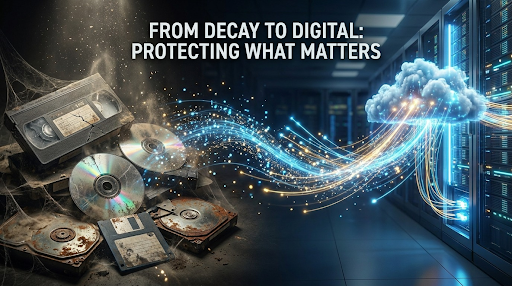
Aging media refers to storage formats that are deteriorating physically, becoming technologically obsolete, or both. This includes:
- Magnetic tapes (e.g., LTO, VHS, DAT)
- Hard disk drives nearing end-of-life
- CDs, DVDs, and Blu-ray discs
- Legacy file formats are no longer supported
- Early-generation cloud storage architectures
The issue is not simply age. It is the combination of physical degradation and declining compatibility with modern systems. Even if the data still exists, the ability to access it may not.
For example, an organization might still have perfectly intact data stored on tapes, but lack the hardware required to read them. In such cases, data loss occurs not because the data is gone, but because it is effectively unreachable.
Why Aging Media Poses a Growing Threat
1. Physical Degradation Over Time
Most storage media degrade naturally, regardless of how carefully they are handled. Magnetic tapes gradually lose signal strength due to environmental exposure and repeated use. Optical discs can suffer from “disc rot,” where the reflective layer deteriorates and makes data unreadable. Traditional hard drives are prone to mechanical failure as moving parts wear out over time. Even solid-state drives (SSDs), which have no moving parts, can lose stored data if left unpowered for long periods.
What makes this risk more serious is that degradation is often silent. There are rarely clear warning signs until someone attempts to access the data. By that point, files may already be partially corrupted or completely lost. Recovery efforts in such cases are not only expensive but also uncertain, especially when the media has significantly deteriorated.
2. Technological Obsolescence
Technology evolves faster than most organizations anticipate, and storage formats are no exception. Hardware and software required to read older media formats are quickly phased out as newer standards emerge. Devices like tape drives, floppy disk readers, or even certain generations of optical drives are becoming increasingly rare and difficult to maintain.
The challenge is not just finding the hardware, but also ensuring compatibility with modern systems. Older file formats may no longer be supported by current software, making the data effectively inaccessible even if the media itself is intact. Many organizations underestimate how quickly this gap widens. A storage solution that felt “future-proof” a decade ago can now require specialized tools or third-party recovery services, adding both cost and complexity.
3. Hidden Operational Dependencies
One of the most overlooked risks of aging media is how deeply it is embedded in day-to-day operations. Archived systems often hold data that businesses assume they will “rarely need,” but when required, that data becomes critical.
This can include:
- Financial records needed for audits or reporting
- Legal documentation required for compliance or disputes
- Customer data essential for service continuity
- Product designs, blueprints, or intellectual property tied to ongoing operations
When access to this data is delayed or lost, the impact extends beyond IT. Workflows can stall, audits can be delayed, and decision-making can suffer due to missing historical context. In regulated industries, this can also lead to compliance violations and potential penalties.
The key issue is that these dependencies are often invisible until something breaks. By the time organizations realize how critical the data is, retrieving it may already be difficult, slow, or impossible.
The Business Impact of Ignoring Aging Media
Data Loss and Recovery Costs
Recovering data from degraded or obsolete media is not only technically challenging but also financially draining. Specialized data recovery services often require advanced equipment and expertise, which can drive costs into the thousands for a single dataset. Even then, success is not guaranteed, especially if the media has suffered significant physical damage or format incompatibility.
What makes this more concerning is that recovery is typically reactive. By the time organizations realize data is at risk, they are already in a crisis scenario. In contrast, proactive measures such as regular migration and backups are far more predictable and cost-effective, helping businesses avoid sudden financial strain.
Operational Disruption
When legacy data is needed urgently and cannot be accessed, the impact is immediate. Teams may spend days or even weeks attempting to locate, restore, or convert files, pulling resources away from core responsibilities. This slows down decision-making and can delay critical projects, especially when historical data is required for analysis, compliance, or customer support.
In fast-moving environments, even short delays can create bottlenecks across departments. What seems like a technical issue quickly turns into a broader operational problem, affecting productivity and overall business performance.
Reputational Damage
For organizations built on trust—such as financial institutions, healthcare providers, or legal firms—data reliability is non-negotiable. Clients and stakeholders expect that important records will be securely stored and readily accessible, regardless of how old they are.
When data cannot be retrieved, it raises concerns about the organization’s reliability and internal controls. Even a single incident can damage credibility, strain client relationships, and lead to long-term reputational harm. In competitive industries, trust once lost is difficult to rebuild.
Loss of Competitive Advantage
Historical data is more than just a record of the past; it is a valuable source of insight. Businesses rely on it to identify trends, refine strategies, and make informed decisions. Whether it is customer behavior, product performance, or operational patterns, this data often shapes future growth.
When access to this information is lost, organizations are forced to operate with incomplete knowledge. This can lead to missed opportunities, weaker strategic planning, and slower innovation. Over time, competitors who maintain better data accessibility gain a clear advantage.
Industries Most Affected by Aging Media
Media and Entertainment
Film studios, broadcasters, and music labels rely heavily on archived content stored on tapes, reels, and other physical formats. These archives often contain original recordings, unreleased material, and historically significant productions that carry both cultural and commercial value.
The challenge is that many of these formats were never designed for long-term durability. As they degrade or become obsolete, accessing this content becomes increasingly difficult. Digitizing and preserving these assets is not just about protection—it also unlocks new revenue streams through remastering, re-releases, and streaming distribution. Without proper preservation, valuable intellectual property risks being permanently lost.
Healthcare
Healthcare organizations manage vast amounts of data that must be stored and accessed over long periods. This includes patient records, diagnostic imaging (such as MRIs and X-rays), and clinical research data. Much of this information is subject to strict regulatory requirements regarding retention and accessibility. “Delayed or missing medical data can directly impact patient outcomes, making reliable access just as critical as storage,” says Sharon Amos, Director at Air Ambulance 1. Aging media in healthcare environments can directly affect patient care. If historical records are unavailable or delayed, it can hinder diagnosis, treatment decisions, and continuity of care. Additionally, failure to retrieve required data during audits or legal reviews can lead to compliance violations, penalties, and reputational damage.
Financial Services
Banks, insurance companies, and other financial institutions are required to maintain detailed records for regulatory and auditing purposes. These records often span decades and include transaction histories, contracts, and customer information.
When this data is stored on aging systems, the risk is not just loss but inaccessibility. Even minor delays in retrieving financial records can disrupt audits, investigations, or customer requests. In highly regulated environments, this creates significant compliance risks. Modernizing storage systems ensures that data remains both secure and readily accessible when needed.
Manufacturing and Engineering
In manufacturing and engineering, historical data is critical for maintaining and improving operations. Design files, CAD drawings, technical manuals, and production records are often stored for many years, sometimes across multiple generations of technology.
Losing access to this information can have serious operational consequences. It can delay maintenance, complicate upgrades, and make it difficult to replicate or improve existing products. In some cases, companies may even need to recreate designs from scratch, leading to increased costs and inefficiencies. Preserving and migrating this data ensures continuity and supports long-term innovation.
Strategies for Protecting Aging Media
1. Conduct a Media Audit
The first step in protecting aging media is gaining clear visibility into what an organization actually has. Many businesses operate with incomplete or outdated records of their archived data, making it difficult to assess risks or take meaningful action. Conducting a comprehensive media audit helps bridge this gap by identifying the types of storage in use, their age and condition, the importance of the data they hold, and any accessibility risks tied to outdated hardware or software. Without this level of insight, organizations cannot effectively prioritize their efforts, and aging media remains a hidden liability rather than a manageable asset.
2. Prioritize High-Value Data
Once visibility is established, the next step is prioritizing high-value data. Not all stored information carries the same level of importance, and attempting to protect everything at once can be inefficient and costly. Organizations should focus first on data that directly impacts compliance, operations, and revenue generation. This includes regulatory records, intellectual property, frequently accessed archives, and data tied to ongoing business processes. “Organizations don’t fail from lack of data, but from not prioritizing what matters most,” says Logan Peranavan, CEO of TapestoDigital UK. By securing the most critical assets first, businesses can reduce immediate risk while creating a structured roadmap for addressing lower-priority data over time.
3. Migrate to Modern Storage Solutions
Migration to modern storage solutions is one of the most effective ways to reduce the risks associated with aging media. This involves transferring data from outdated formats to more reliable and accessible systems such as cloud platforms, network-attached storage, or advanced archival solutions with built-in redundancy. However, migration must be handled carefully. It requires proper planning, validation, and testing to ensure data integrity is maintained throughout the process. A poorly executed migration can lead to data corruption or loss, which defeats the purpose of modernization efforts.
4. Implement Redundancy and Backup Systems
In addition to migration, implementing strong redundancy and backup systems is essential for long-term protection. Relying on a single copy of data significantly increases vulnerability, especially when dealing with aging storage media. Modern data protection strategies emphasize maintaining multiple copies of data across different physical or geographic locations, automating backup processes, and establishing clear disaster recovery plans. This layered approach ensures that even if one system fails, data remains accessible through alternative sources, minimizing disruption and safeguarding business continuity.
5. Regularly Test Data Accessibility
Finally, organizations must regularly test data accessibility to ensure that stored information can actually be retrieved when needed. Too often, businesses assume that archived data is secure simply because it exists, only to discover problems at critical moments. Periodic testing helps identify corrupted files, compatibility issues, and delays in retrieval before they escalate into major challenges. By taking a proactive approach, organizations can ensure that their data is not only preserved but also usable, which is ultimately the true objective of any data protection strategy.
The Role of Cloud and Modern Archival Technologies
Cloud storage has become a cornerstone of modern data preservation strategies. It offers:.
- Scalability for growing data needs
- Built-in redundancy across geographic locations
- Continuous updates to maintain compatibility
Additionally, modern archival technologies use advanced indexing and metadata tagging, making it easier to locate and retrieve data quickly.
However, the cloud is not a complete solution on its own. Organizations must still manage data lifecycle, access controls, and migration processes.
Challenges in Protecting Aging Media
Cost Constraints
Migration and modernization require investment. Organizations often delay action due to budget limitations, increasing long-term risk.
Lack of Expertise
Handling legacy media requires specialized knowledge. Many organizations lack the internal expertise needed for safe migration and preservation.
Volume of Data
Large organizations may have decades of accumulated data. Sorting, prioritizing, and migrating this volume can be complex and time-consuming.
Organizational Resistance
Data modernization initiatives often face internal resistance. Teams may underestimate risks or prefer maintaining existing systems due to familiarity.
Building a Long-Term Media Preservation Strategy
A sustainable approach to protecting aging media involves more than one-time fixes. It requires a structured, ongoing strategy.
Establish Clear Policies
Define guidelines for:
- Data retention periods
- Storage formats
- Migration timelines
Policies ensure consistency across departments.
Align with Business Objectives
Data preservation should support business goals, not operate in isolation. Aligning strategies with operational needs ensures relevance and ROI.
Invest in Scalable Infrastructure
As data continues to grow, infrastructure must scale accordingly. Choosing flexible solutions prevents future bottlenecks.
Train Teams and Build Awareness
Employees should understand the importance of data preservation. Training reduces errors and encourages proactive management.
Conclusion: From Passive Storage to Active Preservation
The era of passive data storage is over. Aging media is not just an IT issue; it is a business risk with far-reaching consequences.
Organizations must shift from a reactive mindset to a proactive strategy. This means auditing existing media, prioritizing critical data, and investing in modern storage solutions.
Protecting aging media is ultimately about safeguarding knowledge, ensuring continuity, and enabling future growth. Those who recognize its importance today will be better positioned to navigate the challenges of tomorrow.
