
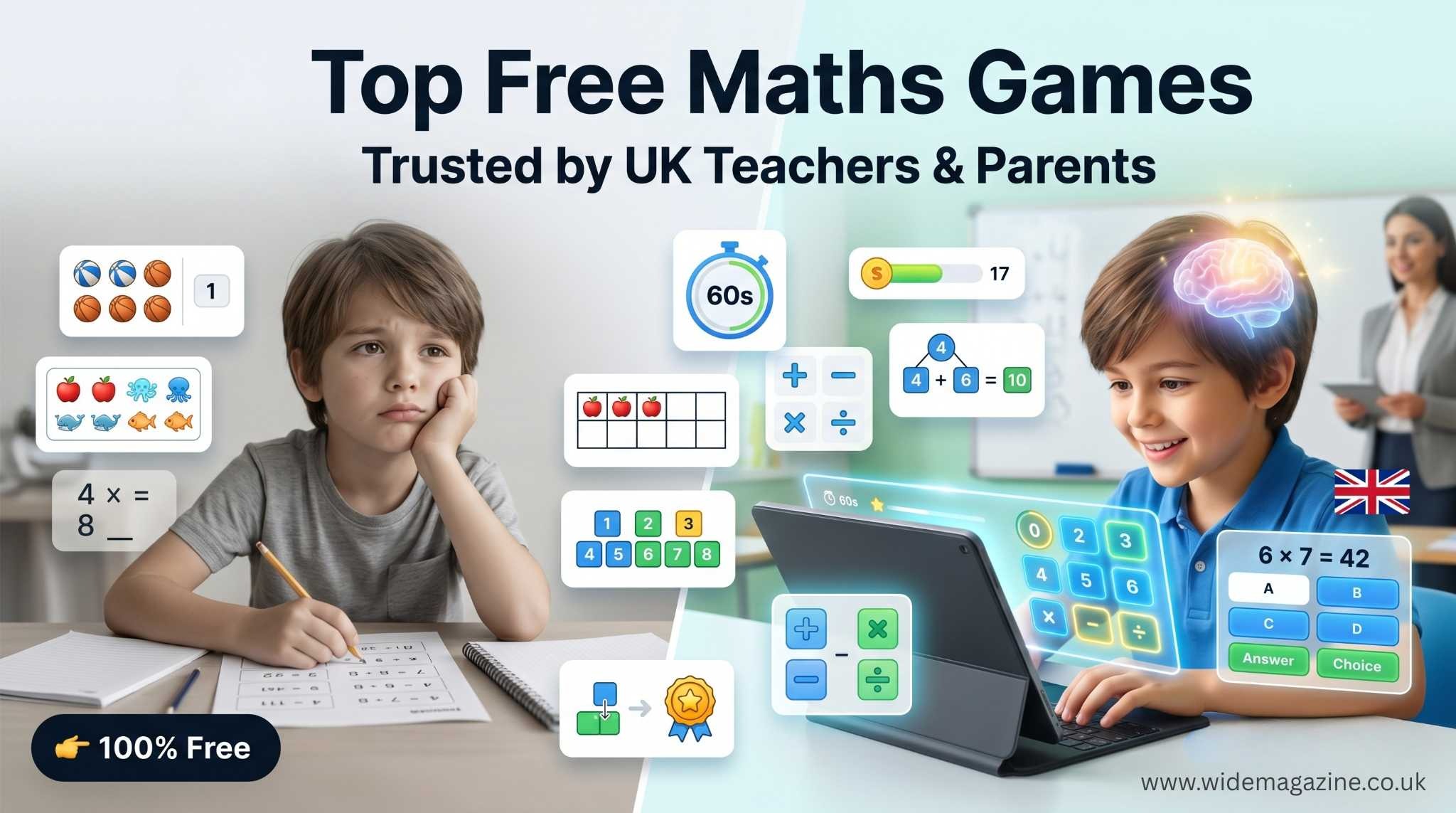
Here is something about cool math games most maths websites will not tell you. The reason your child avoids practising online games for free has nothing to do with ability. It has everything to do with how the brain responds to boredom.
When a child stares at a worksheet, their brain receives no signal that something important is happening. There is no reward, no feedback, no sense of progress. The brain simply disengages. Research from the University of Cambridge found that maths anxiety in children begins as early as age four, and poor marks or repeated frustration are the most common triggers. Once that anxiety takes hold, avoidance follows, and the gap widens fast. According to current data, 27% of UK primary children move into secondary school below their expected maths level. That is not a talent problem. That is a method problem.
The right free maths games cut through all of that. When a child is playing, their brain is actively looking for patterns, making decisions, and receiving immediate feedback on every move. Each correct answer produces a small dopamine response, which is the brain’s way of saying “remember this, it worked.” That is exactly the condition under which number facts move from short-term memory into long-term recall. You do not need expensive software, a tutor, or a subscription. You need the right game and ten minutes a day.
What is an Online Maths Game?
An online maths game is a browser-based learning activity that teaches number skills through structured play. The key word is structured. There is an important difference between a child passively watching a video about numbers and a child actively making decisions inside a game that responds to every choice they make.
The best online maths games are built around three things: immediate feedback so a child never sits stuck without knowing why, repetition with variety so the brain does not tune out, and a difficulty curve that keeps challenge at the edge of a child’s current ability. That last point matters more than most people realise. Learning researchers call it the “zone of proximal development.” When a task is too easy, a child switches off. When it is too hard, anxiety spikes. A well-designed maths game sits right in the middle and adjusts as the child improves. The most popular free maths games available in 2026 do all three of these things, cover the full UK primary curriculum from early counting to times tables and division, and work on any device without a single download.
Top 5 Online Maths Games for Kids
Here are the top 5 most popular free math games in the world;
Hit the Button
Best for: Ages 6 to 11 | Times Tables, Number Bonds, Doubles, Halves, Division Facts, Square Numbers.
Walk into almost any UK primary classroom at 9am and there is a reasonable chance you will see this game on the whiteboard. Hit the button math has become the go-to daily warm-up tool for KS1 and KS2 teachers across the country, and the reason is straightforward: it works, it is free, it is among the crazy math games and children actually look forward to it.
The format is beautifully simple. A question appears. Several answer buttons light up. The child hits the correct one as fast as possible, scoring as many right answers as they can in 60 seconds. That timed pressure is not just for fun. Speed-based recall practice forces the brain to retrieve number facts automatically rather than calculating them step by step. Over time, this builds what researchers call arithmetic fluency, the ability to produce answers without conscious effort, which frees up working memory for harder problems. Think of it like learning to drive. At first every gear change takes concentration. Eventually it becomes automatic and your focus moves to the road.
Hit the Button maths online covers six curriculum areas: times tables up to 12, number bonds to 10, 20 and 100, doubles, halves, division facts, and square numbers to 20. All of it aligns directly with the KS1 and KS2 National Curriculum. There are no adverts, no data collection, and no login required. Teachers recommend five to ten minutes of daily practice for consistent results, and parents who use it at home consistently report that it is the one piece of “homework” their child actually asks to repeat.
Today’s Number (to 20)
Best for: Ages 3 to 5 | Number Formation, Recognition, Counting, Before and After.
Most parents rush children toward addition before those children truly understand what a number means. Today’s Number, a free game from Topmarks, addresses exactly that gap. It focuses on one number at a time, working through every number from 1 to 20 across a short set of activities that build genuine number sense rather than surface-level recognition.
In a single session, a child watches an animated guide showing how to form the number correctly, counts out objects to match it, identifies which number comes before and which comes after, and practises placing it in a ten frame.
That final activity is more important than it looks. Ten frame visualisation is one of the strongest early predictors of later maths ability because it teaches children to see number relationships rather than treat each digit as an isolated symbol. You can set the game to pick a random number each day or select numbers in sequence, which is particularly useful for reception teachers working through the curriculum in order. Clean, calm, purposeful, and completely free.
Teddy Numbers
Best for: Ages 2 to 5 | Counting to 15, Digit Recognition, Number Words.
There is a specific challenge with teaching very young children online. Most interfaces are built for adults or older children and require fine motor precision that a two or three year old simply does not have yet. Teddy Numbers, an unblocked maths playground, solves this. The buttons are large, the drag-and-drop targets are generous, and the whole game is paced slowly enough for little hands and short attention spans.
The concept is simple. A number appears on screen. The child drags the correct number of objects into a teddy bear’s basket. The game covers numbers 1 to 15 and reinforces three things at once: accurate one-to-one counting, digit recognition, and the written number word. That combination matters because young children often learn to recite numbers verbally long before they connect the spoken word “seven” to the written symbol 7 or to a group of seven actual objects. Teddy Numbers builds all three connections simultaneously in a context that feels more like playing with a stuffed toy than doing schoolwork. Multiple difficulty levels mean it stays relevant from a child’s very first encounter with numbers right through to school entry.
Underwater Counting
Best for: Ages 3 to 6 | Counting to 10, Number Matching, Early Quantity Recognition.
Underwater Counting by Topmarks frames early number games practice as a treasure hunt. Children count sea creatures on screen, select the matching number, and work toward ten correct answers to find the hidden treasure. Two levels cover counting to 5 and counting to 10, making it easy to match the game to exactly where a child currently is.
What makes this one of the fun math games more valuable than it first appears is what it develops beneath the surface. Repeated practice counting small groups of objects builds subitising, the ability to recognise how many items are in a group at a glance without counting each one individually. Subitising might sound like a minor skill, but early years researchers consistently identify it as one of the strongest foundations for future number sense. Children who can subitise reliably tend to develop stronger addition instincts because they stop treating every calculation as a counting exercise and start perceiving quantity directly. A few sessions a week with this game builds that skill quietly and naturally, wrapped in a storyline appealing enough to hold a young child’s attention from start to finish.
Gingerbread Man Game
Best for: Ages 3 to 5 | Counting, Number Matching, Ordering Numbers to 10.
The Gingerbread Man Game from Topmarks earns its place on this list not because of flashy design but because it covers three distinct number skills in a single themed session. Children count the buttons on gingerbread men, match decorated gingerbread men to their correct numbers, and then order them from smallest to largest. All three tasks work with numbers 1 to 10 and offer varying difficulty levels to suit children at different stages.
The ordering activity is the standout feature. Many parents focus on helping children recognise and name numbers, which matters, but overlook the equally important concept of numerical order. Understanding that 4 sits between 3 and 5, that it is one more than 3 and one less than 5, is the conceptual groundwork for a number line, for addition, and eventually for more advanced maths. The Gingerbread Man Game introduces this through a format children connect with naturally, and the familiar story character gives even reluctant learners a reason to engage. It works well on a classroom whiteboard and equally well on a tablet at the kitchen table.
Conclusion
What these five games share is not a common theme or matching visual style. Some of these popular online games also use top AI tools to provide the customized questions to kids for better brainstorming. What they share is an understanding of how children actually build number confidence: through active decision-making, immediate feedback, and repetition that never feels like repetition because the child is too focused on winning to notice.
The most important thing any parent or teacher can take from this list is not the names of the games. It is the habit behind them. Ten consistent minutes a day outperforms a reluctant hour at the weekend every single time. Pick the game that matches your child’s level right now, build it into the daily routine, and give it three weeks. The shift in confidence that follows is the kind that actually sticks.
Visit More : widemagazine.co.uk
